Altair Hypercam 585MM review: TEC-cooled mono IMX585 camera
Where does it rank on our leaderboard
| Rank | Camera | Stars for Your Buck | Recorded UK price |
|---|---|---|---|
| 1 | SVBONY SV705C | 93 out of 100 | £229 |
| 2 | SVBONY SC571CC | 90 out of 100 | £1,029 |
| 7 | ZWO ASI2600MM Air | 84 out of 100 | £2,499 |
| 11 | Player One Saturn-C | 78 out of 100 | £514 |
| 20 | ASI 4400MC | 72 out of 100 | £3,299 |
| 22 | Altair Hypercam 585MM | 71 out of 100 | £445 |
| 24 | ZWO ASI533MM | 66 out of 100 | £999 |
| 28 | ZWO ASI183MC | 38 out of 100 | £549 |
| 29 | Nikon COOLPIX P1000 | 32 out of 100 | £787 |
Contents
- 01 Where does it rank on our leaderboard
- 02 Specifications and features
- 03 In the hand
- 04 The rig on the mount
- 05 How good is it? Here is what it captured
- 06 Raw against finished
- 07 Watch the review
- 08 Tested numbers and the download
- 09 Should you buy it?
- 10 Questions and more about this review
In 30 seconds
Stars for Your Buck 71/100
Reviewed 23 Jul 2025 Updated 24 Sep 2026
- Rank
- #22 of 29 cameras
- Verdict
- Worth a look
Written by Damon Scotting 5 min read
Buy it if
- You image nebulae through narrowband filters and want a cooled mono camera for a small refractor.
- You already own a filter wheel and 1.25 or 2 inch filters, or plan to buy them with the camera.
- You capture from a laptop with SharpCap or N.I.N.A. rather than an ASIAIR.
Skip it if
- You want colour pictures with nothing else to buy: a mono camera needs a filter wheel and filters.
- You run an ASIAIR: it connects ZWO cameras only.
- You want a wide field: the 1/1.2 inch sensor covers 2.25 x 1.26 degrees at 284 mm.
“An upgraded cooled monochrome variation of the immensely popular 585 sensor, it is still relatively affordable.”
Specifications and features
Against the cameras I have reviewed
Compare with
| Altair Hypercam 585MM reviewed #22 of 29 | ZWO ASI585MM Air #9 of 29 | Altair Hypercam 585C #6 of 29 | ZWO ASI533MM #24 of 29 | |
|---|---|---|---|---|
| Recorded UK price | £445 | £1,099 | £359 | £999 |
| Stars for Your Buck | 71/100 | 83/100 | 84/100 | 66/100 |
| Sensor | Sony IMX585 Starvis 2 BSI CMOS | Sony IMX585 mono, plus an SC2210 mono guide sensor | Sony IMX585 Starvis 2 BSI CMOS | Sony IMX533, back illuminated |
| Format | 1/1.2 inch, 11.14 x 6.26 mm, 12.85 mm diagonal | 1/1.2 inch, 11.2 x 6.3 mm, 13.2 mm diagonal | 1/1.2 inch, 11.2 x 6.26 mm, 12.85 mm diagonal | 1 inch, 11.31 x 11.31 mm, 15.97 mm diagonal |
| Colour or mono | Mono | Mono | Colour | Mono |
| Resolution | 3840 x 2160, 8.3 MP | 3840 x 2160, 8.3 MP | 3840 x 2160, 8.3 MP | 3008 x 3008, 9.05 MP |
| Pixel size | 2.9 um | 2.9 um | 2.9 um | 3.76 µm |
| Cooling | Two-stage TEC, to 35 C below ambient | Two-stage TEC, 30 to 35 C below ambient | Fan and heatsink, powered by the USB cable; no TEC | Two-stage TEC, 35 C below ambient |
| Read noise | 0.42 to 2.43 e- | 0.7 to 6.4 e- | 0.42 to 2.43 e- | 1.0 to 3.8 e- |
| Full well | 40 ke- | 38.7 ke- | 40 ke- | 50 ke- |
| ADC | 12-bit (16-bit output in HDR mode) | 12-bit | 12-bit | 14-bit |
| Weight | 500 g | 620 g | 300 g | 470 g |
| Back focus | 17.5 mm | 12.5 mm or 17.5 mm | 17.5 mm | 17.5 mm |
| Interface | USB 3.0, a two-port USB hub, 12 V DC for the cooler | Dual-band Wi-Fi (2.4 and 5 GHz), four-port USB 2.0 hub, USB-C, 256 GB eMMC | USB 3.0, ST4 guide port | USB 3.0, M42 x 0.75 thread |
| In the box | The camera, a 1.5 m USB cable, a 12 V DC power adaptor, an armoured case with foam inserts, a silicone dust cap and a software CD | Camera, camera bag, external antenna, 1 m DC cable and 1.5 m DC extension, two 0.5 m USB 2.0 cables, 21 mm T2 extender, 16.5 mm T2 to M48 extender, M42 to M48 tilter, 1 m hook-and-loop strap, 2 mm hex wrench, quick guide | The camera, a 1.5 m USB cable, a 2 inch nosepiece, a silicone dust cap and a software CD | Camera, lens cover, T2-M48 16.5 mm extender, T2 21 mm extender, M42-M48 adapter ring, T2-1.25 inch adapter, four spacer rings, 1.25 inch nosepiece, two USB 2.0 cables, USB 3.0 cable, padded bag, quick start guide |
In the hand
Hypercam 585M TEC
Hub, USB 3 and 12 V
The sensor window
On the filter wheel
With the filters
On the rig
The rig on the mount
On the TeSeek 11, then on six other mounts
How good is it? Here is what it captured
Three targets
IC 1396 Elephant's Trunk Nebula, Altair Hypercam 585M TEC, Ha, SII and OIII
- Integration
- 45 min (15 x 180 s: H 5, S 5, O 5)
- Field
- 2.25 x 1.26 degrees
- Telescope
- Altair 60EDF with the 0.8x reducer
- Camera
- Altair Hypercam 585M TEC
- Mount
- Sky-Watcher Star Adventurer GTi
- Target
- IC 1396 Elephant's Trunk Nebula
- Type
- Emission nebula
- Location
- Bortle 6.8 (in my garden)
NGC 7000 North America Nebula, Altair Hypercam 585M TEC, Ha, SII and OIII
- Integration
- 1 h 12 min (24 x 180 s: H 10, S 6, O 8)
- Field
- 2.25 x 1.26 degrees
- Telescope
- Altair 60EDF with the 0.8x reducer
- Camera
- Altair Hypercam 585M TEC
- Mount
- Sky-Watcher Star Adventurer GTi
- Target
- NGC 7000 North America Nebula
- Type
- Emission nebula
- Location
- Bortle 6.8 (in my garden)
NGC 6960 and NGC 6992 Veil Nebula, a four-panel mosaic, Altair Hypercam 585M TEC
- Integration
- Unknown
- Field
- Unknown
- Telescope
- Altair 60EDF
- Camera
- Altair Hypercam 585M TEC
- Mount
- Sky-Watcher Star Adventurer GTi
- Target
- NGC 6960 and NGC 6992 Veil Nebula, a four-panel mosaic
- Type
- Supernova remnant
- Location
- Bortle 6.8 (in my garden)
I'm going for the Veil Nebula, so I don't have to pick or choose between just imaging the western or eastern parts of the nebula.
Raw against finished
Watch the review
The 2 targets, the raw combined stack against my finished image, each with its integration, the camera and the palette:
- IC 1396 Elephant's Trunk Nebula: 45 min (15 x 180 s: H 5, S 5, O 5) of light, Altair Hypercam 585M TEC, Ha, SII and OIII, the raw combined stack with one automatic stretch
- NGC 7000 North America Nebula: 1 h 12 min (24 x 180 s: H 10, S 6, O 8) of light, Altair Hypercam 585M TEC, Ha, SII and OIII, the raw combined stack with one automatic stretch
What YOU can SEE with a £3000 Telescope setup?! · published 23 July 2025 · 6:03 · Watch on YouTube · 6,440 views, 373 likes on 2 Oct 2026
Jump to
- 0:13 A new cooled mono 585 camera
- 1:06 The camera swap: the cooled mono 585
- 1:29 The seven-slot 2 inch filter wheel
- 1:55 LRGB and narrowband filters
- 3:37 The total cost
- 4:21 The Elephant's Trunk in Ha, SII and OIII
- 4:34 The North America Nebula in Ha, SII and OIII
- 4:44 The Veil Nebula, a mosaic
- 5:14 Conclusion
Transcript of the review video 1,043 words · 11 chapters · searchable
Press a time stamp to play from there.
0:00 Intro
0:00 Last time on Astronomical, we explored what you could see with a £2,000 telescope set-up. 0:05 And as it turned out, you could see quite a lot of lovely deep sky wonders. 0:08 This time though, we are expanding our budget by £1,000 and adding some exciting improvements.
0:13 A new cooled mono 585 camera
0:14 These include an autofocuser, a new cooled monochrome 585 sensor camera, and perhaps most exciting of all, a 7-piece motorised filter wheel designed for 2-inch filters. 0:24 Look at this, a royal flush if there ever was such a thing in astrophotography. 0:29 These filters are specifically designed not only to reduce the effects of light pollution, but also dramatically increase the colours in our images. 0:35 I mean look at that for a sneak peek comparison between this setup and the last setup. 0:39 The explosive difference is like night and day. 0:42 So let's get stuck in and find out what you can see with a £3,000 telescope setup. 0:47 I'm Damon Scotting and this is Astronomical. 0:53 So piggybacking on the structure of the last episode, I want to quickly start off by talking about the entire setup itself So here's a swift breakdown of the total cost and then we will move on to looking at the images. 1:03 This is a total cost breakdown following on from the last episode.
1:06 The camera swap: the cooled mono 585
1:07 The only thing we're removing from the last setup is the camera. 1:09 Since we are replacing the camera with an upgraded cooled monochrome variation of the immensely popular 585 sensor, it is still relatively affordable at £539.
1:19 The Altair autofocuser
1:19 Next up we're introducing Altair Astro's very own automatic focuser, the AAF for just £139 which makes it just about one of the cheapest automatic focusers on the market.
1:29 The seven-slot 2 inch filter wheel
1:29 And finally we have the biggest upgrade of them all and that is the one I am most eager to try out. 1:33 The Altair electronic filter wheel with seven 2 inch filter slots. 1:39 At £299 this is again one of the cheapest of its kind on the market. 1:44 Although if we are speaking about pound for pound the best value, I think it's very obvious to note that their 5x2 inch filter wheel is a smarter alternative. 1:51 Two less slots for £100 less is a no brainer if you're trying to save money.
1:55 LRGB and narrowband filters
1:55 But with that being said I needed the 7 filter wheel specifically because I'm using a full set of 2 inch filters. 2:00 We have luminance, red, green, blue as well as premium narrowband filters in hydrogen alpha, sulphur II and oxygen III. 2:06 Now the LRGB filters are undoubtedly going to improve the quality of our images and make the colours themselves much more excellent and vibrant but it's the narrowband filters that isolate the most pristine wavelengths of light which allow you to take mind-blowingly professional images from your back garden.
2:24 Why Altair filters
2:24 Now it's true you can buy your filters from anywhere so why Altair Astro? 2:30 Well it boils down to three reasons. 2:30 Number one they design them themselves and have been widely noted as the original variation of the particular filters with competing brands attempting to replicate their filters and cut corners in the process to save money. 2:39 They are as you say the OGs. 2:44 These companies trying to replicate their new filters often leads to lower quality filters on the market and what the astrophotography community has come to refer to as the filter lottery. 2:54 Will it be good? 2:54 Will it be bad? 2:54 Is anyone's guess. 2:54 You'd expect us creators to be sent the most pristine lab tested filters in order to review, making it hard to trust even our own judgment. 3:05 Which leads me on to reason number two. 3:05 Individual test reports for each filter. 3:11 Bingo. 3:11 Finally a trustworthy filter brand. 3:11 Altair Astro are putting their money where their mouth is and providing empirical evidence for your very own reassurance. 3:16 From speaking with those in charge it's clear that they take a lot of pride in their work. 3:20 Their customer service is second to none. 3:24 Then lastly reason three, which to many will be the most important factor, and that is money. 3:29 Despite being very new to the market these premium filters are once again amongst the very cheapest. 3:33 You can even save a little bit more by getting them as a set like I've done here.
3:37 The total cost
3:37 Which brings our total spend for this set up to £3,079.50. 3:41 With this budget we have achieved the absolute complete astrophotography setup. 3:46 There are only two things that I can think of that you might want to still add to it just to make it absolutely perfect. 3:50 Number one is a dew heater which is very cheap and number two is an astro specific mini computer to handle all of the imaging and guiding for you. 4:01 You know something like the ASIAIR or the StellaVita but in accordance with our budgets we are going to do the same as we did last time with our previous setup and that is to just use our laptop or pc to capture our images and guide through free or included software like SharpCap or N.I.N.A..
4:14 The images
4:15 Alright it's picture time so say cheese!
4:44 The Veil Nebula, a mosaic
4:45 Much like in the last video I wanted to make a mosaic shot, whereas last time I chose to image the Markarian's Chain, this time I'm going for the Veil Nebula, so I don't have to pick or choose between just imaging the western or eastern parts of the nebula. 4:59 And here we go, an 8K resolution mosaic shot, roughly 33 megapixels in resolution. 5:05 I'm still using the setup as we speak, and over the summer months where the nights are frustratingly short, I'll be capturing even more shots with this setup, so be sure to subscribe or follow for more.
5:14 Conclusion
5:14 In conclusion, a £3,000 budget can get you the complete astrophotography setup thanks to the help of Altair Astro. 5:21 It's nice not to have to bounce between about 14 different retailers for each of the components that make up your rig. 5:26 If you're interested in purchasing some of the items shown in today's video or perhaps the entire setup for yourself so that you can take some stunning deep sky images like these, then I've attached a link in the description below. 5:36 Thanks for watching, I'm Damon Scotting and this was Astronomical.
Tested numbers and the download
Finished image
- Download the raw stack JPEG · 2.3 MB · 3,836 x 2,156
- Download the finished image JPEG · 1.6 MB · 3,836 x 2,156
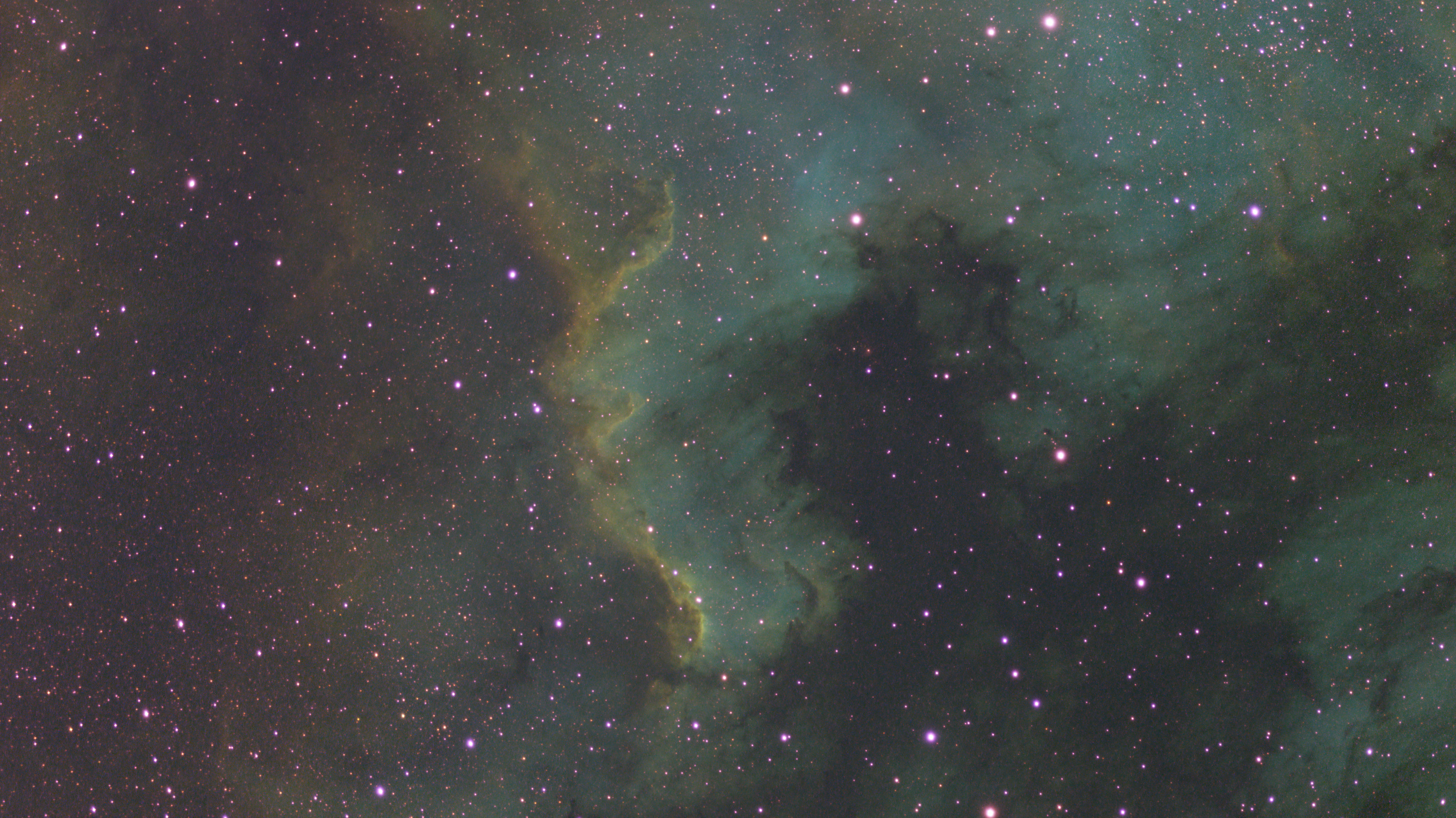
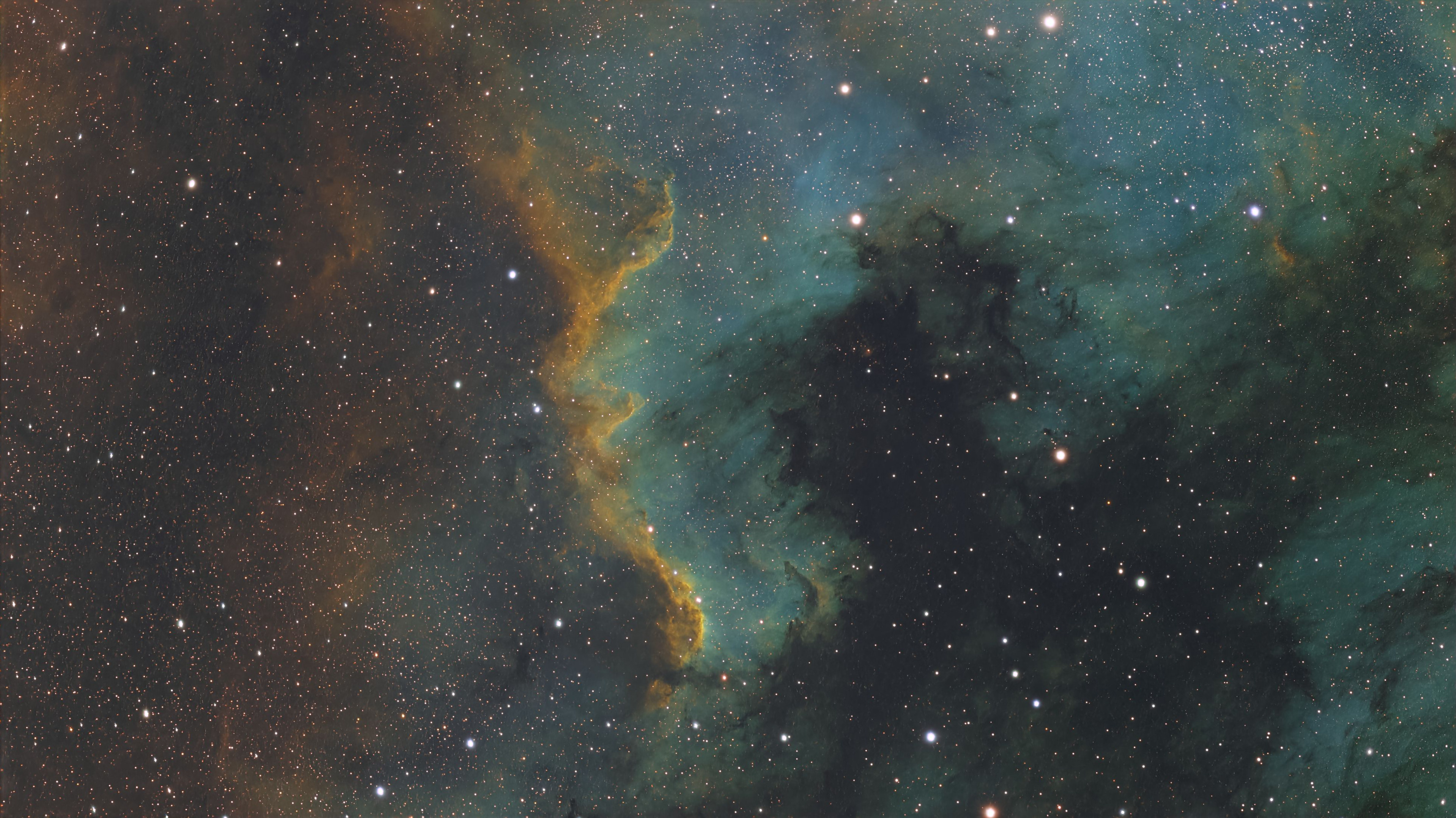
Licence: for personal use, credit Damon Scotting. Both JPEGs 3,836 x 2,156 px.
-10 C sensor set point the set point I run every cooled camera at
284 mm focal length, plate solved stated 288 mm, with the 0.8x reducer on the Altair 60EDF
2.25 x 1.26° field of view 3,840 x 2,160 px on Hypercam 585M TEC
8.3 MP Hypercam 585M TEC 3,840 x 2,160 px, 11.14 x 6.26 mm
Should you buy it?
71/100 Stars for Your Buck
Pros
- “These filters are specifically designed not only to reduce the effects of light pollution, but also dramatically increase the colours in our images.”
- Two-stage TEC cooling to 35 C below ambient: my subs held -9.9 to -10 C against a -10 C set point.
- On a 60 mm refractor it took the Elephant's Trunk in 45 minutes and the North America Nebula in 72 minutes of hydrogen alpha, sulphur II and oxygen III.
- A two-port USB hub on the back for a filter wheel or focuser, beside the USB 3 socket and the 12 V input.
- The mono IMX585 costs £445 here against £1,099 for the ZWO ASI585MM Air.
Cons
- Mono means a filter wheel and filters before the first colour picture, and three or four channels to capture and combine every time.
- The small sensor gives a small field: 2.25 x 1.26 degrees at 284 mm.
- A 12-bit ADC, with 16-bit output only in HDR mode.
- The cooler needs its own 12 V supply (one is in the box), so the camera takes two leads.
It's the narrowband filters that isolate the most pristine wavelengths of light, which allow you to take mind-blowingly professional images from your back garden.
Who the Hypercam 585MM is for
Narrowband imager under light pollution
Buy
Hydrogen alpha, sulphur II and oxygen III filters on this mono sensor gave me the Elephant's Trunk and the North America Nebula on a 60 mm refractor in 45 and 72 minutes.
Owner of a filter wheel who wants a cooled mono camera on a budget
Buy
It is TEC cooled with a USB hub on the back for the wheel, at £445.
Laptop imager
Buy
It runs from a laptop or PC with free or included software such as SharpCap or N.I.N.A., so there is no astro computer to buy.
Complete beginner
Skip
Start with the colour Altair Hypercam 585C: no filter wheel, no filters, one channel to process.
ASIAIR user
Skip
My recommendation is the ZWO ASI585MM Air: the same mono sensor with the controller and a guide sensor built in.
Wide-field imager
Skip
At 284 mm the sensor covers 2.25 x 1.26 degrees; an APS-C mono camera covers more than five times the area on the same telescope.
Three alternatives I have reviewed
- ZWO ASI585MM Air The same mono IMX585 with the controller and a guide sensor built in 83/100 £1,099 Read the review
- Altair Hypercam 585C The fan-cooled colour version: no filters to buy 84/100 £359 Read the review
- ZWO ASI533MM A TEC-cooled mono camera with a 1 inch square IMX533 sensor 66/100 £999 Read the review
Questions and more about this review
Reviewed by
Damon Scotting
The Telescope Man Verified
BSc (Hons) Physics with Astrophysics and Cosmology, Loughborough University PGCE / QTS, University of Nottingham
About Damon About Damon Damon Scotting is The Telescope Man. He holds a BSc (Hons) in Physics with Astrophysics and Cosmology from Loughborough University and a PGCE with QTS from the University of Nottingham, and taught physics in secondary schools before becoming an astronomy creator. He is a contributing writer for BBC Sky at Night Magazine and the author of 42 Wonders of Our Night Sky, and his photograph of the galaxy M100 with the dwarf planet Ceres was Highly Commended in the Astronomy Photographer of the Year 2024 competition run by Royal Observatory Greenwich. He has appeared on the BBC's Blue Peter. More than 750,000 people follow his astronomy channels on YouTube, Instagram and TikTok, and he has reviewed more than 140 telescopes, mounts, cameras, filters and accessories hands-on for this site. More about Damon · How I test · Damon's book
I review all kinds of gear: most of it I buy, some is gifted and some is loaned, and all of it is reviewed the same way. How this site is funded
Seven questions, answered
Questions about the Altair Hypercam 585MM
Reviewed 23 July 2025 ·Updated 24 September 2026
I review all kinds of gear. Most of it I buy, some is gifted and some is loaned, and all of it is reviewed the same way: no company sees or approves a review before it is published. How this site is funded
- Is the Altair Hypercam 585MM fan cooled or TEC cooled? TEC cooled. Mine is lettered HYPERCAM TEC 585M, and its back panel carries TEC and FAN lights beside the 12 V input for the two-stage cooler. Altair sells the mono IMX585 as the Hypercam 585M MONO TEC; there is no fan-cooled mono version on its site. The specifications and the comparison table ↓
- Do I need filters with the 585MM? Yes, for colour: a mono camera records one channel at a time, so it needs a filter wheel and at least three filters. Mine ran luminance, red, green and blue plus hydrogen alpha, sulphur II and oxygen III in a seven-slot 2 inch wheel. What I captured ↓
- What field of view does it give on a small refractor? 2.25 x 1.26 degrees at 284 mm: that is my plate solve of the Elephant's Trunk stack on the Altair 60EDF with its 0.8x reducer. Tested numbers and the download ↓
- How long were the exposures in my images? Three-minute subs: 5 each of hydrogen alpha, sulphur II and oxygen III on the Elephant's Trunk, and 10, 6 and 8 on the North America Nebula. What I captured ↓
- Should I buy the Altair 585MM or the ZWO ASI585MM Air? The Altair if you capture from a laptop and want the cooled mono sensor for £445; the ZWO if you want the controller and a guide sensor in the camera, at £1,099. The specifications and the comparison table ↓
- What software runs it? Altair's own AltairCapture comes on the CD, with ASCOM drivers to download; Altair lists PHD2, SharpCap Pro, APT and N.I.N.A. The specifications and the comparison table ↓
- What have I not tested on the Hypercam 585MM? I have not imaged the planets or the Moon with the 585MM, and I have not measured its read noise or dark current.