ZWO ASI585MM Air review: the cooled mono all-in-one camera
Where does it rank on our leaderboard
| Rank | Camera | Stars for Your Buck | Recorded UK price |
|---|---|---|---|
| 1 | SVBONY SV705C | 93 out of 100 | £229 |
| 2 | SVBONY SC571CC | 90 out of 100 | £1,029 |
| 6 | Altair Hypercam 585C | 84 out of 100 | £359 |
| 9 | ZWO ASI585MM Air | 83 out of 100 | £1,099 |
| 12 | ZWO ASI533MC | 77 out of 100 | £859 |
| 17 | ZWO ASI120MM | 75 out of 100 | £199 |
| 27 | ZWO ASI6200MC | 59 out of 100 | £3,999 |
| 28 | ZWO ASI183MC | 38 out of 100 | £549 |
| 29 | Nikon COOLPIX P1000 | 32 out of 100 | £787 |
Contents
- 01 Where does it rank on our leaderboard
- 02 Specifications and features
- 03 In the hand
- 04 The rig on the mount
- 05 How good is it? Here is what it captured
- 06 Raw against finished
- 07 What is it for
- 08 Watch the review
- 09 Tested numbers and the download
- 10 Should you buy it?
- 11 Questions and more about this review
In 30 seconds
Stars for Your Buck 83/100
Reviewed 28 Jan 2026 Updated 26 Sep 2026
- Rank
- #9 of 29 cameras
- Verdict
- Damon recommends
Written by Damon Scotting 6 min read
Buy it if
- You image nebulae from light-polluted skies and are ready to add narrowband filters.
- You want one small cooled camera that also guides, runs the rig and stores the data, with no guide scope.
- You already own a filter wheel and filters that cover a 1/1.2 inch sensor.
Skip it if
- You want colour images with nothing else to buy.
- You want wide fields of nebulae and galaxies in one frame.
- You want one channel to capture and process, not three or four.
“The trade-off here for higher quality images is that you do need to introduce the use of filters and add a few more extra steps when it comes to processing your images.”
Specifications and features
Against the cameras I have reviewed
Compare with
| ZWO ASI585MM Air reviewed #9 of 29 | ZWO ASI585MC Air #3 of 29 | Altair Hypercam 585MM #22 of 29 | ZWO ASI533MM #24 of 29 | |
|---|---|---|---|---|
| Recorded UK price | £1,099 | £799 | £445 | £999 |
| Stars for Your Buck | 83/100 | 89/100 | 71/100 | 66/100 |
| Sensor | Sony IMX585 mono, plus an SC2210 mono guide sensor | Sony IMX585 colour, plus an SC2210 mono guide sensor | Sony IMX585 mono | Sony IMX533 mono |
| Format | 1/1.2 inch, 11.2 x 6.3 mm, 13.2 mm diagonal | 1/1.2 inch, 11.2 x 6.3 mm | 1/1.2 inch, 12.85 mm diagonal | 1 inch, 11.31 x 11.31 mm |
| Colour or mono | Mono | Colour | Mono | Mono |
| Resolution | 3840 x 2160, 8.3 MP (guide sensor 1920 x 1080) | 3840 x 2160, 8.3 MP | 3840 x 2160, 8.3 MP | 3008 x 3008, 9 MP |
| Pixel size | 2.9 um (guide sensor 4 um) | 2.9 um | 2.9 um | 3.76 um |
| Cooling | Two-stage TEC, 30 to 35 C below ambient | Two-stage TEC, 30 to 35 C below ambient | Two-stage TEC, about 35 C below ambient | TEC, 35 C below ambient |
| Read noise | 0.7 to 6.4 e- | 0.7 to 6.67 e- | 0.42 to 2.43 e- | 1.0 e- |
| Full well | 38.7 ke- | 40 ke- | 40 ke- | 50 ke- |
| ADC | 12-bit | 12-bit | 12-bit | 14-bit |
| Weight | 620 g | 620 g | 500 g | 470 g |
| Back focus | 12.5 mm or 17.5 mm | 12.5 mm or 17.5 mm | 17.5 mm | 17.5 mm |
| Interface | Dual-band Wi-Fi (2.4 and 5 GHz), four-port USB 2.0 hub, USB-C, 256 GB eMMC | Dual-band Wi-Fi (2.4 and 5 GHz), four-port USB 2.0 hub, USB-C, 256 GB eMMC | USB 3.0, ST4 guide port | USB 3.0 |
| In the box | Camera, camera bag, external antenna, 1 m DC cable and 1.5 m DC extension, two 0.5 m USB 2.0 cables, 21 mm T2 extender, 16.5 mm T2 to M48 extender, M42 to M48 tilter, 1 m hook-and-loop strap, 2 mm hex wrench, quick guide | The camera, a camera bag, the external antenna, a 1 m DC cable, a 1.5 m DC extension, two 0.5 m USB 2.0 cables, a 21 mm T2 extender, a 16.5 mm T2 to M48 extender, an M42 to M48 tilter, a 1 m hook-and-loop strap, a 2 mm hex wrench and a quick guide | Camera, 1.5 m USB cable, 12 V adaptor, case, dust cap, software CD | Camera, lens cover, T2-M48 16.5 mm extender, T2 21 mm extender, M42-M48 adapter ring, T2-1.25 inch adapter, four spacer rings, 1.25 inch nosepiece, two USB 2.0 cables, USB 3.0 cable, padded bag, quick start guide |
In the hand
Imaging and guide sensors
Fitting the antenna
On the rig
Under the filter wheel
On the ZWO AM3N
With the Hope D60
The rig on the mount
On the JUWEI-17, then on six other mounts
How good is it? Here is what it captured
Five targets
Horsehead and Flame, ZWO ASI585MM Air, Ha SII OIII
- Integration
- 45 min (5 x 3 min each of Ha, SII and OIII)
- Field
- 2.29 x 1.29 degrees
- Telescope
- ToupTek Hope D60
- Camera
- ZWO ASI585MM Air
- Mount
- ZWO AM3N
- Target
- IC 434 Horsehead and NGC 2024 Flame nebulae
- Type
- Dark and emission nebulae
- Location
- Bortle 6.8 (in my garden)
Rosette Nebula, ZWO ASI585MM Air, Ha SII OIII
- Integration
- 45 min (5 x 3 min each of Ha, SII and OIII)
- Field
- 2.29 x 1.29 degrees
- Telescope
- ToupTek Hope D60
- Camera
- ZWO ASI585MM Air
- Mount
- ZWO AM3N
- Target
- NGC 2237 Rosette Nebula
- Type
- Emission nebula
- Location
- Bortle 6.8 (in my garden)
Thor's Helmet, ZWO ASI585MM Air, Ha SII OIII
- Integration
- 1 h 30 min (10 x 3 min each of Ha, SII and OIII)
- Field
- 1.27 x 0.71 degrees
- Telescope
- Askar SQA106
- Camera
- ZWO ASI585MM Air
- Mount
- Unknown
- Target
- NGC 2359 Thor's Helmet
- Type
- Emission nebula
Crab Nebula, ZWO ASI585MM Air, Ha SII OIII
- Integration
- 30 min (5 x 3 min Ha, 4 x 3 min SII, 1 x 3 min OIII)
- Field
- 2.29 x 1.29 degrees
- Telescope
- ToupTek Hope D60
- Camera
- ZWO ASI585MM Air
- Mount
- ZWO AM3N
- Target
- M 1 Crab Nebula
- Type
- Supernova remnant
- Location
- Bortle 6.8 (in my garden)
Elephant's Trunk, ZWO ASI585MM Air, Ha SII OIII
- Integration
- 45 min (5 x 3 min each of Ha, SII and OIII)
- Field
- 2.29 x 1.29 degrees
- Telescope
- ToupTek Hope D60
- Camera
- ZWO ASI585MM Air
- Mount
- ZWO AM3N
- Target
- IC 1396 Elephant's Trunk Nebula
- Type
- Emission nebula and dark globule
- Location
- Bortle 6.8 (in my garden)
Raw against finished
What is it for
The 4 targets, the raw combined stack against my finished image, each with its integration, the camera and the palette:
- IC 434 Horsehead and NGC 2024 Flame nebulae: 45 min (5 x 3 min each of Ha, SII and OIII) (15 x 180 s) of light, ASI585MM Air, Ha, SII and OIII, the raw combined stack with one automatic stretch
- NGC 2237 Rosette Nebula: 45 min (5 x 3 min each of Ha, SII and OIII) (15 x 180 s) of light, ASI585MM Air, Ha, SII and OIII, the raw combined stack with one automatic stretch
- NGC 2359 Thor's Helmet: 1 h 30 min (10 x 3 min each of Ha, SII and OIII) (30 x 180 s) of light, ASI585MM Air, Ha, SII and OIII, the raw combined stack with one automatic stretch
- M 1 Crab Nebula: 30 min (5 x 3 min Ha, 4 x 3 min SII, 1 x 3 min OIII) (10 x 180 s) of light, ASI585MM Air, Ha, SII and OIII, the raw combined stack with one automatic stretch
Three things it is for
Guiding through narrowband filters
The guiding sensor that it uses really is terrific. I did have a major concern going into this that when using narrowband filters the camera was going to struggle picking up guide stars, but it has worked an absolute treat.
Narrowband from a light-polluted sky
Narrowband isolates your imaging channels to hydrogen alpha, sulphur II and oxygen III, which combine to give you some truly breathtaking images, and it dramatically limits the effects of light pollution.
The camera runs the rig
It shoots in 4K. It guides your telescope mount. It even live stacks your images and allows you to control your entire setup, with the filter wheel and the camera angle adjuster plugged into its own USB hub.
Watch the review
ZWO ASI585MM Air Review: Is This the BEST Beginner MONO Astro Camera?! · published 28 January 2026 · 5:29 · Watch on YouTube · 6,388 views, 252 likes on 2 Oct 2026
Jump to
- 0:40 Specs
- 1:02 All-in-one?
- 1:16 Broadband or narrowband filters
- 1:47 Narrowband against light pollution
- 2:24 The Horsehead Nebula
- 2:38 The Rosette Nebula
- 3:08 The Elephant's Trunk
- 3:38 Thor's Helmet
- 4:08 The Crab Nebula
- 4:49 The built-in guide sensor
Transcript of the review video 726 words · 9 chapters · searchable
Press a time stamp to play from there.
0:00 Intro
0:02 In tonight's video, I'm going to be reviewing one of the best astronomy cameras released within the last year. 0:05 It's the $999 ASI585MM Air. 0:05 It shoots in 4K. 0:09 It guides your telescope mount. 0:12 It even live stacks your images and allows you to control your entire setup. 0:15 You might say it's the complete package. 0:17 Well, almost. 0:17 Monochrome cameras are better than colour cameras in terms of efficiency, but they require the additional purchase of a filter holder and a set of filters. 0:24 So, in today's video, I'm going to be comparing the images I captured with the ASI 585 monochrome versus those captured with the ASI 585 colour camera in order to determine which offers the most value for money. 0:35 I'm Damon Scotting and this is Astronomical. 0:40 So, the specifications of the ASI585MM Air are almost identical to the ASI 585 Colour Air.
0:40 Specs
0:44 When I reviewed the ASI 585MC Air last month, it was on promotion for just $719, making it a considerably cheaper option than the monochrome variation. 0:53 This price difference becomes doubly as important when we start shopping for our filters. 0:59 So, the question is, what do we need to add to this all-in-one camera to start taking exceptional images of our night sky?
1:02 All-in-one?
1:04 Because in the colour camera's case, that was it. 1:06 That was all we needed. 1:08 It really was the complete package. 1:09 Well, if you go by ZWO's website, the company that makes this camera, they offer seven different filters to be used with this camera.
1:16 Broadband or narrowband filters
1:16 They are split into two distinct categories: broadband and narrowband. 1:20 Broadband utilizes your colour filters, red, green, and blue, as well as a fine detail addition of a luminance filter. 1:26 These combine to give you the same looking images to the colour camera, except by isolating the imaging channels and using a monochrome camera, you are picking up more detail and therefore producing more vibrant images. 1:34 So, it definitely feels like a slightly longer and more arduous process having to image in luminance red, green, and blue as opposed to just colour. 1:42 But the results speak for themselves. 1:44 LRGB filters won't particularly help you battle against light pollution, but narrowband is the perfect tool.
1:47 Narrowband against light pollution
1:50 It isolates your imaging channels to hydrogen alpha, sulphur II, and oxygen III, which combined to give you some truly breathtaking images that in most cases very different colour palettes to your traditional colour shots. 2:01 By imaging in these narrow wavelengths, you are isolating the amount of light hitting the camera sensor and dramatically limiting the effects of light pollution. 2:08 So, this is a huge part of our motivation for monochrome imaging, and it's why tonight I'm going to be fixated on capturing some narrowband images from my garden.
2:17 My images: the rig on the Hope D60
2:17 I've decided to partner the ASI585MM Air with the ToupTek Hope D60. 2:21 I'm going to show you the raw stacked HSO shots, followed by the BlurXTerminator and NoiseXTerminator images, and finally, my finished image overall after playing with the colours and curves in Photoshop.
2:24 The Horsehead Nebula
2:32 I'll also be doing a side-by-side comparison with a 585 colour camera whenever possible.
4:23 Conclusion
4:24 So, what do you think of the ASI585MM Air? 4:24 When using the colour variation of this camera, I really did feel like it truly was an all-in-one smart camera. 4:30 But the trade-off here for higher quality images is that you do need to introduce the use of filters and add a few more extra steps when it comes to processing your images. 4:37 I think there's a very clear distinction here between upgrading your astronomy gear. 4:42 Specification wise, you aren't really changing much, but you are quite literally viewing the universe in a different light and enabling yourself to take some really serious astrophotography images.
4:49 The built-in guide sensor
4:50 The convenience factor for having your guiding sensor and imaging sensor side by side cannot be understated. 4:56 It really does make everything a lot easier, especially since you don't have to introduce a guide scope on top of your telescope. 5:03 And the guiding sensor that it uses really is terrific. 5:05 I did have a major concern going into this that when using narrowband filters that the camera was going to struggle picking up guide stars, but it has worked an absolute treat. 5:13 You can find a direct link to the ASI585MC Air and ASI585MM Air cameras in the description down below. 5:18 Thanks for watching. 5:20 I'm Damon Scotting and this was Astronomical.
Tested numbers and the download
Finished image
- Download the raw stack JPEG · 1.9 MB · 3,255 x 1,666
- Download the finished image JPEG · 0.5 MB · 3,255 x 1,666
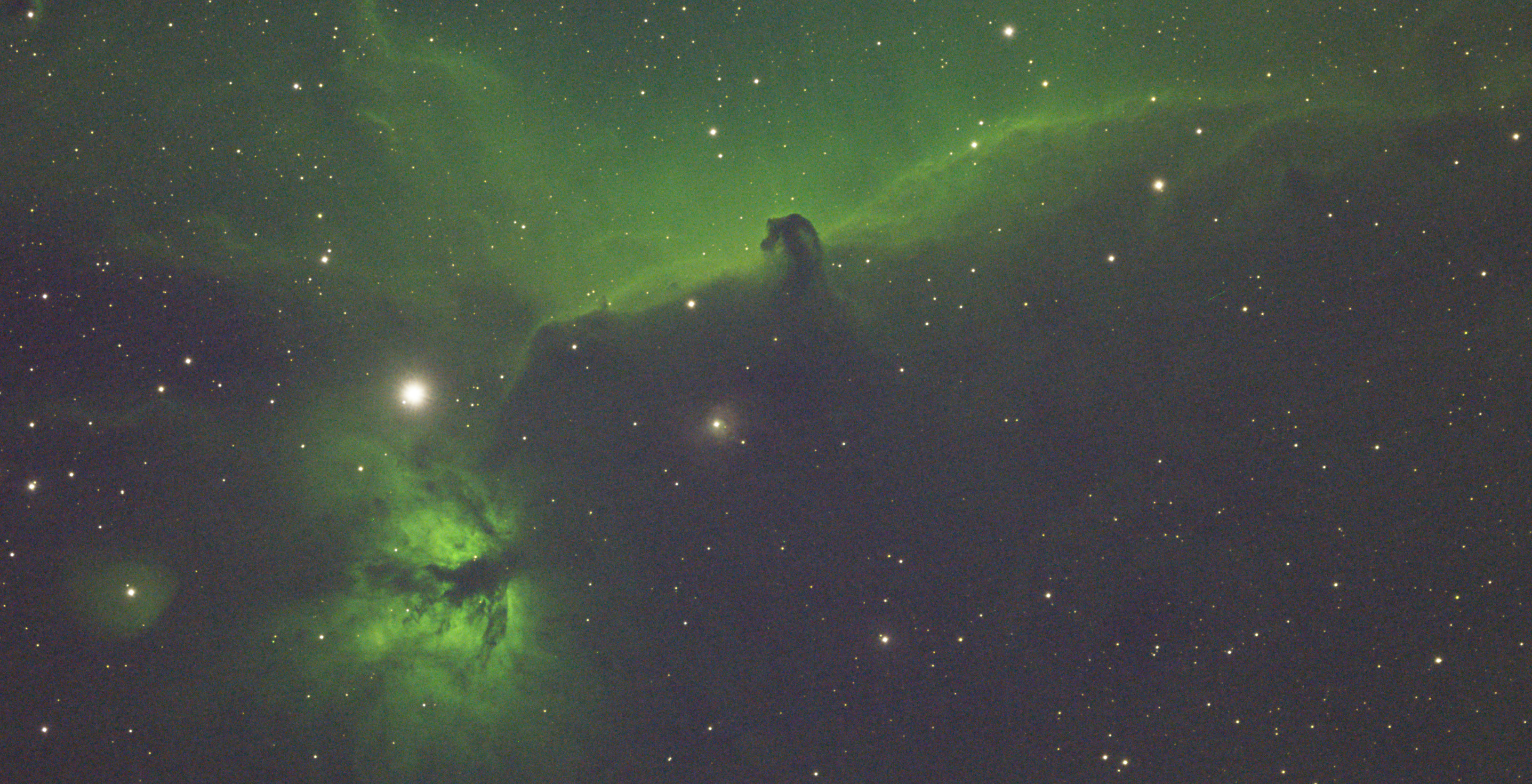
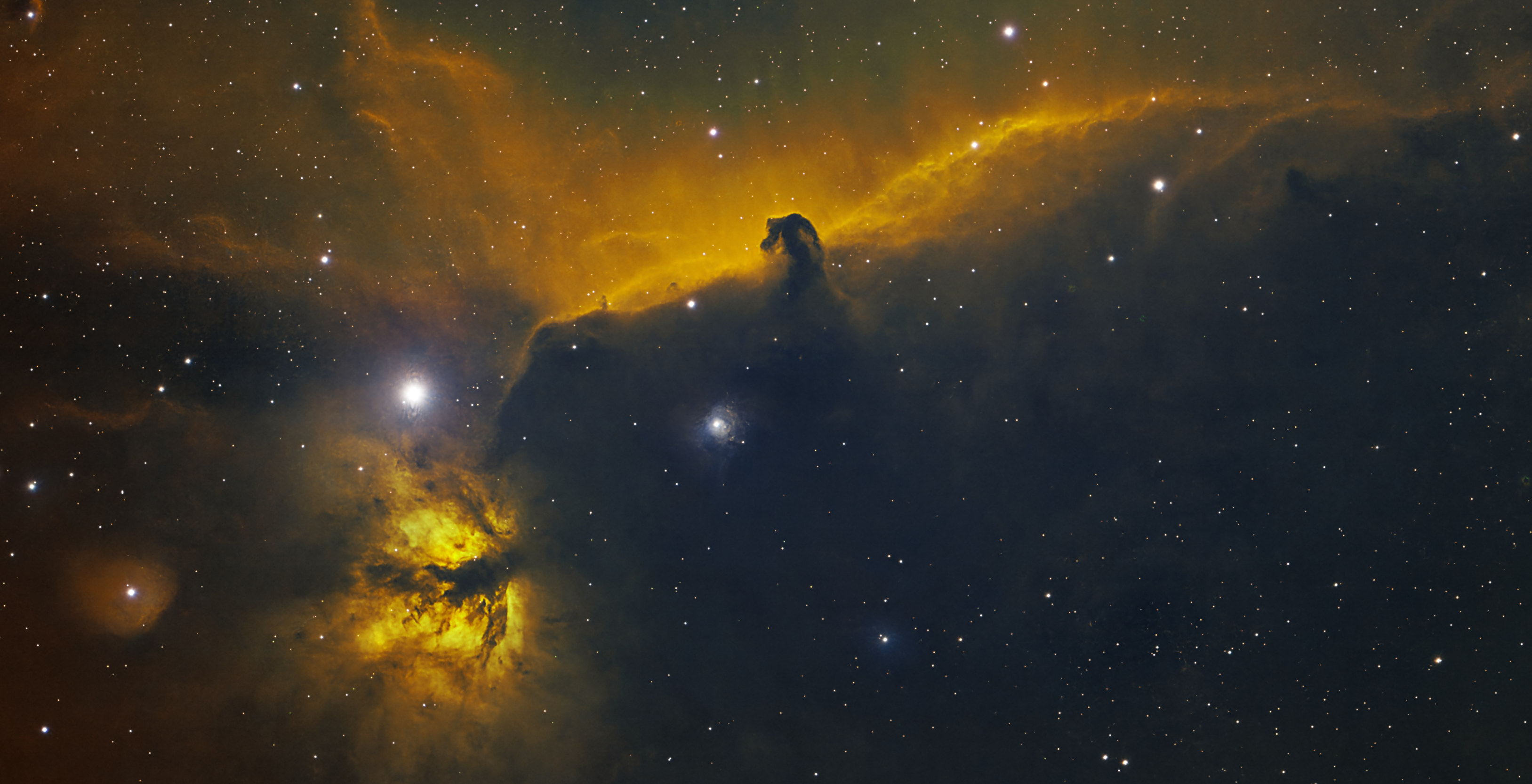
Licence: for personal use, credit Damon Scotting. Both JPEGs 3,255 x 1,666 px.
-10 C sensor set point the set point I run every cooled camera at
278 mm focal length, plate solved stated 280 mm, on the ToupTek Hope D60
2.29 x 1.29° field of view 3,840 x 2,160 px on ASI585MM Air
8.3 MP ASI585MM Air 3,840 x 2,160 px, 11.2 x 6.3 mm
Should you buy it?
83/100 Stars for Your Buck
Pros
- “It really does make everything a lot easier, especially since you don't have to introduce a guide scope on top of your telescope.”
- “By isolating the imaging channels and using a monochrome camera, you are picking up more detail and therefore producing more vibrant images.”
- “You are quite literally viewing the universe in a different light and enabling yourself to take some really serious astrophotography images.”
- One 620 g body is the imaging camera, the guide camera and the controller, with 256 GB of storage for the night.
Cons
- “Monochrome cameras are better than colour cameras in terms of efficiency, but they require the additional purchase of a filter holder and a set of filters.”
- “It definitely feels like a slightly longer and more arduous process having to image in luminance, red, green and blue as opposed to just colour.”
- It costs $200 more than the colour ASI585MC Air before a single filter: $999 against $799 at ZWO.
- The 1/1.2 inch sensor gives a small field: 2.29 x 1.29 degrees at 278 mm.
The convenience factor for having your guiding sensor and imaging sensor side by side cannot be understated.
Who the ASI585MM Air is for
Complete beginner
Skip
Start with the colour ASI585MC Air: the same camera with no filter wheel, no filters and one channel to process.
Nebula imager under light pollution
Buy
Ha, SII and OIII filters on a mono sensor cut through light pollution, and 45 minutes a target already gives a finished image.
Owner of a small refractor and harmonic mount
Buy
The camera is also the controller and the guide camera, so a small refractor, a filter wheel and the Air make a complete rig with no guide scope.
Wide-field imager
Skip
The ZWO ASI2600MM Air's APS-C sensor covers far more sky on the same telescope.
Already own a ZWO ASI585MC Air
Skip
The specifications are almost identical; the reason to add the mono version is narrowband, and that needs a filter wheel and filters on top.
Mono imager with a filter wheel and a laptop
Buy
Your filters carry straight over, and the Air replaces the camera, the guide camera and the laptop in one body.
Three alternatives I have reviewed
- ZWO ASI585MC Air The colour twin: the same cooled all-in-one IMX585 with no filters to buy 89/100 £799 Read the review
- ZWO ASI2600MM Air ZWO's APS-C mono all-in-one: a far bigger field on the same telescope 84/100 £2,499 Read the review
- Altair Hypercam 585MM The same mono IMX585 with TEC cooling, run from a computer, for less 71/100 £445 Read the review
Questions and more about this review
Reviewed by
Damon Scotting
The Telescope Man Verified
BSc (Hons) Physics with Astrophysics and Cosmology, Loughborough University PGCE / QTS, University of Nottingham
About Damon About Damon Damon Scotting is The Telescope Man. He holds a BSc (Hons) in Physics with Astrophysics and Cosmology from Loughborough University and a PGCE with QTS from the University of Nottingham, and taught physics in secondary schools before becoming an astronomy creator. He is a contributing writer for BBC Sky at Night Magazine and the author of 42 Wonders of Our Night Sky, and his photograph of the galaxy M100 with the dwarf planet Ceres was Highly Commended in the Astronomy Photographer of the Year 2024 competition run by Royal Observatory Greenwich. He has appeared on the BBC's Blue Peter. More than 750,000 people follow his astronomy channels on YouTube, Instagram and TikTok, and he has reviewed more than 140 telescopes, mounts, cameras, filters and accessories hands-on for this site. More about Damon · How I test · Damon's book
I review all kinds of gear: most of it I buy, some is gifted and some is loaned, and all of it is reviewed the same way. How this site is funded
Eight questions, answered
Questions about the ZWO ASI585MM Air
Reviewed 28 January 2026 ·Updated 26 September 2026
I review all kinds of gear. Most of it I buy, some is gifted and some is loaned, and all of it is reviewed the same way: no company sees or approves a review before it is published. Shop links marked Ad are affiliate links: I earn a commission when you buy through them, at no extra cost to you. How this site is funded
- Do I need filters with the ZWO ASI585MM Air? Yes. A mono camera needs a filter holder and filters: LRGB for natural colour, or Ha, SII and OIII narrowband, which is what every image on this page used. What I captured ↓
- Can the built-in guide sensor guide through narrowband filters? Yes. With the filter wheel in front of both sensors it guided at 0.57 to 0.75 arcsec total RMS on the Elephant's Trunk, read off the ASIAIR screen. What is it for ↓
- How cold does the ASI585MM Air run? It held its -10 C set point with the cooler at 25 to 26%. ZWO rates the cooling at 30 to 35 C below ambient. Tested numbers and the download ↓
- What field of view does it give on a small refractor? My plate solves give 2.29 x 1.29 degrees at 278 mm on the ToupTek Hope D60 and 1.27 x 0.71 degrees at 504 mm on the Askar SQA106. Tested numbers and the download ↓
- Should I buy the ASI585MM Air or the ASI585MC Air? The colour ASI585MC Air if you want one box and one channel. The mono ASI585MM Air if you want narrowband, and budget a filter wheel and filters on top. The verdict, the readers and the sellers ↓
- How much integration went into these images? Short sessions: 30 to 45 minutes of 3 minute subs split across Ha, SII and OIII on the Hope D60, and 1 hour 30 minutes for Thor's Helmet on the SQA106. The raw stacks against the finished images ↓
- Does the ASI585MM Air need a computer? No. It runs from the ASIAIR app on a phone or tablet over its own Wi-Fi, and controls the mount, filter wheel and focuser through its USB hub. The specifications and the comparison table ↓
- What have I not tested on the ASI585MM Air? I did not test the ASI585MM Air with LRGB filters or on the planets, and I did not measure its read noise or dark current myself.