Player One Uranus-C review: an uncooled IMX585 all-rounder
Where does it rank on our leaderboard
| Rank | Camera | Stars for Your Buck | Recorded UK price |
|---|---|---|---|
| 1 | SVBONY SV705C | 93 out of 100 | £229 |
| 2 | SVBONY SC571CC | 90 out of 100 | £1,029 |
| 3 | ZWO ASI585MC Air | 89 out of 100 | £799 |
| 9 | ZWO ASI585MM Air | 83 out of 100 | £1,099 |
| 15 | Player One Uranus-C | 76 out of 100 | £395 |
| 16 | ToupTek ATR533C | 76 out of 100 | £799 |
| 23 | ZWO ASI220MM | 67 out of 100 | £299 |
| 28 | ZWO ASI183MC | 38 out of 100 | £549 |
| 29 | Nikon COOLPIX P1000 | 32 out of 100 | £787 |
Contents
- 01 Where does it rank on our leaderboard
- 02 Specifications and features
- 03 In the hand
- 04 From the review video
- 05 The rig on the mount
- 06 How good is it? Here is what it captured
- 07 Raw against finished
- 08 What is it for
- 09 Watch the review
- 10 Tested numbers and the download
- 11 Should you buy it?
- 12 Questions and more about this review
In 30 seconds
Stars for Your Buck 76/100
Reviewed 29 May 2024 Updated 26 Sep 2026
- Rank
- #15 of 29 cameras
- Verdict
- Damon recommends
Written by Damon Scotting 6 min read
Buy it if
- you want one uncooled camera for planets, the Moon and live views of bright deep-sky targets
- you image with a fast telescope such as a RASA, where short exposures and a light camera matter
- you want the IMX585 sensor for much less than a cooled camera
Skip it if
- you plan long, calibrated deep-sky integrations: a cooled camera holds a set temperature
- you already own an IMX585 camera: the sensor is the same
- you want wide fields from a longer refractor: the 1/1.2 inch sensor is small
“The Uranus camera is fantastic. I've been very impressed by what it's able to achieve.”
Specifications and features
Against the cameras I have reviewed
Compare with
| Player One Uranus-C reviewed #15 of 29 | SVBONY SV705C #1 of 29 | ZWO ASI585MC Air #3 of 29 | Player One Saturn-C #11 of 29 | Altair Hypercam 585C #6 of 29 | QHY 585C #26 of 29 | |
|---|---|---|---|---|---|---|
| Recorded UK price | £395 | £229 | £799 | £514 | £359 | £359 |
| Stars for Your Buck | 76/100 | 93/100 | 89/100 | 78/100 | 84/100 | 59/100 |
| Sensor | Sony IMX585, colour CMOS | Sony IMX585, colour CMOS | Sony IMX585 colour, plus an SC2210 mono guide sensor | Sony IMX533, colour CMOS | Sony IMX585 Starvis 2, colour CMOS | Sony IMX585, back-illuminated STARVIS 2 |
| Format | 1/1.2 inch, 11.2 x 6.3 mm, 12.85 mm diagonal | 1/1.2 inch, 11.2 x 6.3 mm, 12.85 mm diagonal | 1/1.2 inch, 11.2 x 6.3 mm, 13.2 mm diagonal | 1 inch square, 16 mm diagonal | 11.2 x 6.26 mm, 12.85 mm diagonal | 1/1.2 inch, 11.2 x 6.3 mm |
| Colour or mono | Colour | Colour | Colour | Colour | Colour | Colour |
| Resolution | 3856 x 2180, 8.3 MP | 3856 x 2180, 8.3 MP | 3840 x 2160, 8.3 MP | 3008 x 3008, 9 MP | 3840 x 2160, 8.3 MP | 3856 x 2180, 8.4 MP |
| Pixel size | 2.9 um | 2.9 um | 2.9 um | 3.76 um | 2.9 um | 2.9 um |
| Cooling | Uncooled, passive cooling body; active cooling accessory sold separately | Uncooled | Two-stage TEC, 30 to 35 C below ambient | Uncooled, passive cooling body; active cooling accessory sold separately | USB-powered fan with heatsink, switchable | Uncooled |
| Read noise | 0.7 to 7.2 e- | 0.7 to 6.5 e- | 0.7 to 6.67 e- | 1 to 4.46 e- | 0.42 to 2.43 e- | 0.77 to 8 e- |
| Full well | 47 ke- | 38 ke- | 40 ke- | 73 ke- | 40 ke- | 52 ke- |
| ADC | 12-bit | 12-bit | 12-bit | 14-bit | 12-bit | 12-bit |
| Weight | 160 g | 160 g | 620 g | 160 g | 300 g | 90 g |
| Back focus | 12.5 mm | 6.5 mm or 12.5 mm | 12.5 mm or 17.5 mm | 12.5 mm | 17.5 mm with the C adapter, 12.5 mm with the CS adapter | 8 mm, 17 mm with the adapter |
| Interface | USB 3.0 (USB 2.0 compatible), 256 MB DDR3 buffer | USB 3.0, ST-4 guide port | Wi-Fi 5, four-port USB 2.0 hub, 256 GB eMMC | USB 3.0 | USB 3.0, ST-4 guide port | USB 3.0 Type-C, ST-4 guide port, 512 MB DDR3 |
| In the box | Camera; T-mount; USB 3.0 cable; ST4 cable; M2 hex key; 1.25 inch cap; air blower | Camera, USB 3.0 cable, ST-4 cable, M42 to CS adapter, T2 adapter, 1.25 inch T adapter, 2 inch dust cover, manual, cleaning cloth | The camera, a camera bag, the external antenna, a 1 m DC cable, a 1.5 m DC extension, two 0.5 m USB 2.0 cables, a 21 mm T2 extender, a 16.5 mm T2 to M48 extender, an M42 to M48 tilter, a 1 m hook-and-loop strap, a 2 mm hex wrench and a quick guide | Camera; T-mount; USB 3.0 cable; ST4 cable; M2 hex key; 1.25 inch cap; air blower | Camera, 1.5 m USB cable, 2 inch nosepiece, silicone dust cap, software CD | IR-cut and IR850 filters; a 1.25 inch nosepiece with CS and C-mount adapters |
In the hand
At the front of the 8 inch RASA
On the RASA, ready for the night
Mine, on camera
From the review video
Three frames from my videos
Jupiter in the live view
Saturn in the live view
M 57 after live stacking five-second frames
The rig on the mount
On the JUWEI-17, then on six other mounts
How good is it? Here is what it captured
Six targets
M 13 Great Globular Cluster in Hercules, Player One Uranus-C
- Integration
- 30 min 55 s (371 x 5 s)
- Field
- 1.29 x 0.78 degrees
- Telescope
- Celestron 8 inch RASA
- Camera
- Player One Uranus-C
- Mount
- ZWO AM5
- Target
- M 13 Great Globular Cluster in Hercules
- Type
- Globular cluster
- Location
- Bortle 6.8 (in my garden)
700,000 stars, some of which are packed so close and tightly together that they're only a light year apart.
M 27 Dumbbell Nebula, Player One Uranus-C
- Integration
- 10 min 50 s (130 x 5 s)
- Field
- 1.34 x 0.85 degrees
- Telescope
- Celestron 8 inch RASA
- Camera
- Player One Uranus-C
- Mount
- ZWO AM5
- Target
- M 27 Dumbbell Nebula
- Type
- Planetary nebula
- Location
- Bortle 6.8 (in my garden)
M 51 Whirlpool Galaxy, Player One Uranus-C
- Integration
- 12 min 30 s (150 x 5 s)
- Field
- 1.59 x 0.90 degrees
- Telescope
- Celestron 8 inch RASA
- Camera
- Player One Uranus-C
- Mount
- ZWO AM5
- Target
- M 51 Whirlpool Galaxy
- Type
- Interacting spiral galaxies
- Location
- Bortle 6.8 (in my garden)
M 81 and M 82, Player One Uranus-C
- Integration
- Unknown
- Field
- 1.36 x 0.84 degrees
- Telescope
- Celestron 8 inch RASA
- Camera
- Player One Uranus-C
- Mount
- Unknown
- Target
- M 81 and M 82
- Type
- Galaxies
- Location
- Bortle 6.8 (in my garden)
M 101 Pinwheel Galaxy, Player One Uranus-C
- Integration
- Unknown
- Field
- 1.57 x 0.82 degrees
- Telescope
- Celestron 8 inch RASA
- Camera
- Player One Uranus-C
- Mount
- Unknown
- Target
- M 101 Pinwheel Galaxy
- Type
- Spiral galaxy
- Location
- Bortle 6.8 (in my garden)
NGC 6960 Western Veil Nebula, Player One Uranus-C
- Integration
- Unknown
- Field
- 1.35 x 0.82 degrees
- Telescope
- Celestron 8 inch RASA
- Camera
- Player One Uranus-C
- Mount
- ZWO AM5
- Target
- NGC 6960 Western Veil Nebula
- Type
- Supernova remnant
- Location
- Bortle 6.8 (in my garden)
Raw against finished
What is it for
The 1 target, the raw combined stack against my finished image, each with its integration, the camera and the palette:
- M 13 Great Globular Cluster in Hercules: 30 min 55 s (371 x 5 s) of light, Player One Uranus-C, the raw combined stack with one automatic stretch
Three things it is for
Live views I can share
I'm able to share these live views with you thanks to the help of my Player One Uranus camera.
Colour in a sixth of a second
That right now is a one-sixth of a second exposure, and we're seeing a lot of colour in it already.
Live stacking
Every single picture I take is going to increase the quality of the overall image by quite a bit.
Watch the review
What YOU can SEE with a $1000 Telescope?! · published 29 May 2024 · 9:07 · Watch on YouTube · 66,225 views, 1,827 likes on 2 Oct 2026
Jump to
- 0:32 The used 10 inch Newtonian and CG5 mount
- 2:31 The 8 to 24 mm zoom eyepiece
- 4:05 Jupiter and Saturn in the live view
- 4:37 The Moon
- 4:58 Live views through the Uranus-C
- 5:17 Long exposures with the Uranus-C
- 5:40 Buying new for under $1,000
- 7:23 The bottom line
Transcript of the review video 213 words · 3 chapters · searchable
Press a time stamp to play from there.
4:05 Jupiter and Saturn in the live view
4:07 Jupiter looks phenomenal as always and we can make out three of its largest moons, with one of them transiting the gas giant. 4:11 Jupiter is of course the largest planet in our solar system and this particular moon is Ganymede, which also happens to be the largest moon in our solar system. 4:19 In second place for the planet-measuring contest comes Saturn. 4:23 Its brightest moons are a little harder to make out so I've played around with the exposure a little so that you can see them. 4:31 You can clearly identify the Cassini division in Saturn's rings. 4:34 It's very distinct but still a testament to a telescope's capabilities if you can make it out.
4:37 The Moon
4:38 Next up, the Moon. 4:38 Never better to observe than when it's between 25 to 75% illuminated. 4:43 This allows you to explore many of its craters with terrific levels of contrast, but if you're in search of something a little beyond the reaches of our solar system, perhaps the birthplace of new solar systems, then this is what you can expect to see. 4:57 I'm able to share these live views with you thanks to the help of my Uranus camera, my Player One Uranus camera.
5:17 Long exposures with the Uranus-C
5:19 When taking long exposure images with this camera and telescope, this is what you can create.
Check out more videos on the Player One Uranus-C
STARGAZING / AURORA LIVE!! UK
12 May 2024
Tested numbers and the download
Finished image
- Download the raw stack JPEG · 1.2 MB · 3,125 x 1,893
- Download the finished image JPEG · 0.7 MB · 3,125 x 1,893
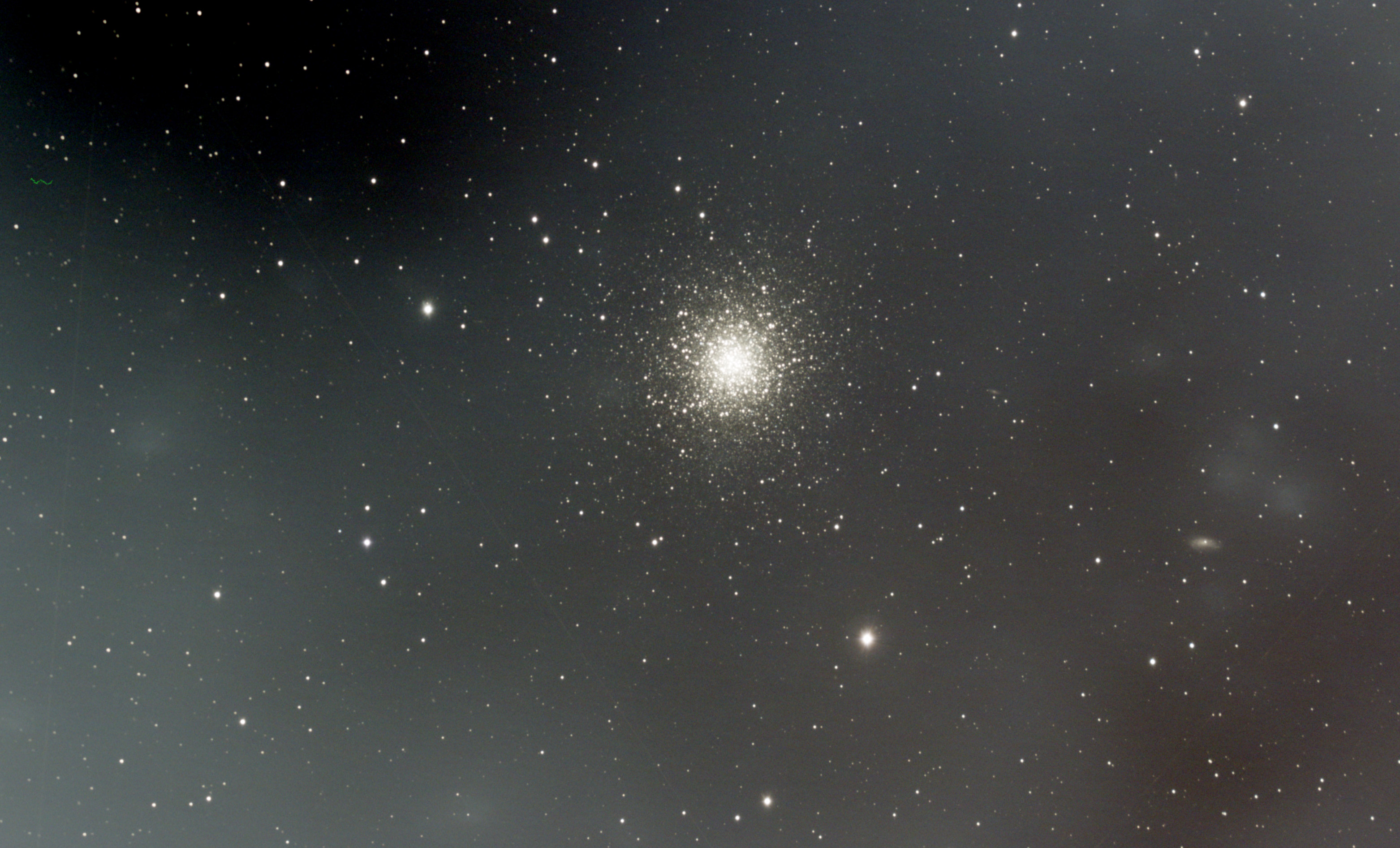
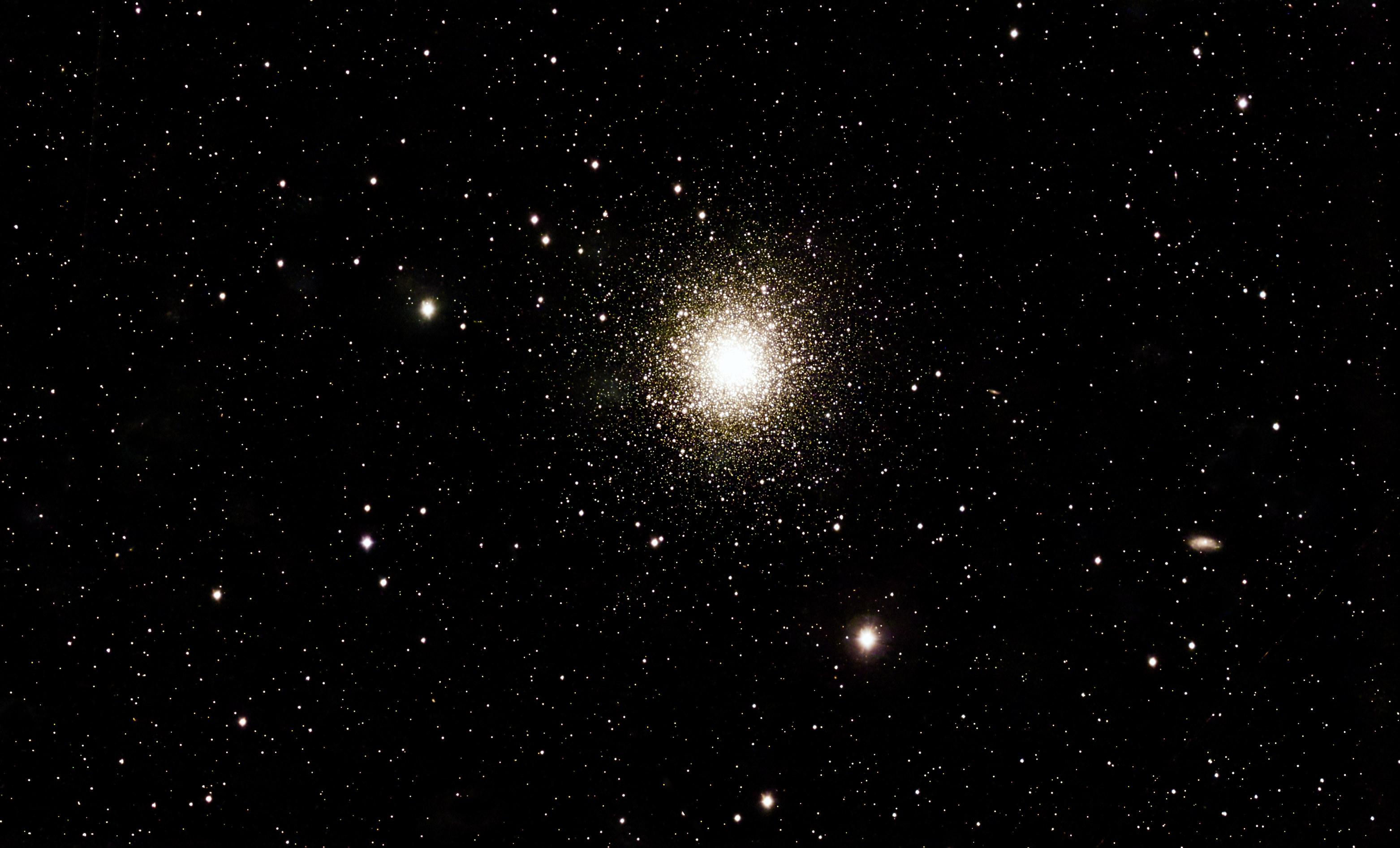
Licence: for personal use, credit Damon Scotting. Both JPEGs 3,125 x 1,893 px.
+23 C sensor temperature during imaging uncooled camera
402 mm focal length, plate solved Celestron states 400 mm for the 8 inch RASA
1.59 x 0.90° field of view 3,856 x 2,180 px on Uranus-C, 1/1.2 inch
8.3 MP Uranus-C, 1/1.2 inch 3,856 x 2,180 px, 11.2 x 6.3 mm
Should you buy it?
76/100 Stars for Your Buck
Pros
- In my side-by-side test against the ZWO ASI585MC, which shares its IMX585 sensor, the two cameras were impossible to separate
- Five-second subs on the 8 inch RASA gave M 13, M 27 and M 51 in 11 to 31 minutes each
- 160 g and 66 mm across: light and slim enough to sit in the light path at the front of an f/2 RASA
- USB 3.0 and 47 frames a second at full resolution in 10-bit for planetary and lunar video
Cons
- No cooling: the sensor read 23 C during a May night's M 13 stack, so darks cannot be matched to a set temperature
- A small 1/1.2 inch sensor, 11.2 x 6.3 mm: a narrow field on anything but a short, fast telescope
- 12-bit readout, against 14 or 16 bits on cooled deep-sky cameras
- Neither First Light Optics nor Agena Astro sells it: Rother Valley Optics in the UK, Player One's own store in the US
I actually meant it for imaging planets, but its deep-sky work is phenomenal. I cannot speak highly enough of that Player One camera.
Who the Uranus-C is for
Planetary and lunar imager
Buy
An IMX585 with 2.9 micron pixels and 47 frames a second over USB 3.0 suits planetary and lunar video.
Live-view and outreach observer
Buy
Exposures of a fraction of a second show colour in bright nebulae as it happens, which is what a live view needs.
Owner of a RASA or another fast astrograph
Buy
At 160 g and 66 mm across it hides behind the 93 mm central obstruction of an 8 inch RASA.
Deep-sky imager planning long integrations
Skip
My recommendation is a cooled camera such as the ZWO ASI585MC Air: it holds -10 C, so darks match every night.
Owner of an ASI585MC, SV705C or another IMX585 camera
Skip
It is the same sensor; spend the money on the telescope or a filter instead.
Wide-field imager with a short refractor
Skip
The 1/1.2 inch sensor crops the field; an APS-C camera makes better use of a small refractor's image circle.
Three alternatives I have reviewed
- ZWO ASI585MC Air The same IMX585 with a cooler, a guide sensor and an ASIAIR built in 89/100 £799 Read the review
- Player One Saturn-C Player One's uncooled 1 inch square IMX533 for a wider field 78/100 £514 Read the review
- SVBONY SV705C The same IMX585 sensor for less money, with an ST-4 port 93/100 £229 Read the review
Questions and more about this review
Reviewed by
Damon Scotting
The Telescope Man Verified
BSc (Hons) Physics with Astrophysics and Cosmology, Loughborough University PGCE / QTS, University of Nottingham
About Damon About Damon Damon Scotting is The Telescope Man. He holds a BSc (Hons) in Physics with Astrophysics and Cosmology from Loughborough University and a PGCE with QTS from the University of Nottingham, and taught physics in secondary schools before becoming an astronomy creator. He is a contributing writer for BBC Sky at Night Magazine and the author of 42 Wonders of Our Night Sky, and his photograph of the galaxy M100 with the dwarf planet Ceres was Highly Commended in the Astronomy Photographer of the Year 2024 competition run by Royal Observatory Greenwich. He has appeared on the BBC's Blue Peter. More than 750,000 people follow his astronomy channels on YouTube, Instagram and TikTok, and he has reviewed more than 140 telescopes, mounts, cameras, filters and accessories hands-on for this site. More about Damon · How I test · Damon's book
I review all kinds of gear: most of it I buy, some is gifted and some is loaned, and all of it is reviewed the same way. How this site is funded
Seven questions, answered
Questions about the Player One Uranus-C
Reviewed 29 May 2024 ·Updated 26 September 2026
I review all kinds of gear. Most of it I buy, some is gifted and some is loaned, and all of it is reviewed the same way: no company sees or approves a review before it is published. Shop links marked Ad are affiliate links: I earn a commission when you buy through them, at no extra cost to you. How this site is funded
- Is the Player One Uranus-C cooled? No. It has a passive cooling body and no fan or thermoelectric cooler; Player One sells an active cooling accessory separately. My M 13 stack recorded a sensor temperature of 23 C. Tested numbers and the download ↓
- What can the Uranus-C image? Planets, the Moon and bright deep-sky targets: the six captures on this page are M 13, M 27, M 51, M 81 and M 82, M 101 and the Western Veil through the Celestron 8 inch RASA; M 13, M 27 and M 51 were stacked from five-second subs. What I captured ↓
- How is the Uranus-C different from the ZWO ASI585MC Air? They share the Sony IMX585. The ASI585MC Air adds a two-stage cooler, a separate guide sensor and a built-in ASIAIR, and weighs 620 g against the Uranus-C's 160 g. The specifications and the comparison table ↓
- Does the Uranus-C work at the front of a RASA? Yes. It sat in the camera holder at the front of the 8 inch RASA for every capture on this page; at 66 mm across it is smaller than the RASA's own 93 mm central obstruction. In the hand ↓
- What back focus does the Uranus-C need? 12.5 mm from the front of the body to the sensor, Player One's figure. The specifications and the comparison table ↓
- Where can I buy the Player One Uranus-C? The prices I recorded: £395 at Rother Valley Optics (UK), in stock; $369 at Player One Astronomy (US), in stock; $354 at AliExpress (Laida Optics Store), Global, listed. A record, not a live price The verdict, the readers and the sellers ↓
- What have I not tested on the Uranus-C? I have not measured the Uranus-C's read noise, dark current or amp glow myself, and I have not tried Player One's optional active cooling accessory.