Player One Saturn-C review: a square 1 inch IMX533 colour camera
Where does it rank on our leaderboard
| Rank | Camera | Stars for Your Buck | Recorded UK price |
|---|---|---|---|
| 1 | SVBONY SV705C | 93 out of 100 | £229 |
| 2 | SVBONY SC571CC | 90 out of 100 | £1,029 |
| 6 | Altair Hypercam 585C | 84 out of 100 | £359 |
| 11 | Player One Saturn-C | 78 out of 100 | £514 |
| 15 | Player One Uranus-C | 76 out of 100 | £395 |
| 16 | ToupTek ATR533C | 76 out of 100 | £799 |
| 23 | ZWO ASI220MM | 67 out of 100 | £299 |
| 28 | ZWO ASI183MC | 38 out of 100 | £549 |
| 29 | Nikon COOLPIX P1000 | 32 out of 100 | £787 |
Contents
- 01 Where does it rank on our leaderboard
- 02 Specifications and features
- 03 In the hand
- 04 The rig on the mount
- 05 How good is it? Here is what it captured
- 06 Saturn through the Saturn-C
- 07 Raw against finished
- 08 What is it for
- 09 Watch it in my videos
- 10 Tested numbers and the download
- 11 Should you buy it?
- 12 Questions and more about this review
In 30 seconds
Stars for Your Buck 78/100
Reviewed 21 Jul 2025 Updated 26 Sep 2026
- Rank
- #11 of 29 cameras
- Verdict
- Damon recommends
Written by Damon Scotting 5 min read
Buy it if
- You want live views or short deep-sky exposures from a light colour camera.
- You want a 1 inch square sensor with 3.76 um pixels for short focal lengths such as 250 mm.
- You also want a planetary camera for a long-focus telescope.
Skip it if
- You want long deep-sky subs in warm weather: it has no cooler, and the Active Cooling System is an extra.
- You run everything from a ZWO ASIAIR: it only connects ZWO cameras.
- The camera must sit in front of the optics with the slimmest cable: its data port is on the side.
“The IMX533 sensor is slightly higher resolution and bigger pixel size, making it an even better choice for live imaging than the QHY585 Mark III colour camera.”
Specifications and features
Against the cameras I have reviewed
Compare with
| Player One Saturn-C reviewed #11 of 29 | Player One Uranus-C #15 of 29 | SVBONY SV705C #1 of 29 | ZWO ASI533MC #12 of 29 | |
|---|---|---|---|---|
| Recorded UK price | £514 | £395 | £229 | £859 |
| Stars for Your Buck | 78/100 | 76/100 | 93/100 | 77/100 |
| Sensor | Sony IMX533 colour | Sony IMX585 colour | Sony IMX585 colour | Sony IMX533 colour |
| Format | 1 inch square, 11.31 x 11.31 mm, 16 mm diagonal | 1/1.2 inch, 12.85 mm diagonal | 1/1.2 inch, 12.85 mm diagonal | 1 inch square, 11.31 x 11.31 mm |
| Colour or mono | Colour | Colour | Colour | Colour |
| Resolution | 3008 x 3008, 9 MP | 3856 x 2180, 8.3 MP | 3856 x 2180, 8.3 MP | 3008 x 3008, 9 MP |
| Pixel size | 3.76 um | 2.9 um | 2.9 um | 3.76 um |
| Cooling | Uncooled (passive); Active Cooling System optional | Uncooled (passive); Active Cooling System optional | Uncooled | TEC, 35 C below ambient |
| Read noise | 1.0 to 4.46 e- (standard mode) | 0.7 to 7.2 e- | 0.7 to 6.5 e- | 1.0 e- |
| Full well | 73 ke- | 47 ke- | 38 ke- | 50 ke- |
| ADC | 14-bit | 12-bit | 12-bit | 14-bit |
| Weight | 160 g | 160 g | 160 g | 470 g |
| Back focus | 12.5 mm | 12.5 mm | 6.5 mm or 12.5 mm | 17.5 mm |
| Interface | USB 3.0, 256 MB DDR3 buffer | USB 3.0, 256 MB DDR3 buffer | USB 3.0, ST4 guide port, 128 MB buffer | USB 3.0 |
| In the box | Camera; T-mount; USB 3.0 cable; ST4 cable; M2 hex key; 1.25 inch cap; air blower | Camera; T-mount; USB 3.0 cable; ST4 cable; M2 hex key; 1.25 inch cap; air blower | The camera, a USB 3.0 cable, an ST4 guide cable, an M42 to CS adapter, a T2 adapter, a 1.25 inch T-adapter, a 2 inch dust cover, a manual and a cleaning cloth | Camera, padded case, T2 nosepieces and adapters, 1.25 inch cap, USB cables, T2 and M48 extenders, M42 to M48 adapter, spacers |
In the hand
In the dew shield
At the front of the HAC125DX
Fitting the adapter
Ready to image
The rig on the mount
On the JUWEI-17, then on six other mounts
How good is it? Here is what it captured
Three targets
Andromeda, Player One Saturn-C, HAC125DX
- Integration
- 2 h (240 x 30 s)
- Field
- 2.6 x 1.4 degrees
- Telescope
- Sky-Watcher HAC125DX
- Camera
- Player One Saturn-C SQR
- Mount
- ZWO AM5N
- Target
- M 31 Andromeda Galaxy
- Type
- Spiral galaxy
- Location
- Bortle 6.8 (in my garden)
North America Nebula, Player One Saturn-C, HAC125DX
- Integration
- 35 min (7 x 300 s)
- Field
- 2.35 x 1.57 degrees
- Telescope
- Sky-Watcher HAC125DX
- Camera
- Player One Saturn-C SQR
- Mount
- Unknown
- Target
- NGC 7000 North America Nebula
- Type
- Emission nebula
- Location
- Bortle 6.8 (in my garden)
Veil Nebula, Player One Saturn-C, HAC125DX
- Integration
- Unknown
- Field
- 2.57 x 2.57 degrees
- Telescope
- Sky-Watcher HAC125DX
- Camera
- Player One Saturn-C SQR
- Mount
- Unknown
- Target
- NGC 6960 and NGC 6992 Veil Nebula
- Type
- Supernova remnant
- Location
- Bortle 6.8 (in my garden)
Saturn through the Saturn-C
One planet
Saturn
- Date
- 20 Sep 2026
- Gear
- Celestron 8 inch EdgeHD + Player One Saturn-C SQR, ZWO AM3N
Raw against finished
What is it for
The 2 targets, the raw combined stack against my finished image, each with its integration, the camera and the palette:
- M 31 Andromeda Galaxy: 2 h (240 x 30 s) of light, Player One Saturn-C SQR, the raw combined stack with one automatic stretch
- NGC 7000 North America Nebula: 35 min (7 x 300 s) of light, Player One Saturn-C SQR, the raw combined stack with one automatic stretch
Three things it is for
Live views of the night sky
I capture 0.3 second exposures at gain 600, then play these images back in sequence at four times the speed.
Six-point stars
None of this one awkward spike sticking out nonsense. This looks beautiful. It actually reminds me of the stars from the images taken by the James Webb telescope.
A comet in one minute
I managed to snap a single 60 second exposure of Comet Lemmon and bring out a lot more detail in its tail.
Watch it in my videos
One of my Favourite Telescopes just got BETTER!? (Skywatcher HAC125 DX first impressions...) · published 21 July 2025 · 9:17 · Watch on YouTube · 41,722 views, 1,275 likes on 2 Oct 2026
Jump to
- 0:31 An IMX533 camera at the front of the DX
- 1:52 The Player One Saturn camera
- 2:31 A side-mounted data port
- 2:46 A hole in the dew shield for the cable
- 3:32 Set up in 30 seconds
- 3:47 Live views: 0.3 seconds at gain 600
- 4:09 LIVE VIEWS
- 4:22 Six-point diffraction spikes
- 5:58 A sneak peek of the Swan Nebula
- 7:10 Why it's GOAT'd
Transcript of the video 588 words · 7 chapters · searchable
Press a time stamp to play from there.
1:52 The Player One Saturn camera
1:52 Now, with the original design, I proclaimed that the only cameras that would work with the telescope were lipstick style cameras so as to not obstruct the telescope's field of view. 1:59 But with that being said, I did try and use the Player One Saturn camera with the telescope, which uses the very popular IMX533 sensor. 2:05 I did really struggle with it, but I just about managed to achieve somewhere near optimal focus. 2:11 The IMX533 sensor is slightly higher resolution and bigger pixel size, making it an even better choice for live imaging than the QHY585 Mark III colour camera. 2:19 But the beauty of the QHY585 camera was that it utilized a USBC input, which meant I could use a super skinny cable like this and obstruct as little of the light as physically possible.
2:31 A side-mounted data port
2:32 Whereas when I attached the Player One Saturn camera to a telescope, it needs your typical astro data cable and the input port is on the side of the camera, which meant for the old design, I could not attach the dew shield, nor could I do anything about the thickness of the cable, which brings me to the second major improvement of the Sky-Watcher HAC125DX, a hole in the dew shield that allows you to thread the cable through.
2:46 A hole in the dew shield for the cable
2:54 This is very well designed and clearly shows that the manufacturers have considered real world uses when selling this telescope. 2:59 And to back that claim up even further, the original dew shield had like a screw thread at the end of it so you could put it onto the telescope, which was a bit of a nuisance. 3:08 Now though, it uses three screws to tighten its position and secure it at the end of the telescope. 3:13 So all in all, I'm very happy with this. 3:15 The telescope has now received a worldwide release as opposed to just limited locations, and it's still priced very competitively at just £599 here in the UK. 3:24 But the real selling point for me is that the telescope is designed to work with an imaging circle of up to 16 mm. 3:30 It even comes with multiple adapters for you to attach your own camera to, which means it took like 30 seconds for me to set the Player One Saturn camera up.
3:32 Set up in 30 seconds
3:37 It's summer time here in England, which generally means 20° C and lots of rain. 3:42 So, this video is solely going to be my first impressions and not an in-depth review. 3:46 Now, when shooting with this setup, I want you to know that I'm capturing 0.3 second long exposures at gain 600.
3:47 Live views: 0.3 seconds at gain 600
3:52 I'm then playing these images back in sequence at four times playback speed. 3:57 The videos therefore are going to be really noisy, but they are very good live views of what the night sky looks like. 4:03 And that for me is the reason I want this telescope. 4:05 And I think it could be the perfect telescope. 4:06 So right now, this isn't looking at anything special.
4:09 LIVE VIEWS
4:10 I'm just doing a first video test whilst the telescope is in its home position and pointing at Polaris, the North Star. 4:16 But already this footage tells us three really interesting details. 4:20 Number one, the star shape is stunning.
4:22 Six-point diffraction spikes
4:23 I hadn't even considered it, but I suspect the shape of the camera is causing these tremendously aesthetically pleasing diffraction spikes. 4:28 So, none of this one awkward spike sticking out nonsense. 4:32 This looks beautiful. 4:32 It actually reminds me of the stars from the images taken by the James Webb telescope.
Check out more videos on the Player One Saturn-C
Can I PHOTOGRAPH a COMET with my SMARTPHONE?!
28 Oct 2025
Tested numbers and the download
Finished image
- Download the raw stack JPEG · 0.6 MB · 1,445 x 1,398
- Download the finished image JPEG · 0.5 MB · 1,445 x 1,398
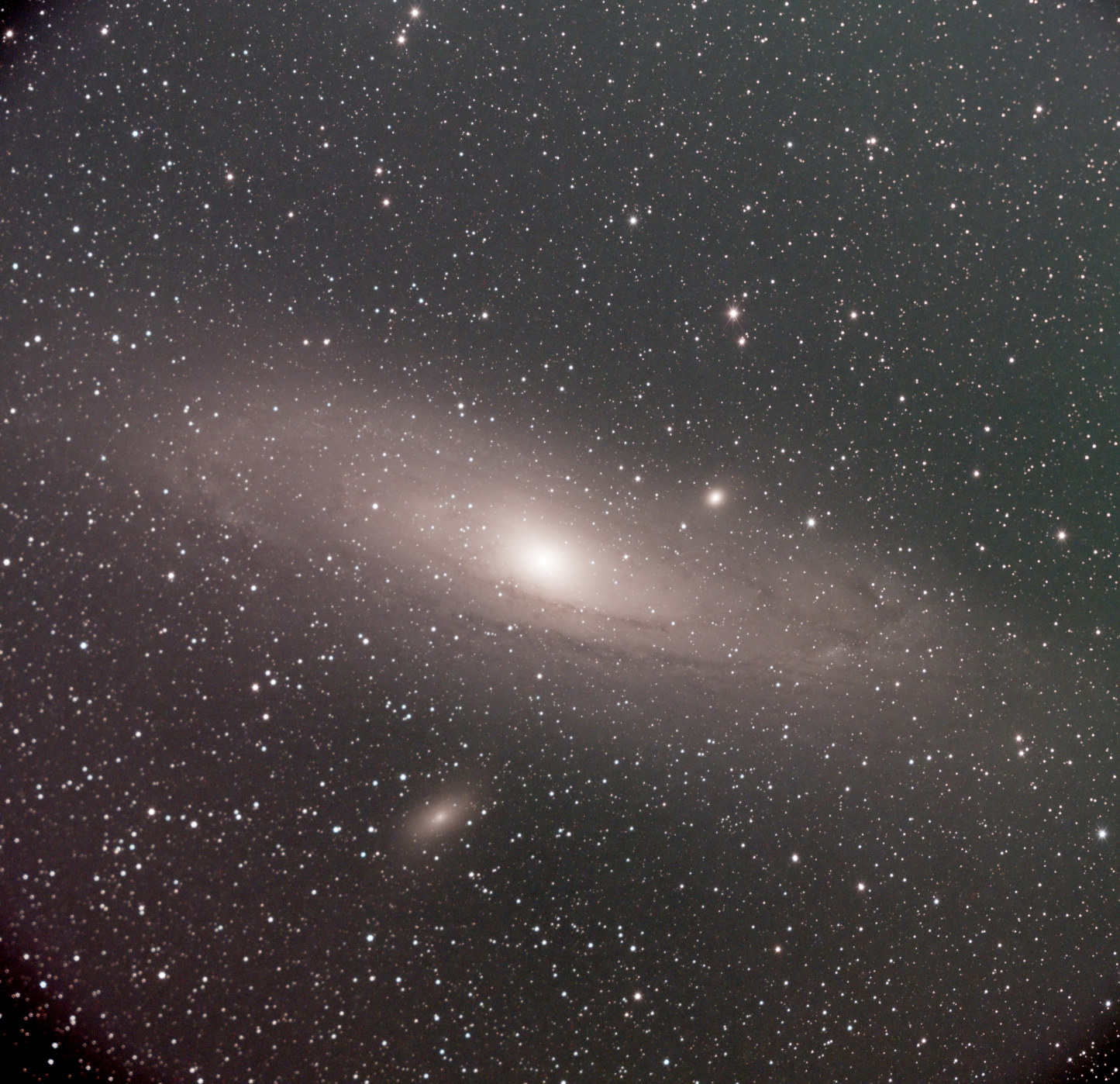
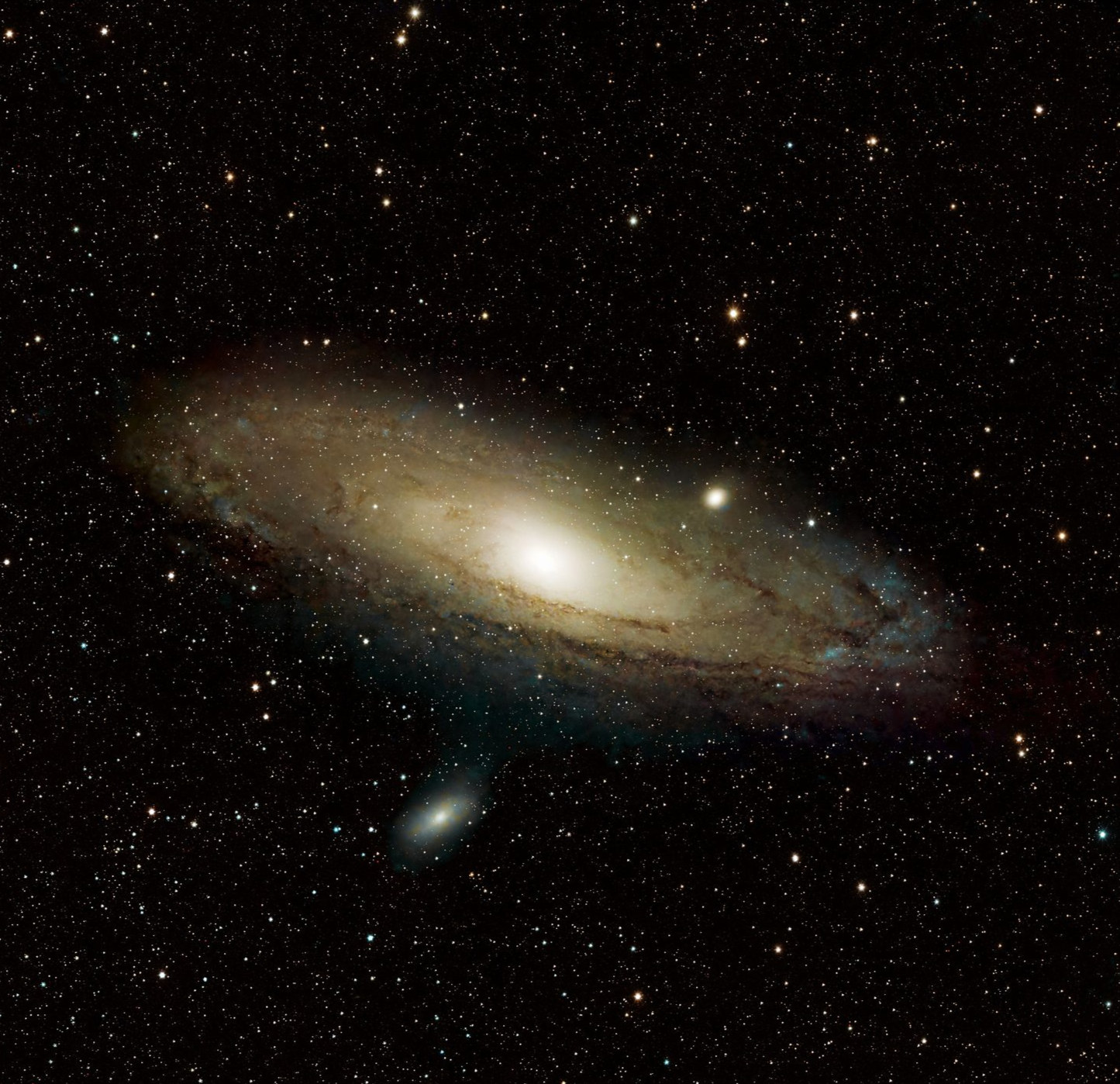
Licence: for personal use, credit Damon Scotting. Both JPEGs 1,445 x 1,398 px.
+22 C sensor temperature during imaging uncooled camera
252 mm focal length, plate solved stated 250 mm, on the Sky-Watcher HAC125DX
2.57 x 2.57° field of view 3,008 x 3,008 px on Player One Saturn-C SQR
9 MP Player One Saturn-C SQR 3,008 x 3,008 px, 11.31 x 11.31 mm
Should you buy it?
78/100 Stars for Your Buck
Pros
- “It took like 30 seconds for me to set the Player One Saturn camera up.”
- “The videos therefore are going to be really noisy, but they are very good live views of what the night sky looks like.”
- At 160 g it adds almost nothing to a focuser or a mount.
- One camera for deep sky, live views and the planets.
- Player One states no amp glow, a 14-bit ADC and a 256 MB buffer.
Cons
- No cooler: the sensor sits at whatever temperature the night gives it (22 C during my Saturn capture), so dark frames have to match each session.
- No ASIAIR: it needs a computer or another maker's controller to run.
I suspect the shape of the camera is causing these tremendously aesthetically pleasing diffraction spikes.
Who the Saturn-C is for
Complete beginner
Skip
It needs a telescope, a tracking mount and a computer; a smart telescope gives the same live views with nothing to connect.
Live-view and outreach imager
Buy
Short, high-gain exposures played in sequence make live views of nebulae, clusters and galaxies that a group can watch on a screen.
Owner of a Honders or RASA astrograph
Buy
The small hexagonal body sits in the light path with little obstruction and gives neat six-point stars; thread its side cable through the dew shield.
Long-exposure deep-sky imager
Skip
A cooled IMX533 such as the ZWO ASI533MC or the ToupTek ATR533C holds a set point through long subs.
Planetary imager with a long telescope
Buy
Planets are short exposures, where the missing cooler matters least, and a small region of interest keeps the frame rate high.
Three alternatives I have reviewed
- Player One Uranus-C Player One's IMX585 colour camera in the same light body 76/100 £395 Read the review
- SVBONY SV705C An uncooled IMX585 colour camera for less 93/100 £229 Read the review
- ZWO ASI533MC The same IMX533 sensor with TEC cooling for long subs 77/100 £859 Read the review
Questions and more about this review
Reviewed by
Damon Scotting
The Telescope Man Verified
BSc (Hons) Physics with Astrophysics and Cosmology, Loughborough University PGCE / QTS, University of Nottingham
About Damon About Damon Damon Scotting is The Telescope Man. He holds a BSc (Hons) in Physics with Astrophysics and Cosmology from Loughborough University and a PGCE with QTS from the University of Nottingham, and taught physics in secondary schools before becoming an astronomy creator. He is a contributing writer for BBC Sky at Night Magazine and the author of 42 Wonders of Our Night Sky, and his photograph of the galaxy M100 with the dwarf planet Ceres was Highly Commended in the Astronomy Photographer of the Year 2024 competition run by Royal Observatory Greenwich. He has appeared on the BBC's Blue Peter. More than 750,000 people follow his astronomy channels on YouTube, Instagram and TikTok, and he has reviewed more than 140 telescopes, mounts, cameras, filters and accessories hands-on for this site. More about Damon · How I test · Damon's book
I review all kinds of gear: most of it I buy, some is gifted and some is loaned, and all of it is reviewed the same way. How this site is funded
Eight questions, answered
Questions about the Player One Saturn-C
Reviewed 21 July 2025 ·Updated 26 September 2026
I review all kinds of gear. Most of it I buy, some is gifted and some is loaned, and all of it is reviewed the same way: no company sees or approves a review before it is published. Shop links marked Ad are affiliate links: I earn a commission when you buy through them, at no extra cost to you. How this site is funded
- Which sensor does the Player One Saturn-C use? The 1 inch square Sony IMX533: 3008 x 3008 pixels at 3.76 um. The Player One camera with the IMX585 is the Uranus-C. The specifications and the comparison table ↓
- Is the Saturn-C cooled? No. It has passive cooling, with Player One's Active Cooling System sold as an extra; the sensor read 22 C in SharpCap during my Saturn capture. Tested numbers and the download ↓
- Can the Saturn-C take deep-sky images? Yes. My Andromeda is 2 hours of 30 second subs and my North America Nebula 35 minutes of 5 minute subs, both through the Sky-Watcher HAC125DX. What I captured ↓
- Can the Saturn-C image the planets? Yes. I recorded Saturn through an 8 inch EdgeHD at 56 frames a second on a 1084 x 764 region, 17.7 ms exposures at gain 537.
- What field does it give on a 250 mm astrograph? My plate solve puts the square sensor at 2.57 x 2.57 degrees on the HAC125DX, measured at 252 mm. Tested numbers and the download ↓
- Does the Saturn-C work with a ZWO ASIAIR? No. My deep-sky stacks were made with ToupTek's StellaVita and my Saturn with SharpCap on a computer. The specifications and the comparison table ↓
- How heavy is the Saturn-C? 160 g, with a 66 mm hexagonal body and 12.5 mm of back focus. The specifications and the comparison table ↓
- What have I not tested on the Saturn-C? I did not use the Saturn-C with its Active Cooling System, did not measure its read noise or amp glow, and have not made a review video of the camera on its own.