QHY 585C review: the QHY5III585C lipstick camera
Where does it rank on our leaderboard
| Rank | Camera | Stars for Your Buck | Recorded UK price |
|---|---|---|---|
| 1 | SVBONY SV705C | 93 out of 100 | £229 |
| 2 | SVBONY SC571CC | 90 out of 100 | £1,029 |
| 5 | ToupTek SkyEye 24AC | 85 out of 100 | £1,804 |
| 9 | ZWO ASI585MM Air | 83 out of 100 | £1,099 |
| 18 | ZWO ASI6200MM Pro | 74 out of 100 | £3,999 |
| 21 | ZWO ASI2600MC | 72 out of 100 | £1,599 |
| 26 | QHY 585C | 59 out of 100 | £359 |
| 28 | ZWO ASI183MC | 38 out of 100 | £549 |
| 29 | Nikon COOLPIX P1000 | 32 out of 100 | £787 |
Contents
- 01 Where does it rank on our leaderboard
- 02 Specifications and features
- 03 In the hand
- 04 The rig on the mount
- 05 How good is it? Here is what it captured
- 06 Raw against finished
- 07 What is it for
- 08 Watch the review
- 09 Tested numbers and the download
- 10 Should you buy it?
- 11 Questions and more about this review
In 30 seconds
Stars for Your Buck 59/100
Reviewed 28 Nov 2024 Updated 26 Sep 2026
- Rank
- #26 of 29 cameras
- Verdict
- With reservations
Written by Damon Scotting 5 min read
Buy it if
- You need a slim camera that sits in the light path of a fast astrograph, such as a HAC125, a RASA or a HyperStar.
- You want live views and short-exposure deep-sky frames from an IMX585 in a 90 g body.
- Your capture software is not an ASIAIR: a laptop or mini PC runs it over one USB-C cable.
Skip it if
- You run an ASIAIR: it runs ZWO cameras and a few DSLRs, never a QHY.
- You want long cooled exposures: there is no TEC and no set point.
- You want the cheapest IMX585: the SVBONY SV705C costs less with the same sensor.
“I decided that I want to use the best possible lipstick camera that I could find in the market, which led me to the QHY5 Mark III 585C.”
Specifications and features
Against the IMX585 cameras I have reviewed
Compare with
| QHY 585C reviewed #26 of 29 | SVBONY SV705C #1 of 29 | ZWO ASI585MC Air #3 of 29 | Player One Uranus-C #15 of 29 | Altair Hypercam 585C #6 of 29 | |
|---|---|---|---|---|---|
| Recorded UK price | £359 | £229 | £799 | £395 | £359 |
| Stars for Your Buck | 59/100 | 93/100 | 89/100 | 76/100 | 84/100 |
| Sensor | Sony IMX585, back-illuminated STARVIS 2 | Sony IMX585 | Sony IMX585, with a separate guide sensor | Sony IMX585 | Sony IMX585, STARVIS 2 |
| Format | 1/1.2 inch, 11.2 x 6.3 mm | 1/1.2 inch, 11.2 x 6.3 mm | 1/1.2 inch, 11.2 x 6.3 mm | 1/1.2 inch | 1/1.2 inch, 11.2 x 6.26 mm |
| Colour or mono | Colour | Colour | Colour | Colour | Colour |
| Resolution | 3856 x 2180, 8.4 MP | 3856 x 2180, 8.3 MP | 3840 x 2160, 8.3 MP | 3856 x 2180, 8.3 MP | 3840 x 2160, 8.3 MP |
| Pixel size | 2.9 um | 2.9 um | 2.9 um | 2.9 um | 2.9 um |
| Cooling | Uncooled | Uncooled | Cooled, 30 to 35 C below ambient | Uncooled | Fan and heatsink, no TEC |
| Read noise | 0.77 to 8 e- | 0.7 to 6.5 e- | 0.7 to 6.67 e- | 0.7 to 7.2 e- | 0.42 to 2.43 e- |
| Full well | 52 ke- | 38 ke- | 40 ke- | 47 ke- | 40 ke- |
| ADC | 12-bit | 12-bit | 12-bit | 12-bit | 12-bit |
| Weight | 90 g | 160 g | 620 g | 160 g | 300 g |
| Back focus | 8 mm, 17 mm with the adapter | 6.5 mm, 12.5 mm with the adapter | 12.5 mm or 17.5 mm | 12.5 mm | 12.5 mm, 17.5 mm with the adapter |
| Interface | USB 3.0 Type-C, ST-4 guide port, 512 MB DDR3 | USB 3.0 | USB-C, built-in controller with four USB 2.0 ports | USB 3.0 | USB 3.0, ST-4 guide port |
| In the box | IR-cut and IR850 filters; a 1.25 inch nosepiece with CS and C-mount adapters | The camera, a USB 3.0 cable, an ST4 guide cable, an M42 to CS adapter, a T2 adapter, a 1.25 inch T-adapter, a 2 inch dust cover, a manual and a cleaning cloth | The camera, a camera bag, the external antenna, a 1 m DC cable, a 1.5 m DC extension, two 0.5 m USB 2.0 cables, a 21 mm T2 extender, a 16.5 mm T2 to M48 extender, an M42 to M48 tilter, a 1 m hook-and-loop strap, a 2 mm hex wrench and a quick guide | Camera; T-mount; USB 3.0 cable; ST4 cable; M2 hex key; 1.25 inch cap; air blower | The camera, a 1.5 m USB cable, a 2 inch nosepiece, a silicone dust cap and a software CD |
In the hand
Six frames from my videos
The rig on the mount
On the JUWEI-17, then on six other mounts
How good is it? Here is what it captured
Four targets through the HAC125
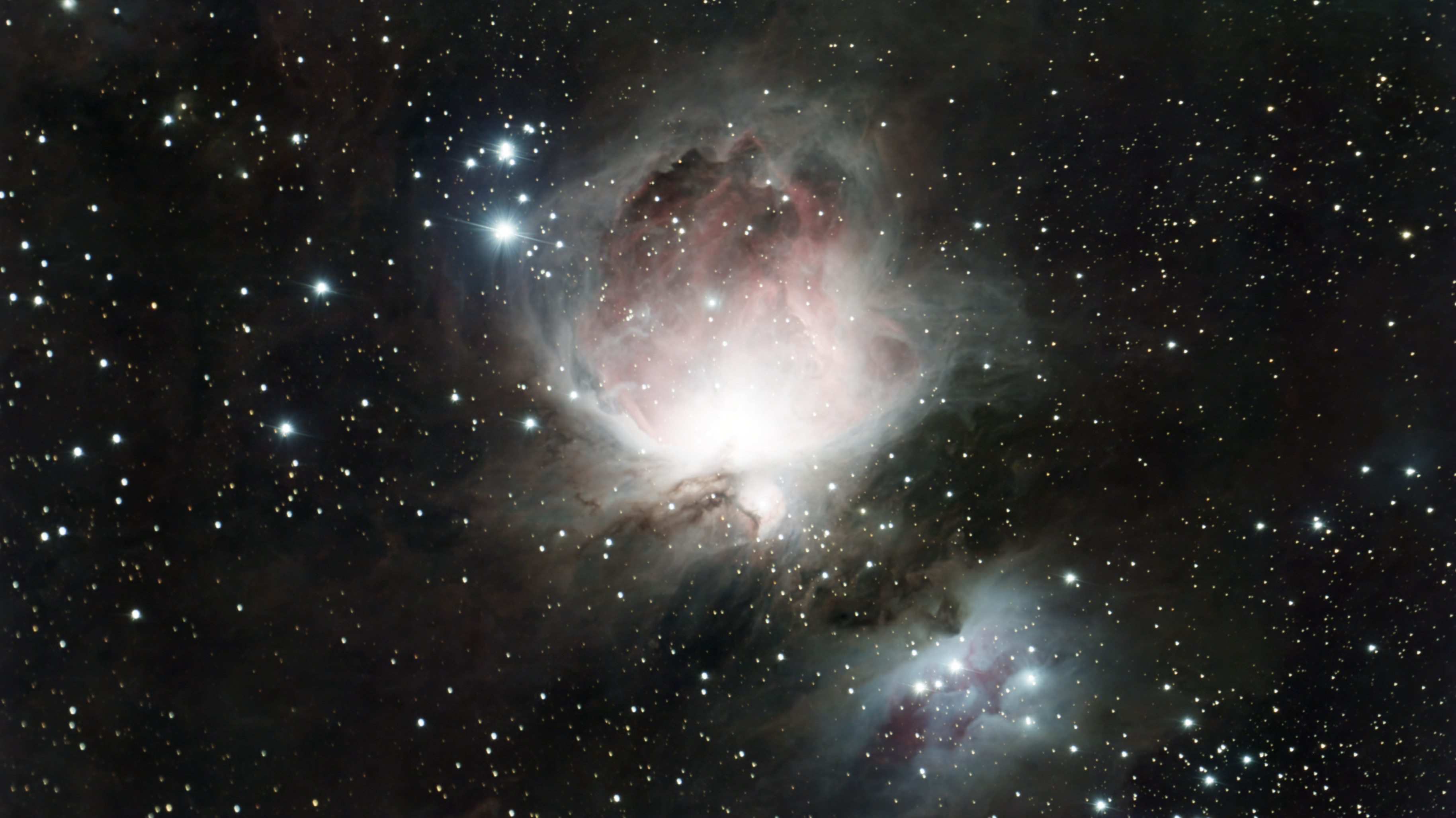
M 42 Orion Nebula, QHY5III585C
- Integration
- 20 min (80 x 15 s)
- Field
- 2.49 x 1.40 degrees
- Telescope
- Sky-Watcher HAC125
- Camera
- QHY5III585C
- Mount
- ZWO AM5N
- Target
- M 42 Orion Nebula
- Type
- Emission and reflection nebula
- Location
- Bortle 6.8 (in my garden)
IC 434 Horsehead and NGC 2024 Flame Nebula, QHY5III585C
- Integration
- 17 min (68 x 15 s)
- Field
- 2.50 x 1.45 degrees
- Telescope
- Sky-Watcher HAC125
- Camera
- QHY5III585C
- Mount
- ZWO AM5N
- Target
- IC 434 Horsehead and NGC 2024 Flame Nebula
- Type
- Dark and emission nebulae
- Location
- Bortle 6.8 (in my garden)
M 31 Andromeda Galaxy, QHY5III585C
- Integration
- 31 min (31 x 60 s)
- Field
- 2.58 x 1.44 degrees
- Telescope
- Sky-Watcher HAC125
- Camera
- QHY5III585C
- Mount
- ZWO AM5N
- Target
- M 31 Andromeda Galaxy
- Type
- Galaxy
- Location
- Bortle 6.8 (in my garden)
M 45 Pleiades, QHY5III585C
- Integration
- 30 min
- Field
- 2.58 x 1.44 degrees
- Telescope
- Sky-Watcher HAC125
- Camera
- QHY5III585C
- Mount
- ZWO AM5N
- Target
- M 45 Pleiades
- Type
- Open star cluster with reflection nebula
- Location
- Bortle 6.8 (in my garden)
Raw against finished
What is it for
The 3 targets, the raw combined stack against my finished image, each with its integration, the camera and the palette:
- M 42 Orion Nebula: 20 min (80 x 15 s) of light, QHY5III585C, the raw combined stack with one automatic stretch
- IC 434 Horsehead and NGC 2024 Flame Nebula: 17 min (68 x 15 s) of light, QHY5III585C, the raw combined stack with one automatic stretch
- M 45 Pleiades: 13 min (52 x 15 s) of light, QHY5III585C, the raw combined stack with one automatic stretch
Three things it is for
A lipstick camera
Inside the HAC125 I can't just put any plain old camera. I have to use what is known as a lipstick camera, because other types of camera obscure more and more of the telescope's view, which means letting less light in.
One skinny USB-C cable
The beauty of the QHY 585 camera was that it utilised a USB-C input, which meant I could use a super skinny cable and obstruct as little of the light as physically possible.
Live views in real time
This is live footage captured with the telescope. More and more often our images are spoiled by bright streaks of light passing through them. These are most often caused by satellites, but what was once an annoying interference has now become an exciting spectacle.
Watch the review
This COULD have been the BEST Telescope EVER?! · published 28 November 2024 · 9:11 · Watch on YouTube · 59,933 views, 1,351 likes on 2 Oct 2026
Jump to
- 0:47 My setup: the AM5N and a lipstick camera
- 1:09 Why the camera sits in the light path
- 1:34 Live views through the HAC125
- 2:51 A 13-minute stack of the Pleiades
- 3:25 Collimation and star shapes
- 3:42 BlurXTerminator on the raw stacks
- 5:07 Against a RASA and a HyperStar
- 6:30 Why it was never sold in the UK or US
- 7:54 A sequence of targets for outreach
Transcript of the review video 1,647 words · 10 chapters · searchable
Press a time stamp to play from there.
0:00 One of the fastest telescopes in the world
0:00 this is one of the fastest telescopes in the world and it is forbidden it will not be sold in the US or UK and that for 0:06 good reason it's sold on a Chinese website called AliExpress a telescope like this for under £500 is completely unheard of it had the 0:15 potential to be a game changer but unfortunately it never even got the chance to reach the market in today's episode I'm going to be showcasing you 0:22 the Fantastic things that this telescope is capable of such as giving you a live view of deep Sky objects such as the Andromeda Galaxy you can also take some 0:30 pretty special images and do some other very cool things I'm also going to be explaining in detail as to why this is expected to not hit the market and to be 0:39 fair I think some of the reasons are very well Justified I'm Damon Scotting and this is astronomical right so the setup that I have with me right now is an AM5 mount
0:47 My setup: the AM5N and a lipstick camera
0:51 the Sky-Watcher HAC125 obviously that's what this review is about but then inside it I can't just put any plain old camera I have to use what is known as a 1:00 lipstick camera this is due to the fact that if you use other types of cameras it obscures more and more of the actual telescope View and therefore it means 1:08 you're letting less light in traditionally with Newtonian telescopes you'll have a secondary mirror that's placed somewhere around this point with inside a telescope and then you'll have
1:09 Why the camera sits in the light path
1:15 your eyepiece coming out just here now that's good that means if you're looking into a telescope you're taking images you're not blocking any of the light 1:21 coming in whereas this design has a very obvious flaw and that is that you're obstructing your view right before I get too deep into the bad parts of the 1:27 Sky-Watcher HAC125 allow me to demonstrate why this scope has the potential to be the best telescope ever made what you're seeing right now is
1:34 Live views through the HAC125
1:36 live footage captured with the telescope live this right here is practically as close as it gets to what these objects will look like when viewed through a 1:44 telescope the only difference is I've boosted the saturation a little and you're not having to squint with one eye in order to focus on viewing the object 1:52 not only is this an incredible viewing experience it allows you to capture what's happening around the object in real time what I mean by that is it more 2:00 often our images are spoiled by these bright streaks of light passing through them these are most often caused by satellites but what was once an 2:07 annoying interference has now become an exciting spectacle it's kind of like a meteor shower only far more abundant to add an extra layer of depth to your 2:14 observations you can open up your Sky Atlas such as Stellarium and locate your current Target to see what satellite it was that just passed by in the rare case 2:23 it may have actually been several human beings that just zipped past aboard the International Space Station so here we have the fastest telescope in 2:43 the Galaxy bringing the light from Deep Sky wonders to us in a dramatic fashion but there is a reason telescope companies rarely go for this design and
2:51 A 13-minute stack of the Pleiades
2:51 here's why this is a 13-minute stacked image of the Seven Sisters now I thoroughly expect your viewing experience of these images to go from 2:59 Wow to oh never mind to holy this image was unguided in fact I actually reduced exposures all the way down to 15 seconds that's for two reasons number 3:09 one the telescope could handle it even at short enough exposures such as this it made light work number two my Stars kept appearing to Trail the truth was 3:18 that even at 2 minutes long exposures they still had the exact same shape and that is due to the design of the telescope I really cannot emphasize this
3:25 Collimation and star shapes
3:27 enough but the collimation of this telescope is a gigantic pain in the a**. Star shapes like this are going to be unavoidable and nobody wants this it's such a huge 3:35 shame because otherwise the level of detail the scope picks up in under 15 minutes is very impressive if only there was a way to correct the star shape well
3:42 BlurXTerminator on the raw stacks
3:44 there is an effective editing cheat code that many astrophotographers have been utilizing for the last few years and that is the BlurXTerminator tool by Russell 3:53 Croman this tool helps to remove the blur in your images caused by bad Optics and Atmospheric disturbance prepare yourself for the ridiculous transformation that's about to occur 4:05 I don't think that there are many more sets of images on the planet that are more perfectly designed to be enhanced by this tool it turns each of 5:02 them into works of art you see this is what gets me excited about a telescope especially at a super low price the cheapest RASA telescope you can buy is
5:07 Against a RASA and a HyperStar
5:11 at least £2,000 RASA telescopes have a similarly fast focal ratio you can actually convert Schmidt-Cassegrain telescopes into RASAs through the help of a tool 5:19 known as a hyperstar so perhaps you're watching this video about the Sky-Watcher HAC125 available for under £500 and thinking nah why not just go for the 5:28 Celestron 6 and slap on a hyperstar like this guy here well it's a fair point except for the fact that the hyperstar alone can 5:36 cost significantly more than the Sky-Watcher HAC125 and that's before you even purchased a telescope to go with it as it currently stands the only 5:45 place I'm confident any of you watching this can reliably get this telescope from is AliExpress and as of right now 5:53 they do currently have big black Friday promotion sales which means you can get this telescope for even cheaper just keep your eye out for the Postage and 6:00 customs fees so it's undeniable that the speed of this telescope is impressive achieving views like this for under £500 is astonishing but with that being said 6:08 unless your collimation is perfect then the images produced are horrific unless you use deconvolution tools that bring the star shapes back around to the normal 6:18 standard now although this is a very common editing method would you consider this to be cheating let me know what your thoughts are down in the comments 6:25 below so we've seen what makes this scope so special and why you should buy it but let's finish off with why you really shouldn't so one of the biggest
6:30 Why it was never sold in the UK or US
6:32 issues as to why it's not going to hit the market is because it's very finicky the use of lipstick cameras makes it very restrictive it's very susceptible 6:40 to building up dew on the secondary mirror just here and also adjusting the primary mirror at the back has been a nightmare it feels like it's pretty much 6:48 impossible to get a completely uniform flat image across the board there always seems to be a slight Distortion in my star shapes due to the fact that I can't 6:57 perfectly align this so it's been very frustrating but with that being said all of it been worth it cuz I thoroughly enjoy this telescope and the things I've been 7:04 capable of doing with it in fact in a future video I'm going to be showcasing you guys my Observatory setup and I've been doing something very cool with this 7:11 particular setup which I'm going to wait to show you in a future video actually I've had a change of heart since filming this review video I am going to give you 7:17 a sneak peek into one of my upcoming videos titled The best/worst Observatory ever and this is because I've got a long list of videos I need to release before 7:25 this one so make sure you have the Bell notification turned on in order to hear about it once it does become visible I've tried my best to make a warm 7:31 feeling setup in my garden on a very limited budget since traditional observatories cost an arm and a leg and have their own long list of pros and 7:38 cons what's extra unique about my setup is that I have one rig designated for Astro Imaging you know long exposure images and the other specifically for 7:47 live viewing of the night sky which constitutes anything from the moon to the Andromeda galaxy in fact I figured out a simple method to execute a
7:54 A sequence of targets for outreach
7:55 sequence of targets on the Sky-Watcher HAC125 at the start of my session so every few minutes it zips between a new deep Sky Target this is really fun 8:06 because half the time I don't know what it's looking at which is quite exciting my main focus most nights is taking actual images with my telescope most 8:14 recently telescopes I've been sent to complete a review on before Christmas but having the Sky-Watcher HAC125 in the background is a game changer and makes the 8:22 whole experience a lot more exciting in my upcoming video I explore a lot of different accessories that make my own Observatory the perfect stargazing 8:28 experience as well as the limiting factors that can really hamper the observations I'm excited to share this all with you but as for now let's focus 8:36 on this clever little scope so if you're interested in Sky-Watcher HAC125 and you want to purchase one for yourself then I've included a product Link in the 8:44 description below it is an international website meaning it ships to pretty much everywhere worldwide um fair warning you are going to have to deal with customs charges these vary 8:56 depending on what country you live in thanks for watching I'm Damon Scotting and this was astronomical
Check out more videos on the QHY 585C
One of my Favourite Telescopes just got BETTER!? (Skywatcher HAC125 DX first impressions...)
21 Jul 2025
WAS this the BEST week of STARGAZING EVER?!
29 Oct 2024
Tested numbers and the download
Finished image
- Download the raw stack JPEG · 0.9 MB · 3,657 x 2,055
- Download the finished image JPEG · 1.2 MB · 3,657 x 2,055

Licence: for personal use, credit Damon Scotting. Both JPEGs 3,657 x 2,055 px.
Unknown sensor temperature during imaging
245 mm focal length, plate solved on the Sky-Watcher HAC125, which Sky-Watcher states at 250 mm
2.6 x 1.5° field of view 3,856 x 2,180 px on QHY5III585C
8.4 MP QHY5III585C 3,856 x 2,180 px, 11.2 x 6.3 mm
Should you buy it?
59/100 Stars for Your Buck
Pros
- “It's ideal for both deep sky imaging as well as planetary imaging.”
- A 90 g lipstick body on a 1.25 inch nose: it sat in the middle of the HAC125's f/2 corrector for every image on this page.
- Its 2.9 um pixels give 2.45 arcsec per pixel at 245 mm: a 2.6 x 1.5 degree field on the HAC125.
- An ST-4 guide port and a 512 MB DDR3 buffer on board, with IR-cut and IR850 filters in the box.
Cons
- “I won't be able to use this QHY camera with the ASIAIR Plus. In fact, the only cameras I can use with it are ZWO cameras.”
- “A QHY 585 isn't necessarily a guiding camera.”
- Uncooled: no TEC and no set point, so dark frames have to match each night's temperature.
- £359 at Modern Astronomy, on back order, against £229 for the SVBONY SV705C with the same IMX585 sensor.
The IMX533 sensor is slightly higher resolution and bigger pixel size, making it an even better choice for live imaging than the QHY 585 Mark III colour camera.
Who the QHY 585C is for
Owner of a telescope with the camera in the light path
Buy
A 90 g lipstick body on one thin USB-C cable blocks as little of an f/2 corrector as a camera can; it is what I used in the HAC125.
Live-view and EAA observer
Buy
On a fast telescope a tenth of a second is enough to show nebulae and passing satellites in real time.
ASIAIR user
Skip
The ASIAIR runs ZWO cameras and a few DSLRs, never a QHY; the ZWO ASI585MC Air uses the same IMX585 sensor and works with it.
Budget planetary and lunar imager
Skip
The SVBONY SV705C carries the same IMX585 for £229 against £359.
Long-exposure deep-sky imager
Skip
It is uncooled; a cooled IMX585 such as the ZWO ASI585MC Air holds a set point through long subs.
Imager looking for a guide camera
Skip
Through an off-axis guider on the JUWEI-17 it guided at 1.5 to 1.6 arcsec RMS; the built-in guide sensor of an ASI2600MC Duo guided far more smoothly.
Three alternatives I have reviewed
- SVBONY SV705C the same IMX585 sensor, uncooled, for less 93/100 £229 Read the review
- ZWO ASI585MC Air the IMX585 cooled, with a guide sensor and a controller built in 89/100 £799 Read the review
- Player One Uranus-C another uncooled IMX585 colour camera 76/100 £395 Read the review
Questions and more about this review
Reviewed by
Damon Scotting
The Telescope Man Verified
BSc (Hons) Physics with Astrophysics and Cosmology, Loughborough University PGCE / QTS, University of Nottingham
About Damon About Damon Damon Scotting is The Telescope Man. He holds a BSc (Hons) in Physics with Astrophysics and Cosmology from Loughborough University and a PGCE with QTS from the University of Nottingham, and taught physics in secondary schools before becoming an astronomy creator. He is a contributing writer for BBC Sky at Night Magazine and the author of 42 Wonders of Our Night Sky, and his photograph of the galaxy M100 with the dwarf planet Ceres was Highly Commended in the Astronomy Photographer of the Year 2024 competition run by Royal Observatory Greenwich. He has appeared on the BBC's Blue Peter. More than 750,000 people follow his astronomy channels on YouTube, Instagram and TikTok, and he has reviewed more than 140 telescopes, mounts, cameras, filters and accessories hands-on for this site. More about Damon · How I test · Damon's book
I review all kinds of gear: most of it I buy, some is gifted and some is loaned, and all of it is reviewed the same way. How this site is funded
Seven questions, answered
Questions about the QHY 585C
Reviewed 28 November 2024 ·Updated 26 September 2026
I review all kinds of gear. Most of it I buy, some is gifted and some is loaned, and all of it is reviewed the same way: no company sees or approves a review before it is published. Shop links marked Ad are affiliate links: I earn a commission when you buy through them, at no extra cost to you. How this site is funded
- Is the QHY 585C the QHY5III585C? Yes. The camera on my board as the QHY 585C is the QHYCCD QHY5III585C, the uncooled IMX585 colour camera; the body in my photographs reads QHYCCD QHY5III585, 512MB DDR3, TYPE-C. In the hand ↓
- Is the QHY 585C cooled? No. It has no TEC and no fan, so there is no set point, and none of my frames with it records a sensor temperature. Tested numbers and the download ↓
- Does the QHY 585C work with an ASIAIR? No: the ASIAIR runs ZWO cameras and a few DSLRs, never a camera from another maker. For an ASIAIR rig the ZWO ASI585MC Air uses the same IMX585 sensor. The specifications and the comparison table ↓
- Which telescope did I use the QHY 585C on? The Sky-Watcher HAC125, a 125 mm f/2 Honders astrograph where the camera sits in the middle of the corrector; my plate solves put it at 245 mm. What I captured ↓
- Can the QHY 585C be used as a guide camera? It has an ST-4 guide port, and I ran it as the guide camera on an off-axis guider for my JUWEI-17 test, which averaged 1.5 to 1.6 arcsec RMS; the guiding was far smoother on an ASI2600MC Duo's built-in guide sensor. The specifications and the comparison table ↓
- How much does the QHY 585C cost? The prices I recorded: £359 at Modern Astronomy (UK), on back order; $399 at Agena Astro (US), in stock; $514 at AliExpress (BestGoBuy Store), Global, listed. A record, not a live price The verdict, the readers and the sellers ↓
- What have I not tested on the QHY 585C? No dark, bias or noise measurement, no sensor temperature and no planetary capture with this camera is on file.