SVBONY SV503 70ED review: a small ED refractor that delivers
Where does it rank on our leaderboard
| Rank | Telescope | Stars for Your Buck | Recorded UK price |
|---|---|---|---|
| 1 | Askar 50P | 95 out of 100 | £299 |
| 2 | ToupTek Hope D60 | 93 out of 100 | £749 |
| 3 | Sky-Watcher HAC125DX | 92 out of 100 | £589 |
| 18 | Celestron C11 EdgeHD | 75 out of 100 | £4,845 |
| 30 | SVBONY SV503 70ED | 64 out of 100 | £380 |
| 32 | Sky-Watcher HAC125 | 61 out of 100 | £405 |
| 35 | Celestron 8 inch RASA | 53 out of 100 | £2,595 |
| 41 | Celestron 114 LCM | 42 out of 100 | £361 |
| 42 | Celestron AstroMaster LT 76 | 13 out of 100 | £200 |
Contents
- 01 Where does it rank on our leaderboard
- 02 Specifications and features
- 03 In the hand
- 04 From the review video
- 05 How good is it? Here's what I captured
- 06 Raw against finished
- 07 The rig on the mount
- 08 What is it for
- 09 Versus the Celestron 63ED
- 10 Watch the review
- 11 Tested numbers and the download
- 12 Should you buy it?
- 13 Questions and more about this review
In 30 seconds
Stars for Your Buck 64/100
Reviewed 27 Jul 2023 Updated 23 Sep 2026
- Rank
- #30 of 42 telescopes
- Verdict
- Worth a look
Written by Damon Scotting 6 min read
Buy it if
- You want your first imaging refractor on a small budget, light enough for a star tracker.
- You image big targets like Andromeda, the Pleiades or the Veil with a DSLR or a small-sensor astro camera.
- You are happy to tidy blue star halos in processing.
Skip it if
- You want stars free of blue-magenta halos straight out of the stack.
- You image on a full-frame or large APS-C sensor and do not want to add a flattener.
- You want planets or small galaxies large in the frame: 420 mm makes them small.
This telescope is extremely well made, it comes with a dovetail bar and tube rings already attached, and you are going to be able to get some fantastic images with it.
Specifications and features
Against the telescopes I have reviewed
Compare with
| SVBONY SV503 70ED reviewed #30 of 42 | Askar 80ED #17 of 42 | Altair 60EDF #38 of 42 | Celestron 63ED #40 of 42 | |
|---|---|---|---|---|
| Recorded UK price | £380 | £379 | £499 | £322 |
| Stars for Your Buck | 64/100 | 77/100 | 51/100 | 43/100 |
| Aperture | 70 mm | 80 mm | 60 mm | 63.5 mm |
| Focal length | 420 mm | 560 mm | 360 mm | 381 mm |
| Focal ratio | f/6 | f/7 | f/6 | f/6 |
| Optical design | ED doublet, one S-FPL51 extra-low dispersion element, SMC multi-coated | Doublet refractor, one ED element and one standard glass element | S-FPL53 ED doublet, fully multi-coated | Doublet refractor with one ED element, fully multi-coated |
| Image circle | 1 inch (25.4 mm) | APS-C with the optional flattener or reducers | APS-C with the optional 1.0x flattener | 1 inch |
| Back focus | 90 mm | 55 mm with the optional flattener or reducers | 55 mm sensor spacing with the optional reducer or flattener | not recorded |
| Focuser | 2 inch dual-speed rack and pinion, 1:10 fine focus | dual-speed rack and pinion 2 inch focuser, 70 mm travel, with screw holes for an electronic focuser | 2.5 inch dual-speed 1:10 rack and pinion, brass gear, rear camera rotator, 2 inch push-fit adapter | 2 inch dual-speed 1:10 CNC-machined focuser |
| Weight, tube | 2.22 kg | 1.7 kg OTA; 2 kg gross with tube ring and dovetail plate | about 1.5 kg including rings and rear camera rotator | about 2.5 kg with accessories |
| Length, tube | 318 mm, dew shield retracted | 404 mm dew shield contracted; 505 mm dew shield extended | 230 mm dew shield retracted; 300 mm extended | not recorded |
| Dew shield | Retractable | Retractable | Retractable | Retractable |
| In the box | Tube rings, 150 mm dovetail plate, 2 inch to 1.25 inch eyepiece adapter, lens cover, 1.25 inch dust cover | 80ED OTA with tube ring and dovetail plate (counted in the 2 kg gross weight), 2 inch rear adapter, user manual | OTA with retractable dew shield, optical test report, dual-speed focuser with camera rotator, 2 inch push-fit adapter, X-rings with quick-release clamp, 200 mm dovetail bar, top handle rail, lens cap and dust plug | Tube rings, Vixen dovetail bar, mounting screws |
In the hand
Six photographs
From the review video
Two frames from my video
Orion Nebula and the Running Man, 9 x 20 s, Canon 550D
Andromeda Galaxy with M32 and M110
How good is it? Here's what I captured
Four targets
M 27 Dumbbell Nebula, SVBONY SV705C
- Integration
- 1 h 8 min (68 x 60 s)
- Field
- 1.5 x 0.8 degrees
- Telescope
- SVBONY SV503 70ED
- Camera
- SVBONY SV705C
- Mount
- Sky-Watcher Star Adventurer 2i
- Target
- M 27 Dumbbell Nebula
- Type
- Planetary nebula
- Location
- Bortle 6.8 (in my garden)
M 31 Andromeda Galaxy, SVBONY SV705C
- Integration
- 1 h 30 min (90 x 60 s)
- Field
- 1.5 x 0.8 degrees
- Telescope
- SVBONY SV503 70ED
- Camera
- SVBONY SV705C
- Mount
- Sky-Watcher Star Adventurer 2i
- Target
- M 31 Andromeda Galaxy
- Type
- Galaxy
- Location
- Bortle 6.8 (in my garden)
NGC 6960 Western Veil, SVBONY SV705C
- Integration
- 30 min (30 x 60 s)
- Field
- 1.5 x 0.8 degrees
- Telescope
- SVBONY SV503 70ED
- Camera
- SVBONY SV705C
- Mount
- Sky-Watcher Star Adventurer 2i
- Target
- NGC 6960 Western Veil
- Type
- Supernova remnant
- Location
- Bortle 6.8 (in my garden)
M 13 Hercules Cluster, SVBONY SV705C
- Integration
- 1 h 2 min (62 x 60 s)
- Field
- 1.5 x 0.8 degrees
- Telescope
- SVBONY SV503 70ED
- Camera
- SVBONY SV705C
- Mount
- Sky-Watcher Star Adventurer 2i
- Target
- M 13 Hercules Cluster
- Type
- Globular cluster
- Location
- Bortle 6.8 (in my garden)
Raw against finished
The rig on the mount
The 3 targets, the raw combined stack against my finished image, each with its integration, the camera and the palette:
- M 27 Dumbbell Nebula: 1 h 8 min (68 x 60 s) of light, SVBONY SV705C, the raw combined stack with one automatic stretch
- M 13 Hercules Cluster: 1 h 2 min (62 x 60 s) of light, SVBONY SV705C, the raw combined stack with one automatic stretch
- NGC 6960 Western Veil: 30 min (30 x 60 s) of light, SVBONY SV705C, the raw combined stack with one automatic stretch
On the TeSeek 11, then on six other mounts
What is it for
Four things it is for
Rings and dovetail fitted
It comes with a dovetail bar and tube rings attached already, which makes it super easy to mount the telescope immediately after unpacking it.
Dual-speed focuser
The big focuser knob makes the coarse adjustments, and the golden dial on the end fine-tunes it very slowly, so I can really get those pinpoint stars that make nebula images that much sharper.
Light enough for a tracker
It is fairly lightweight, which means it can go on a small tracking mount like this Sky-Watcher Star Adventurer 2i, and I can move it around the garden easily, unlike the heavy steel tube of a 10 inch Newtonian.
Stacking brings out the detail
It is not a case of take one image, perfect, done: the more images you stack on top of each other, the better the final product, and I stack them in the free DeepSkyStacker on a bog-standard laptop.
Versus the Celestron 63ED
M 31 Andromeda Galaxy on both, plate-solved and star-aligned (residual 0.20 px per 1000)
| Target | Telescope | Integration | Subs | Filter | Nights |
|---|---|---|---|---|---|
| M 31 Andromeda Galaxy | SVBONY SV503 70ED + ASI585MC | 90 min | 90 x 60 s | not recorded | 2024-08-21 |
| M 31 Andromeda Galaxy | Celestron 63ED + ASI183MC | not recorded | not recorded | not recorded | 2024-11-13, 2024-11-14 |
Watch the review
How GOOD is a $380 Refractor Telescope? (Svbony 503 Review) · published 27 July 2023 · 9:22 · Watch on YouTube · 40,248 views, 1,186 likes on 2 Oct 2026
Jump to
- 0:30 Rings and dovetail fitted
- 1:02 A budget rig: a Canon 550D and a star tracker
- 1:47 Images
- 3:02 The Orion Nebula
- 3:27 The Pleiades
- 4:26 Stacking in DeepSkyStacker
- 5:22 Finding the Andromeda Galaxy
- 7:30 Key features
- 8:10 Light enough to carry
- 8:38 Verdict
Transcript of the review video 1,698 words · 11 chapters · searchable
Press a time stamp to play from there.
0:00 Introduction
0:02 okay so this is the telescope we're going to be looking at tonight in this gorgeous weather it is the SVBONY 70 millimetre refractor telescope 0:09 okay so first things first 0:16 this is the smallest model of their latest range and it can be purchased on their official website for as little as 317 Great British pounds as 0:24 you can tell it's a very small telescope but don't let that deceive you as much like a neutron star it is quite dense the telescope is extremely well made
0:30 Rings and dovetail fitted
0:32 excusing the spelling error on the front it comes with a dovetail bar and Tube Rings attached already making it super easy to mount your telescope immediately 0:40 after unpackaging it it also comes with a number of accessories such as a finder scope and some eyepieces they have also sent alongside it a Canon EOS camera 0:49 mount and tube converter this makes it possible to use your DSLR camera for Imaging my first impressions were that this was a very neat telescope if the 0:57 images it takes are half as good as it looks and feels then we are surely on to a winner I did try and cut them some slack I have
1:02 A budget rig: a Canon 550D and a star tracker
1:04 tried my best to use the most reasonably priced and budget-friendly accompanying equipment as possible that is a used Canon 550D at around 80 British 1:14 pounds and a Sky-Watcher tracking Mount at 300 pounds new so when you bundle all of this together your total cost for a very nice 1:21 astrophotography setup is just under 700 pounds there are of course extras You may wish to purchase alongside these because you're a fairly smart person, top of your list would 1:33 perhaps be a 10 pound shutter release cable so that you can take images without having to hold a glove in front of a telescope for the first three 1:39 seconds of every long exposure to reduce the effect of the vibrations caused by you pressing the shutter button on the camera yeah it was a long night okay I
1:47 Images
1:48 think I finally got it set up and taken images and the first star I've pointed at wasn't on purpose but it happens to be the most left star in Orion's Belt 1:58 which is where the Horsehead Nebula is located right now I've managed to pick it up immediately the Flame Nebula which is fantastic I say you want to kick 2:08 things off I'm going to kick things off with the best objects and if you hear rustling sound on the floor right now by the way that's my dog Max he's just 2:15 taking a poo which will soon be frozen by the way almost immediately so I'll put the glove over on a telescope because the first second I pressed the 2:22 camera shutter it's going to vibrate a little bit and in the image itself gets a long exposure it caused the Stars to all Shake a tiny bit hopefully that's 2:30 been avoided so I'm getting some good shots of the Flame Nebula it is minus six degrees out here now so I don't want to spend all night image in the same 2:37 Target you are going to be able to get some fantastic images with this and with most of the things in astrophotography the more time you put into it the better it 2:45 becomes it's it's not a case of take one image perfect done like the more images you stack on top of each other the better the final product 2:54 time is of the essence here though because I'm starting to lose the feeling in my toes and I do have a lot that I 3:00 want to get through tonight I'm shooting the flame everywhere now I'm gonna go for the Orion Nebula straight after this all right I'm just going to take one
3:02 The Orion Nebula
3:16 more image and then I'm going to move on to a different Target now so I've done the Flame Nebula and I'm hoping Horsehead nebula I've done the Orion 3:25 Nebula and now I'm going to move on to I'm going to go for the Pleiades just for Simplicity the Pleiades is just straight up there which makes it a lot
3:27 The Pleiades
3:33 easier and then if I have enough time and haven't frozen to death I will try and rotate it that way and look for an Andromeda Galaxy glove 3:42 in front of camera I'm sure it's a button pressed down on the 30 second exposure and taken away so I think the entire Pleiades cluster fits in perfectly 3:51 within this Frame shot here which is a testament to the actual focal length of this because it may be perfect for Imaging this object normally it's a 3:59 trade-off with the Pleiades you normally see only a few of the stars at once because you're zoomed in so much but we may be able to see all seven it's not 4:07 seven there's a lot more than seven oh wow yes there are a lot more than seven yeah I mean in that shot just there 4:14 there's at least 100 Stars a hundred stars in that image you could faintly make out the dust clouds in the Pleiades so I'm going to see if we can bring more 4:23 of that detail out by taking more exposures and then later on stacking them in a freeware known as DeepSkyStacker so not adding any expense to the
4:26 Stacking in DeepSkyStacker
4:33 budget you just need a bog standard laptop with fairly simple capabilities it's nothing Advanced to take all these images put them on top of each other 4:43 and create one masterpiece okay yeah so we might have to move ourselves slightly in order to accommodate for the fact that we can't see the Andromeda Galaxy it will 4:58 literally be a case of just moving it about six foot that way to avoid the trees just there so we've done all the cool stuff behind me 5:06 just there we've done Flame Nebula Horsehead nebula Orion Nebula and all the up there the Pleiades I don't know how well you can make it out right now 5:13 but that's the Orion Nebula or the constellation of Orion sorry just behind me over there I am now going to adjust the setup here 5:21 and point it up there towards the Andromeda Galaxy you can use really helpful tools like Stellarium on your phone in order to pinpoint exactly where
5:22 Finding the Andromeda Galaxy
5:31 it is the object you're looking for but as someone with 10 years of experience now I'm just gonna eyeball it and hope for the best 5:40 that's not very scientific all right I'm gonna regret going on my knees that's what he said because that's how it really gets us how the cold really 5:49 kills you is when you let it touch a part of your clothing that then sort of soaks or becomes a lot more temperature words yep Cold's got to me now yeah so 6:03 it turns out I actually had covid at this point and although I'm not an actual doctor I'd like to offer you some free medical advice and that is 6:09 regardless of your current health situation try your best to avoid being outside in below freezing temperatures for more than five minutes let alone for 6:18 hours and this is a big part of the reason as to why this video is being posted seven months late all right so I'm going in blind I'm going to be 6:26 looking through the viewfinder just here here Andromeda is a tricky one because it's not a star like object it is a sort of faint blurry patch of light but it's 6:37 not impossible to find I just want to make sure this is in fact looking at the Galaxy and boy oh boy it is that's nice 6:46 that's very nice so press the shutter remove the glove say hi to a dog hey bud oh yeah you're nice and warm yeah good boy okay and then hopefully this 7:04 shot of Andromeda Galaxy looks really nice and I only have to take one or two because if I take one or two shots get 7:10 them in the bag perfect I can call it a night head inside and then me and Max can watch some TV beautiful absolutely beautiful that shot
7:30 Key features
7:35 one of the key features that you'll see on here is that we have a dual speed focuser so most telescopes sorry all telescopes will have a focuser just like 7:41 this quite a big one which allows you to make adjustments in terms of the focus but then there's golden dial on the end just here allows you to fine tune it 7:49 which allows you to very slowly adjust it and really get those pinpoint stars that make the astrophotography images that much more spectacular and when it 7:58 comes to Imaging stuff like nebula we want the picture to be as sharp as possible and that golden dial there will allow us to do so so it's very handy you 8:07 can see me moving around quite easily just here and that is because it's fairly lightweight I think it weighs about four kilograms which means
8:10 Light enough to carry
8:15 it is possible for it to go on a mount just like this one here I've spent many nights in this exact Garden where I've 8:20 had a 10 inch Newtonian which I had to take inside and as you pick up the steel tube it is very cold it's very cold it's 8:30 quite heavy and it's not exactly Nimble you have to carry it like this and carefully walk like a penguin in order to avoid falling over yeah so overall
8:38 Verdict
8:40 very impressive telescope and I'm going to carry on monitoring SVBONY's products going forward because they are relatively new to the game the main leading telescope companies as far as 8:48 I've been aware growing up have always been Celestron, Meade and Sky-Watcher so now we have someone new to the game that is bringing in very good products at a 8:57 very good price so it's exciting looking forward to see what else they might bring to the game right I think I'm about to do it I'm Damon Scotting and 9:06 this was an astronomical review
Check out more videos on the SVBONY SV503 70ED
Is this the BEST Telescope to buy for under £300?
19 Nov 2024
Tested numbers and the download
Finished image
- Download the raw stack JPEG · 0.4 MB · 3,718 x 2,078
- Download the finished image JPEG · 2.9 MB · 3,718 x 2,078
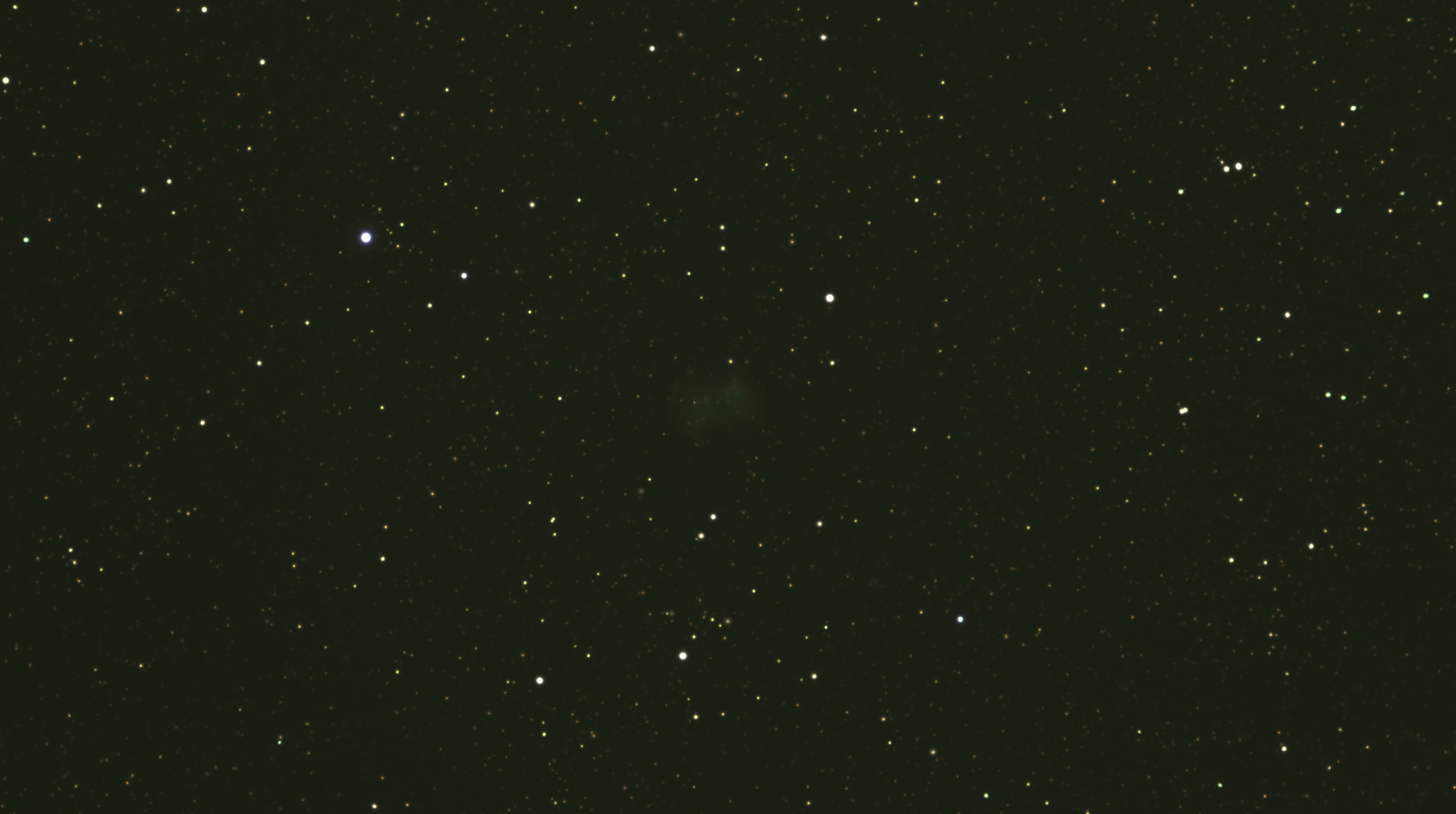
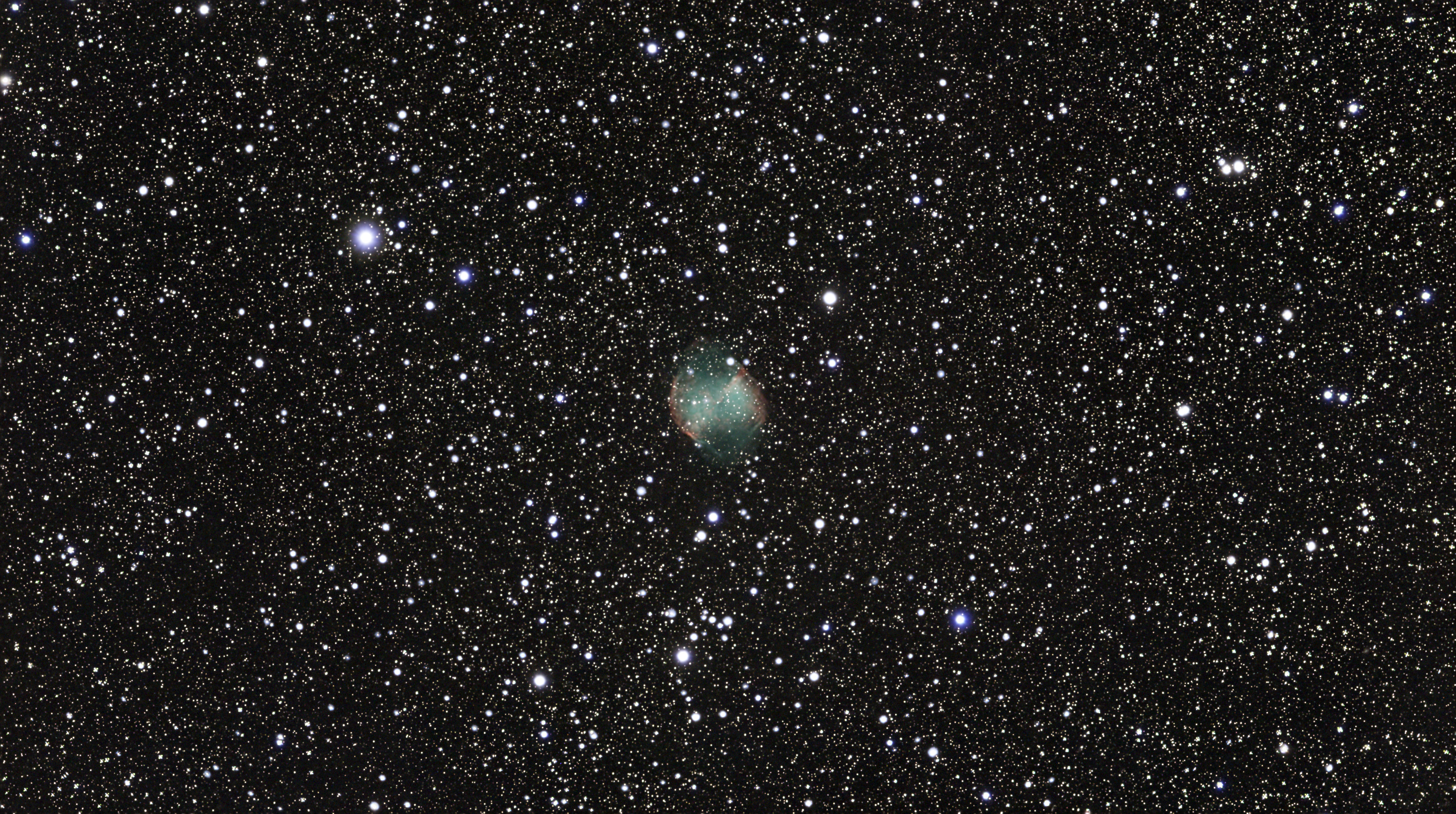
Licence: for personal use, credit Damon Scotting. Both JPEGs 3,718 x 2,078 px.
+17 C sensor temperature during imaging
419 mm focal length, plate solved SVBONY states 420 mm
1.52 x 0.86° field of view 3,840 x 2,160 px on ASI585MC
8.3 MP ASI585MC 3,840 x 2,160 px, 11.1 x 6.3 mm
Should you buy it?
64/100 Stars for Your Buck
Pros
- The dual-speed focuser has a golden dial that fine-tunes the focus very slowly, so I can really get those pinpoint stars.
- It is small and light: 318 mm long with the dew shield retracted, and 2.22 kg by SVBONY's figure.
- At 420 mm the entire Pleiades cluster fits perfectly within the frame of a DSLR, and so does Andromeda with both of its companions.
- The telescope and camera did a surprisingly good job on the Dumbbell Nebula in 68 one-minute exposures.
- “On Andromeda it just pips the Celestron 63ED for detail.”
Cons
- Chromatic aberration puts thick blue-magenta rings around many stars, so the star colour needs work in processing.
- The stars come out large in every image, so deconvolution goes a long way to making them look sharper.
- There is no flattener in the tube: for a large sensor SVBONY suggests its SV193 reducer-flattener, an extra purchase.
- SVBONY has replaced it: svbony.com now sends you to the SV503 70 flat-field, a 474 mm f/6.78 design, so the original f/6 is only sold where retailers still have stock.
Overall, very impressive telescope, and I'm going to carry on monitoring SVBONY's products going forward because they are relatively new to the game.
Who the SV503 70ED is for
Beginner on a small budget
Buy
For a first imaging refractor on a small budget, my recommendation is the SV503, as long as you are happy to tidy the star colour in processing.
DSLR owner with a star tracker
Buy
With a Canon EOS adapter on the focuser, a DSLR on a small star tracker frames the whole Orion Nebula.
Owner of a small-sensor astro camera
Buy
On an IMX585 camera it frames 1.5 x 0.86 degrees at 1.43 arcsec per pixel, room enough for the Dumbbell, M13 and the Western Veil.
Imager who wants colour-pure stars
Skip
My recommendation is the Askar 71F: about twice the price, and it blows the SV503 out of the water.
Full-frame camera owner
Skip
SVBONY designed this f/6 for small sensors, so a full-frame camera is the wrong partner for it.
Owner of an 80 mm ED doublet
Skip
Moving from a scope like the Askar 80ED gains nothing: the SV503 is 10 mm smaller and shorter in focal length.
Three alternatives I have reviewed
- Askar 71F 71 mm f/6.9, quadruplet air-spaced APO, one ED element, self-flattening 81/100 £599 Read the review
- Askar 80ED 80 mm f/7, doublet refractor, one ED element and one standard glass 77/100 £379 Read the review
- Askar 60F 60 mm f/6.8, quadruplet air-spaced APO, one ED element, self-flattening 87/100 £498 Read the review
Questions and more about this review
Reviewed by
Damon Scotting
The Telescope Man Verified
BSc (Hons) Physics with Astrophysics and Cosmology, Loughborough University PGCE / QTS, University of Nottingham
About Damon About Damon Damon Scotting is The Telescope Man. He holds a BSc (Hons) in Physics with Astrophysics and Cosmology from Loughborough University and a PGCE with QTS from the University of Nottingham, and taught physics in secondary schools before becoming an astronomy creator. He is a contributing writer for BBC Sky at Night Magazine and the author of 42 Wonders of Our Night Sky, and his photograph of the galaxy M100 with the dwarf planet Ceres was Highly Commended in the Astronomy Photographer of the Year 2024 competition run by Royal Observatory Greenwich. He has appeared on the BBC's Blue Peter. More than 750,000 people follow his astronomy channels on YouTube, Instagram and TikTok, and he has reviewed more than 140 telescopes, mounts, cameras, filters and accessories hands-on for this site. More about Damon · How I test · Damon's book
I review all kinds of gear: most of it I buy, some is gifted and some is loaned, and all of it is reviewed the same way. How this site is funded
Eight questions, answered
Questions about the SVBONY SV503 70ED
Reviewed 27 July 2023 ·Updated 23 September 2026
I review all kinds of gear. Most of it I buy, some is gifted and some is loaned, and all of it is reviewed the same way: no company sees or approves a review before it is published. Shop links marked Ad are affiliate links: I earn a commission when you buy through them, at no extra cost to you. How this site is funded
- Which SV503 did I review, the 70ED or the 80ED? The 70 mm f/6 SV503 70ED, SKU F9359A, with a 420 mm focal length: the smallest model of the SVBONY range when I reviewed it. The plate solves of my stacks put the focal length at 419 mm. Tested numbers and the download ↓
- Is the SVBONY SV503 70ED still sold? SVBONY has replaced it: svbony.com now sells the SV503 70 flat-field, a 474 mm f/6.78 design with a two-element corrector in the tube, at $525. The original f/6 is still in stock at World of Telescopes in the UK at £380. The verdict, the readers and the sellers ↓
- Does the SV503 70ED show chromatic aberration? You've probably already noticed how many of these stars have thick blue-magenta rings on the outside of them. This is due to chromatic aberration, and it's a running theme throughout the images captured with this telescope, and although I find it to be a fairly big issue, it's something that can be simply resolved in post-processing. The Celestron 63ED showed none on my Pleiades image. From my video review The raw stacks against the finished images ↓
- Does the SV503 70ED need a field flattener? SVBONY pairs the f/6 with 1/2 or 1/3 inch sensors and suggests its SV193 reducer-flattener for a large chip, with the stacked edges cropped. On the IMX585 sensor behind every stack on this page (11.1 x 6.3 mm) the corner stars came out only slightly larger than the centre ones: a flux-weighted radius of 3.7 px against 3.6 px on M27, and 3.7 px against 3.4 px on the Western Veil, with axis ratios of 1.14 to 1.15 against 1.11. The raw stacks against the finished images ↓
- How does the SV503 70ED compare with the Celestron 63ED? The 63ED gives the cleaner star colour, while the SV503's extra 6.5 mm of aperture shows a little more detail on Andromeda; the two frames sit side by side in the Versus section. Versus the Celestron 63ED ↓
- How heavy is the SV503 70ED, and what mount does it need? SVBONY states 2.22 kg for the tube, light enough for a star tracker: my DSLR images were taken with it on a Sky-Watcher Star Adventurer 2i, and my astro-camera stacks on a ZWO AM5. The rig on the mount ↓
- How much does the SV503 70ED cost? World of Telescopes lists the original f/6 at £380 in the UK; Camera Concepts & Telescope Solutions has it in the US at $409, on backorder; SVBONY's own store now sells only the newer flat-field version at $525. Earlier prices: £318 on SVBONY's own site when I made my review in 2023, and about £279 in the UK in November 2024. The verdict, the readers and the sellers ↓
- What have I not tested on the SV503 70ED? I did not use it visually at an eyepiece, did not try SVBONY's SV193 reducer-flattener or a full-frame camera on it, and did not weigh the tube myself.