ZWO ASI2600MC Air review: APS-C colour with ASIAIR built in
Where does it rank on our leaderboard
| Rank | Camera | Stars for Your Buck | Recorded UK price |
|---|---|---|---|
| 1 | SVBONY SV705C | 93 out of 100 | £229 |
| 2 | SVBONY SC571CC | 90 out of 100 | £1,029 |
| 3 | ZWO ASI585MC Air | 89 out of 100 | £799 |
| 4 | ZWO ASI2600MC Air | 88 out of 100 | £2,149 |
| 12 | ZWO ASI533MC | 77 out of 100 | £859 |
| 21 | ZWO ASI2600MC | 72 out of 100 | £1,599 |
| 23 | ZWO ASI220MM | 67 out of 100 | £299 |
| 28 | ZWO ASI183MC | 38 out of 100 | £549 |
| 29 | Nikon COOLPIX P1000 | 32 out of 100 | £787 |
Contents
- 01 Where does it rank on our leaderboard
- 02 Specifications and features
- 03 The rig on the mount
- 04 How good is it? Here is what it captured
- 05 Raw against finished
- 06 Tested numbers and the download
- 07 Should you buy it?
- 08 Questions and more about this review
In 30 seconds
Stars for Your Buck 88/100
Reviewed 5 Feb 2025 Updated 24 Sep 2026
- Rank
- #4 of 29 cameras
- Verdict
- Damon's pick
Written by Damon Scotting 5 min read
Buy it if
- You want the camera, the guide camera and the ASIAIR controller in one body, with no separate box to mount and cable.
- You run a ZWO AM mount and want power to be the only cable into the camera.
- You want a 26 MP APS-C colour sensor that covers the field of most small refractors.
Skip it if
- You want the IMX571 sensor for the least money: the SVBONY SC571CC costs under half as much.
- You already own an ASIAIR or a laptop: the ASI2600MC Duo has the same sensor and a guide sensor for less.
- You image mostly in narrowband and want mono: the ASI2600MM Air is the same camera in mono.
“I love this camera. It has made astrophotography far more streamlined for me, and I cannot speak highly enough of it.”
Specifications and features
Against the cameras I have reviewed
Compare with
| ZWO ASI2600MC Air reviewed #4 of 29 | ZWO ASI2600MC Duo #8 of 29 | SVBONY SC571CC #2 of 29 | ToupTek ATR2600C #10 of 29 | ZWO ASI2600MC #21 of 29 | ZWO ASI2600MM Air #7 of 29 | |
|---|---|---|---|---|---|---|
| Recorded UK price | £2,149 | £1,849 | £1,029 | £1,127 | £1,599 | £2,499 |
| Stars for Your Buck | 88/100 | 83/100 | 90/100 | 80/100 | 72/100 | 84/100 |
| Sensor | Sony IMX571 | Sony IMX571 with an SC2210 guide sensor | Sony IMX571 | Sony IMX571 | Sony IMX571 | Sony IMX571 |
| Format | APS-C, 23.5 x 15.7 mm | APS-C, 23.5 x 15.7 mm | APS-C, 23.5 x 15.7 mm | APS-C, 28.3 mm diagonal | APS-C, 23.5 x 15.7 mm | APS-C, 23.5 x 15.7 mm |
| Colour or mono | Colour | Colour | Colour | Colour | Colour | Mono |
| Resolution | 6248 x 4176, 26 MP | 6248 x 4176, 26 MP | 6224 x 4168, 26 MP | 6224 x 4168, 26 MP | 6248 x 4176, 26 MP | 6248 x 4176, 26 MP |
| Pixel size | 3.76 um | 3.76 um | 3.76 um | 3.76 um | 3.76 um | 3.76 um |
| Cooling | 30 to 35 C below ambient | Two-stage TEC, 30 to 35 C below ambient | Dual-stage TEC, about 35 C below ambient | Up to 42 C below ambient | Two-stage TEC, 30 to 35 C below ambient | 30 to 35 C below ambient |
| Read noise | 0.9 to 4.2 e- | 0.9 to 4.2 e- | 1.14 to 2.6 e- | as low as 0.883 e- | 1.0 to 3.3 e- | 0.9 to 4.2 e- |
| Full well | 50 ke- (73 ke- in extended mode) | 50 ke- | Approximately 16,000 electrons at the lowest plotted HCG gain (0 dB); graph-derived, not an all-mode maximum | 51 ke- | 73 ke- | 50 ke- |
| ADC | 16-bit | 16-bit | 16-bit | 16-bit | 16-bit | 16-bit |
| Weight | 775 g | 700 g | 557 g | 577 g | 700 g | 775 g |
| Back focus | 12.5 or 17.5 mm | 17.5 mm | 17.5 mm | 17.5 mm | 17.5 mm | 12.5 or 17.5 mm |
| Interface | Wi-Fi 5 and Bluetooth; USB-C output, four USB 2.0 ports, three 12 V DC ports, any one of them the power input | USB 3.0 for imaging, USB 2.0 for guiding | USB-C | USB 3.0, two-port USB 2.0 hub, 512 MB DDR3 buffer | USB 3.0 | Wi-Fi 5 and Bluetooth; USB-C output, four USB 2.0 ports, three 12 V DC ports, any one of them the power input |
| In the box | Camera, external antenna, two 1 m DC power cords, 1.5 m DC extension, two 0.5 m USB 2.0 cables, 16.5 mm and 21 mm M54 spacers, M48 to M54 ring, cable strap, hex wrench, quick start guide, soft bag | Camera, soft padded case, 2 m USB 3.0 cable, two 0.5 m USB 2.0 cables, 16.5 mm and 21 mm M54 extenders, M54 to M48 ring, hex key, quick start guide | The camera, three adapter rings (M42 to M42, M48 to M42, M42 to M48), a dust cap, a USB cable, a 12 V 3 A power supply, desiccant, a manual and a cleaning cloth | Camera with its 2 inch adapter, 12 V 3.3 A power adapter and cable, 1.5 m USB 3.0 cable, M48 to M42 adapter, 16.5 mm and 21 mm extenders, 12.5 mm M42 adapter, cover | The camera, a cover, M42-M48 16.5 mm and M42 21 mm extenders, an M42M-M48F adapter, a hex key, two 0.5 m USB 2.0 cables, a 2 m USB 3.0 cable, a quick guide and a camera bag | Camera, two 1 m DC power cords, 1.5 m DC extension, two 0.5 m USB 2.0 cables, 16.5 mm and 21 mm M54 spacers, M48 to M54 ring, cable strap, hex wrench, quick start guide |
The rig on the mount
On the TeSeek 11, then on six other mounts
How good is it? Here is what it captured
One target
North America and Pelican Nebulae (NGC 7000 and IC 5070), ASI2600MC Air
- Integration
- 2 h (40 x 180 s)
- Field
- 7.08 x 4.73 degrees
- Telescope
- Askar 50P
- Camera
- ZWO ASI2600MC Air
- Mount
- Unknown
- Target
- North America and Pelican Nebulae (NGC 7000 and IC 5070)
- Type
- Emission nebula
- Location
- Bortle 6.8 (in my garden)
Raw against finished
Tested numbers and the download
The 1 target, the raw combined stack against my finished image, each with its integration, the camera and the palette:
- North America and Pelican Nebulae (NGC 7000 and IC 5070): 2 h (40 x 180 s) of light, ASI2600MC Air, the raw combined stack with one automatic stretch
Finished image
- Download the raw stack JPEG · 2.6 MB · 4,096 x 2,620
- Download the finished image JPEG · 3.1 MB · 4,096 x 2,620
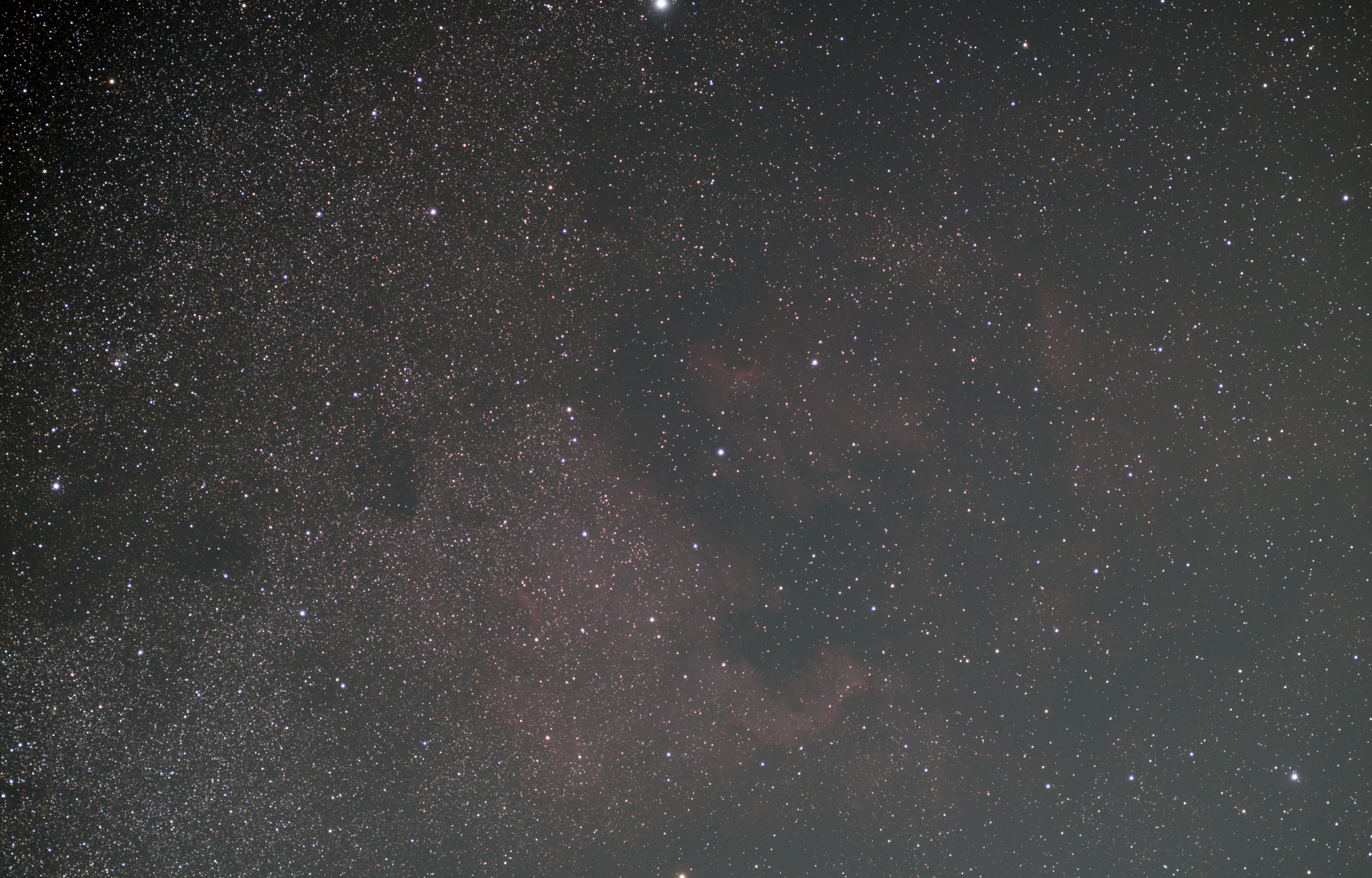
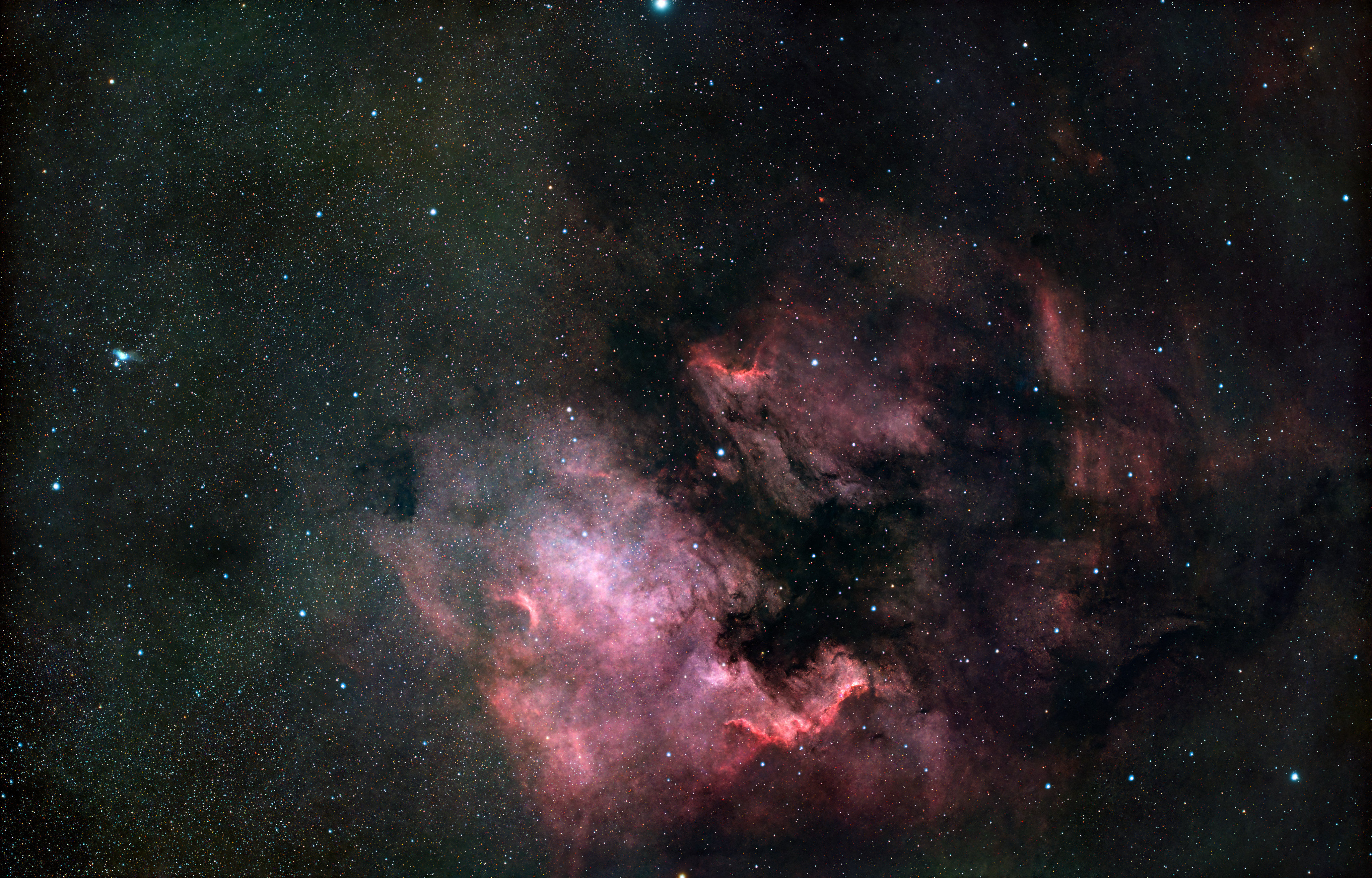
Licence: for personal use, credit Damon Scotting. Both JPEGs 4,096 x 2,620 px.
-10 C sensor set point the set point I run every cooled camera at
190 mm focal length, plate solved stated 190 mm, on the Askar 50P
7.08 x 4.73° field of view 6,248 x 4,176 px on ASI2600MC Air
26 MP ASI2600MC Air 6,248 x 4,176 px, 23.5 x 15.7 mm
Should you buy it?
88/100 Stars for Your Buck
Pros
- It is cheaper than buying the components separately and putting them together, and far less messy.
- Paired with one of my ZWO AM mounts it connects over Bluetooth, so the only cable into the camera is the power cable.
- The IMX571 is the most popular big sensor on the market: it works with the vast majority of telescopes and takes some really special images.
- The ASIAIR inside has 256 GB of storage and live stacking, controlled from a phone over Wi-Fi.
Cons
- At £2,149 it costs £300 more than the ASI2600MC Duo and more than twice the £1,029 of the SVBONY SC571CC, with the same IMX571 sensor in all three.
- At 775 g it is heavier than the 700 g ASI2600MC Pro and ASI2600MC Duo.
- Its control runs through ZWO's ASIAIR app; other software reaches it through ASCOM Alpaca.
You can do a lot worse than this camera, which is why I have given it such a high rating.
Who the ASI2600MC Air is for
ASIAIR imager building a colour rig
Buy
It puts the imaging sensor, the guide sensor and the ASIAIR in one body, so there is no separate controller or guide camera to mount, power and cable.
ZWO AM mount owner
Buy
It pairs with the AM mounts over Bluetooth, so power is the only cable into the camera.
Small refractor owner
Buy
On a 190 mm astrograph the APS-C sensor frames the whole North America and Pelican region in one shot.
Budget-first buyer
Skip
My recommendation is the SVBONY SC571CC: the same IMX571 colour sensor for under half the price, with a separate guide camera and controller.
Laptop or ASIAIR owner
Skip
My recommendation is the ASI2600MC Duo: the same sensor with a built-in guide sensor over USB, for £300 less.
Narrowband imager
Skip
My recommendation is the ASI2600MM Air: the same body and ASIAIR in mono, for a filter wheel and narrowband filters.
Three alternatives I have reviewed
- ZWO ASI2600MC Duo The same IMX571 sensor and a built-in guide sensor, run over USB 83/100 £1,849 Read the review
- SVBONY SC571CC The same IMX571 colour sensor in a plain cooled body 90/100 £1,029 Read the review
- ZWO ASI585MC Air A smaller IMX585 sensor with the same ASIAIR and guider inside 89/100 £799 Read the review
Questions and more about this review
Reviewed by
Damon Scotting
The Telescope Man Verified
BSc (Hons) Physics with Astrophysics and Cosmology, Loughborough University PGCE / QTS, University of Nottingham
About Damon About Damon Damon Scotting is The Telescope Man. He holds a BSc (Hons) in Physics with Astrophysics and Cosmology from Loughborough University and a PGCE with QTS from the University of Nottingham, and taught physics in secondary schools before becoming an astronomy creator. He is a contributing writer for BBC Sky at Night Magazine and the author of 42 Wonders of Our Night Sky, and his photograph of the galaxy M100 with the dwarf planet Ceres was Highly Commended in the Astronomy Photographer of the Year 2024 competition run by Royal Observatory Greenwich. He has appeared on the BBC's Blue Peter. More than 750,000 people follow his astronomy channels on YouTube, Instagram and TikTok, and he has reviewed more than 140 telescopes, mounts, cameras, filters and accessories hands-on for this site. More about Damon · How I test · Damon's book
I review all kinds of gear: most of it I buy, some is gifted and some is loaned, and all of it is reviewed the same way. How this site is funded
Seven questions, answered
Questions about the ZWO ASI2600MC Air
Reviewed 5 February 2025 ·Updated 24 September 2026
I review all kinds of gear. Most of it I buy, some is gifted and some is loaned, and all of it is reviewed the same way: no company sees or approves a review before it is published. Shop links marked Ad are affiliate links: I earn a commission when you buy through them, at no extra cost to you. How this site is funded
- Is the ZWO ASI2600MC Air worth it? Yes, if you want the camera, guiding and control in one body. I think you can do a lot worse than this camera, which is why I've given it such a high rating. What I captured ↓
- Do I need a separate guide camera or an ASIAIR with it? No. The ASI2600MC Air has an SC2210 guide sensor and an ASIAIR inside, so it needs no separate guide camera or controller. The specifications and the comparison table ↓
- ASI2600MC Air or ASI2600MC Duo? Both have the IMX571 sensor and a built-in guide sensor. The Duo runs over USB from an ASIAIR or a computer and costs £1,849 at First Light Optics; the Air adds the ASIAIR, Wi-Fi, Bluetooth and 256 GB of storage for £2,149. The specifications and the comparison table ↓
- ASI2600MC Air or SVBONY SC571CC? The sensor is the same Sony IMX571. The SC571CC costs £1,029 and needs its own guide camera and controller; the Air builds both in. The specifications and the comparison table ↓
- What field of view does it give? On the Askar 50P my stack plate-solves at 190 mm, a field of 7.08 x 4.73 degrees. Tested numbers and the download ↓
- What mount does it need? The camera weighs 775 g. With my 1.4 kg Askar 50P and 1 kg of accessories the rig is 3.2 kg, inside the 5 kg a TeSeek 11 carries without a counterweight. The rig on the mount ↓
- What have I not tested on the ASI2600MC Air? I have not measured its read noise, dark current or cooling time, used it on the planets or run it from third-party software.