ZWO ASI2600MM Pro review: APS-C mono for narrowband
Where does it rank on our leaderboard
| Rank | Camera | Stars for Your Buck | Recorded UK price |
|---|---|---|---|
| 1 | SVBONY SV705C | 93 out of 100 | £229 |
| 2 | SVBONY SC571CC | 90 out of 100 | £1,029 |
| 5 | ToupTek SkyEye 24AC | 85 out of 100 | £1,804 |
| 11 | Player One Saturn-C | 78 out of 100 | £514 |
| 15 | Player One Uranus-C | 76 out of 100 | £395 |
| 23 | ZWO ASI220MM | 67 out of 100 | £299 |
| 25 | ZWO ASI2600MM | 62 out of 100 | £2,059 |
| 28 | ZWO ASI183MC | 38 out of 100 | £549 |
| 29 | Nikon COOLPIX P1000 | 32 out of 100 | £787 |
Contents
- 01 Where does it rank on our leaderboard
- 02 Specifications and features
- 03 In the hand
- 04 The rig on the mount
- 05 How good is it? Here is what it captured
- 06 Raw against finished
- 07 What is it for
- 08 Watch the review
- 09 Tested numbers and the download
- 10 Should you buy it?
- 11 Questions and more about this review
In 30 seconds
Stars for Your Buck 62/100
Reviewed 19 May 2026 Updated 24 Sep 2026
- Rank
- #25 of 29 cameras
- Verdict
- Worth a look
Written by Damon Scotting 6 min read
Buy it if
- You want a big mono sensor for narrowband from a light-polluted garden.
- You have a 400 to 600 mm astrograph with an image circle that covers APS-C.
- You already own or will buy 36 mm or 2 inch filters and a wheel.
Skip it if
- Your filters are 1.25 inch: they vignette and halo on this sensor.
- You want colour from a single exposure.
- You want guiding and Wi-Fi built into the camera.
The ZWO ASI2600MM Pro is a cooled 26 MP APS-C mono camera. Behind my Askar SQA106 it turned an hour and a half of narrowband into the North America and Elephant's Trunk nebulae.
Specifications and features
Against the cameras I have reviewed
Compare with
| ZWO ASI2600MM reviewed #25 of 29 | ZWO ASI2600MM Air #7 of 29 | ToupTek ATR2600MM #19 of 29 | ZWO ASI2600MC #21 of 29 | SVBONY SC571CC #2 of 29 | ZWO ASI2600MC Air #4 of 29 | |
|---|---|---|---|---|---|---|
| Recorded UK price | £2,059 | £2,499 | £1,488 | £1,599 | £1,029 | £2,149 |
| Stars for Your Buck | 62/100 | 84/100 | 73/100 | 72/100 | 90/100 | 88/100 |
| Sensor | Sony IMX571, back illuminated | Sony IMX571 | Sony IMX571 | Sony IMX571 | Sony IMX571, APS-C | Sony IMX571 |
| Format | APS-C, 23.5 x 15.7 mm, 28.3 mm diagonal | APS-C, 23.5 x 15.7 mm | APS-C, 23.5 x 15.7 mm | APS-C, 23.5 x 15.7 mm | APS-C | APS-C, 23.5 x 15.7 mm |
| Colour or mono | Mono | Mono | Mono | Colour | Colour | Colour |
| Resolution | 6248 x 4176, 26.1 MP | 6248 x 4176, 26 MP | 6224 x 4168, 25.9 MP | 6248 x 4176, 26.1 MP | 6224 x 4168, 25.9 MP | 6248 x 4176, 26 MP |
| Pixel size | 3.76 µm | 3.76 µm | 3.76 µm | 3.76 µm | 3.76 µm | 3.76 µm |
| Cooling | Two-stage TEC, 30 to 35 C below ambient | 30 to 35 C below ambient | Two-stage TEC, up to 42 C below ambient | Two-stage TEC, 30 to 35 C below ambient | Two-stage TEC, about 35 C below ambient | 30 to 35 C below ambient |
| Read noise | 1.0 to 3.3 e- | 0.9 to 4.2 e- | as low as 0.883 e- | 1.0 to 3.3 e- | 1.14 to 2.6 e- | 0.9 to 4.2 e- |
| Full well | 73 ke- | 50 ke- | 51 ke- | 73 ke- | Approximately 16,000 electrons at the lowest plotted HCG gain (0 dB); graph-derived, not an all-mode maximum | 50 ke- |
| ADC | 16-bit | 16-bit | 16-bit | 16-bit | 16-bit | 16-bit |
| Weight | 700 g | 775 g | 577 g | 700 g | 557 g | 775 g |
| Back focus | 17.5 mm | 12.5 or 17.5 mm | 17.5 mm with the M42 adapter | 17.5 mm | 17.5 mm | 12.5 or 17.5 mm |
| Interface | USB 3.0, M42 thread | Wi-Fi 5 and Bluetooth; USB-C output, four USB 2.0 ports, three 12 V DC ports, any one of them the power input | USB 3.0, two USB 2.0 hub ports, 512 MB DDR3 buffer | USB 3.0 | USB 3.0 Type-C, DC 12 V | Wi-Fi 5 and Bluetooth; USB-C output, four USB 2.0 ports, three 12 V DC ports, any one of them the power input |
| In the box | Camera, lens cover, T2-M48 16.5 mm extender, T2 21 mm extender, M42-M48 adapter ring, two USB 2.0 cables, USB 3.0 cable, padded bag, hex wrench, quick start guide | Camera, two 1 m DC power cords, 1.5 m DC extension, two 0.5 m USB 2.0 cables, 16.5 mm and 21 mm M54 spacers, M48 to M54 ring, cable strap, hex wrench, quick start guide | The camera, a 12 V 3.3 A power adapter and cable, a 1.5 m USB 3.0 cable, M48-M42 0 mm, 16.5 mm and 21 mm extenders, a 12.5 mm M42 adapter and a cover | The camera, a cover, M42-M48 16.5 mm and M42 21 mm extenders, an M42M-M48F adapter, a hex key, two 0.5 m USB 2.0 cables, a 2 m USB 3.0 cable, a quick guide and a camera bag | The camera, three adapter rings (M42 to M42, M48 to M42, M42 to M48), a dust cap, a USB cable, a 12 V 3 A power supply, desiccant, a manual and a cleaning cloth | Camera, external antenna, two 1 m DC power cords, 1.5 m DC extension, two 0.5 m USB 2.0 cables, 16.5 mm and 21 mm M54 spacers, M48 to M54 ring, cable strap, hex wrench, quick start guide, soft bag |
In the hand
Behind a filter wheel on the Askar SQA106
The camera end of the rig
Set up for a night of narrowband
The rig on the ZWO AM3N
The rig on the mount
On the JUWEI-17, then on six other mounts
How good is it? Here is what it captured
Five targets
IC 1396, ASI2600MM Pro, Ha, SII, OIII
- Integration
- 1 h 30 min (30 x 180 s)
- Field
- 2.67 x 1.78 degrees
- Telescope
- Askar SQA106
- Camera
- ZWO ASI2600MM Pro
- Mount
- ZWO AM3N
- Target
- IC 1396 Elephant's Trunk Nebula
- Type
- Emission nebula
- Location
- Bortle 6.8 (in my garden)
NGC 7000, ASI2600MM Pro, Ha, SII, OIII
- Integration
- 1 h 30 min (30 x 180 s)
- Field
- 2.67 x 1.78 degrees
- Telescope
- Askar SQA106
- Camera
- ZWO ASI2600MM Pro
- Mount
- ZWO AM3N
- Target
- NGC 7000 North America Nebula
- Type
- Emission nebula
- Location
- Bortle 6.8 (in my garden)
M 27, ASI2600MM Pro, Ha, SII, OIII
- Integration
- 45 min (15 x 180 s)
- Field
- 2.67 x 1.78 degrees
- Telescope
- Askar SQA106
- Camera
- ZWO ASI2600MM Pro
- Mount
- ZWO AM3N
- Target
- M 27 Dumbbell Nebula
- Type
- Planetary nebula
- Location
- Bortle 6.8 (in my garden)
IC 434, ASI2600MM Pro, SII, Ha, OIII
- Integration
- 1 h 9 min (23 x 180 s)
- Field
- 0.66 x 0.45 degrees
- Telescope
- Celestron C11 EdgeHD with the 0.7x reducer
- Camera
- ZWO ASI2600MM Pro
- Mount
- Unknown
- Target
- IC 434 Horsehead Nebula
- Type
- Dark nebula
- Location
- Bortle 6.8 (in my garden)
M 1, ASI2600MM Pro, LRGB
- Integration
- 4 h 9 min (83 subs)
- Field
- 0.43 x 0.28 degrees
- Telescope
- Celestron C11 EdgeHD with the 0.7x reducer
- Camera
- ZWO ASI2600MM Pro
- Mount
- Unknown
- Target
- M 1 Crab Nebula
- Type
- Supernova remnant
- Location
- Bortle 6.8 (in my garden)
Raw against finished
What is it for
The 4 targets, the raw combined stack against my finished image, each with its integration, the camera and the palette:
- IC 1396 Elephant's Trunk Nebula: 1 h 30 min (30 x 180 s) of light, ASI2600MM Pro, Ha, SII, OIII (Laida 5 nm, 1.25 inch), the raw combined stack with one automatic stretch
- NGC 7000 North America Nebula: 1 h 30 min (30 x 180 s) of light, ASI2600MM Pro, Ha, SII, OIII (Laida 5 nm, 1.25 inch), the raw combined stack with one automatic stretch
- M 27 Dumbbell Nebula: 45 min (15 x 180 s) of light, ASI2600MM Pro, Ha, SII, OIII (Laida 5 nm, 1.25 inch), the raw combined stack with one automatic stretch
- IC 434 Horsehead Nebula: 1 h 9 min (23 x 180 s) of light, ASI2600MM Pro, SII, Ha, OIII, the raw combined stack with one automatic stretch
Three things it is for
Narrowband through the moonlight
There is a secret to success when it comes to astrophotography during a full moon, and that involves using narrowband filters. Narrowband imaging works exceptionally well during a full moon because it captures only very specific wavelengths like hydrogen alpha, sulphur II and oxygen III, blocking most of the broadband moonlight and sky glow that would otherwise wash out the image.
The Dumbbell's outer wings
Those of you who have shot the Dumbbell Nebula before in colour will know that you can't quite capture its outward-stretching wings of nebulosity. It's so much easier to do when imaging in narrowband.
Black and white, then colour
By themselves, the camera and telescope cannot produce images this vibrant. They will strictly be black and white. So the fact that you can go from black and white to vibrant works of art like this is very impressive.
Watch the review
I Bought £58 Astrophotography Filters, Here's What Happened · published 19 May 2026 · 7:48 · Watch on YouTube · 3,373 views, 208 likes on 2 Oct 2026
Jump to
- 0:21 Tonight's rig, SQA106 + ASI2600MM
- 0:46 North America Nebula raw stack
- 1:11 The elephant in the room, star halos
- 1:31 Fixing halos with StarXTerminator
- 2:08 Final North America Nebula reveal
- 2:41 Elephant Trunk Nebula raw stack
- 3:25 Cropping and finishing the Elephant Trunk
- 5:23 Dumbbell Nebula, my favourite shot
- 6:04 Why bargain filters matter
Transcript of the review video 716 words · 7 chapters · searchable
Press a time stamp to play from there.
0:21 Tonight's rig, SQA106 + ASI2600MM
0:21 Okay, so here's my rig for tonight. 0:23 Spoiler alert, it's an absolute beast. 0:26 As far as backyard setups go, this is amongst the very best. 0:28 We have an Askar SQA106 partnered with an ASI2600MM. 0:33 Together they are capable of producing some incredibly beautiful shots. 0:37 But the last remaining important factor is of course the quality of the filters used. 0:42 So let's see how these £58 filters fare against the North American Nebula.
0:46 North America Nebula raw stack
0:46 Here is the raw stacked 1 hour 30 minute image. 0:49 This combines 10 x 3 minute stacks of images captured with each of the hydrogen alpha sulphur II and oxygen III filters. 0:57 I also captured 20 flats, stacked them, and applied them to this image, leading to the corners looking at first glance, at the very least, pretty good. 1:05 Applying NoiseXTerminator and BlurXTerminator to the image leads to the nebulosity and stars looking sharper and cleaner.
1:11 The elephant in the room, star halos
1:11 But let's be honest, there is one hell of an elephant in this room. 1:16 It's practically a dealbreaker for most astrophotographers, and that is the star haloing. 1:20 Sheesh, look at that. 1:20 It's even off centreed. 1:23 You can make arguments that a lot of the issues with the images captured with these filters are simply due to the larger than allowed camera sensor being used. 1:30 But hey, that's nothing we can't fix.
1:31 Fixing halos with StarXTerminator
1:32 We reduce the vignetting by taking flats. 1:33 And now we're going to remove the star haloing by separating the stars and the nebula with the StarXTerminator tool in PixInsight. 1:41 Please be advised that that tool alone costs more than the filter set does. 1:45 But with the two separated, I actually now just fix the halo with the blemish tool and you wouldn't even know it was there. 1:51 This is what you'd call a cosmetic level edit. 1:53 It doesn't detract from how the deep sky object really looks. 1:57 So, generally, it's okay. 1:57 No one's going to throw you into astrophotography jail for it. 2:00 Then, we blend the two together, have a play around with the levels and colours, and voila, the North America Nebula. 2:06 Wow, can you believe I captured this with nothing more than a set of £58 filters?
2:08 Final North America Nebula reveal
2:15 I should make a third tier to this meme where I include an enormous amount of fat and add PixInsight, Photoshop, BlurXTerminator, NoiseXTerminator, and StarXTerminator. 2:20 I think it's nice. 2:23 The colours are decent. 2:23 The nebulosity is very sharp and clear. 2:27 Yeah, seriously, if you compare this image with the one that I captured with the £800 ZWO filter set beneath some of the best guys in the world on the edge of a volcano, then you certainly wouldn't think that these were less than 10% the cost of those filters. 2:38 Anyway, same again. 2:40 1 hour 30 minutes worth of stacked images leading to this raw image of the elephant trunk nebula.
2:41 Elephant Trunk Nebula raw stack
2:44 I think the vignetting is becoming a bit more apparent here in this image. 2:48 Also, no idea where that is here. 2:50 Maybe a light leak. 2:52 Perhaps someone in the comments can highlight what this discrepancy likely is. 2:55 I've applied the same level of NoiseXTerminator and BlurXTerminator here, and I'm certain the effects appear minuscule when viewed via this video, but nevertheless, they improve the sharpness and clarity of the shot. 3:04 You can really see the effects of the vignetting now that I've isolated the nebulosity from the stars. 3:10 I think I am going to fix this disco light in the top lefthand corner and hopefully it won't affect the final image too much. 3:15 Fortunately, there's no issues in a star image. 3:17 All right, what do we think of that? 3:19 I think it will look significantly better if I crop the edges a little bit and rotate it to be portrait. 3:25 Yeah. 3:25 So, how's that?
3:25 Cropping and finishing the Elephant Trunk
3:27 Is it worthy of being in an art exhibit? 3:29 Yeah, maybe not. 3:29 By themselves, the camera and telescope cannot produce images this vibrant. 3:33 they would strictly be black and white. 3:35 The nebulosity would also not be isolated anywhere near as well as it is being done here. 3:40 So, the fact that you can go from black and white to vibrant works of art like this for as little as £58 is very impressive. 3:49 I decided to Google and see how much the cheapest set of narrowband filters are on the market right now.
Check out more videos on the ZWO ASI2600MM
£58 vs £1369 Filters, Can You Tell the Difference?
18 May 2026
Tested numbers and the download
Finished image
- Download the raw stack JPEG · 3.9 MB · 4,096 x 2,733
- Download the finished image JPEG · 3.1 MB · 4,096 x 2,733
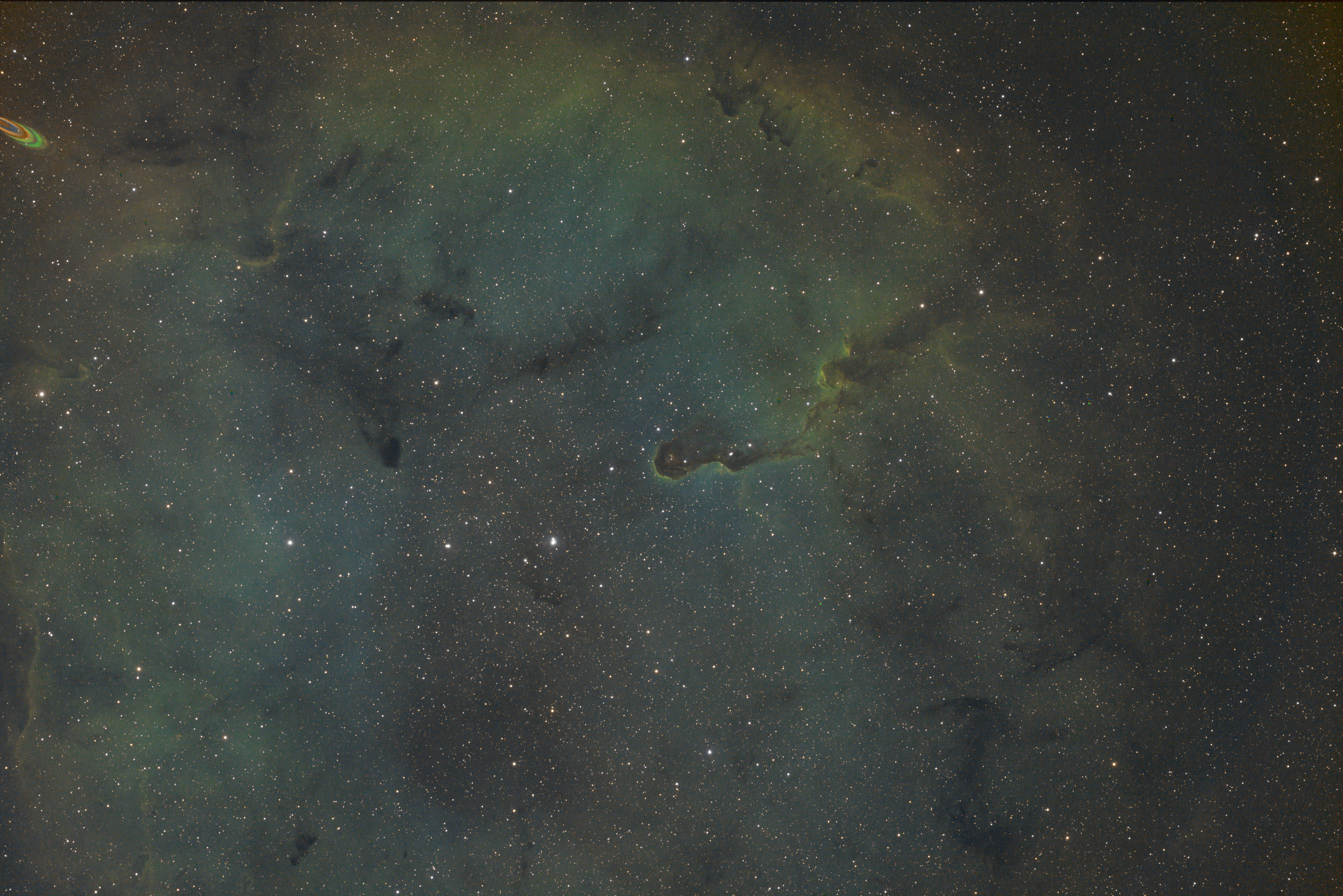
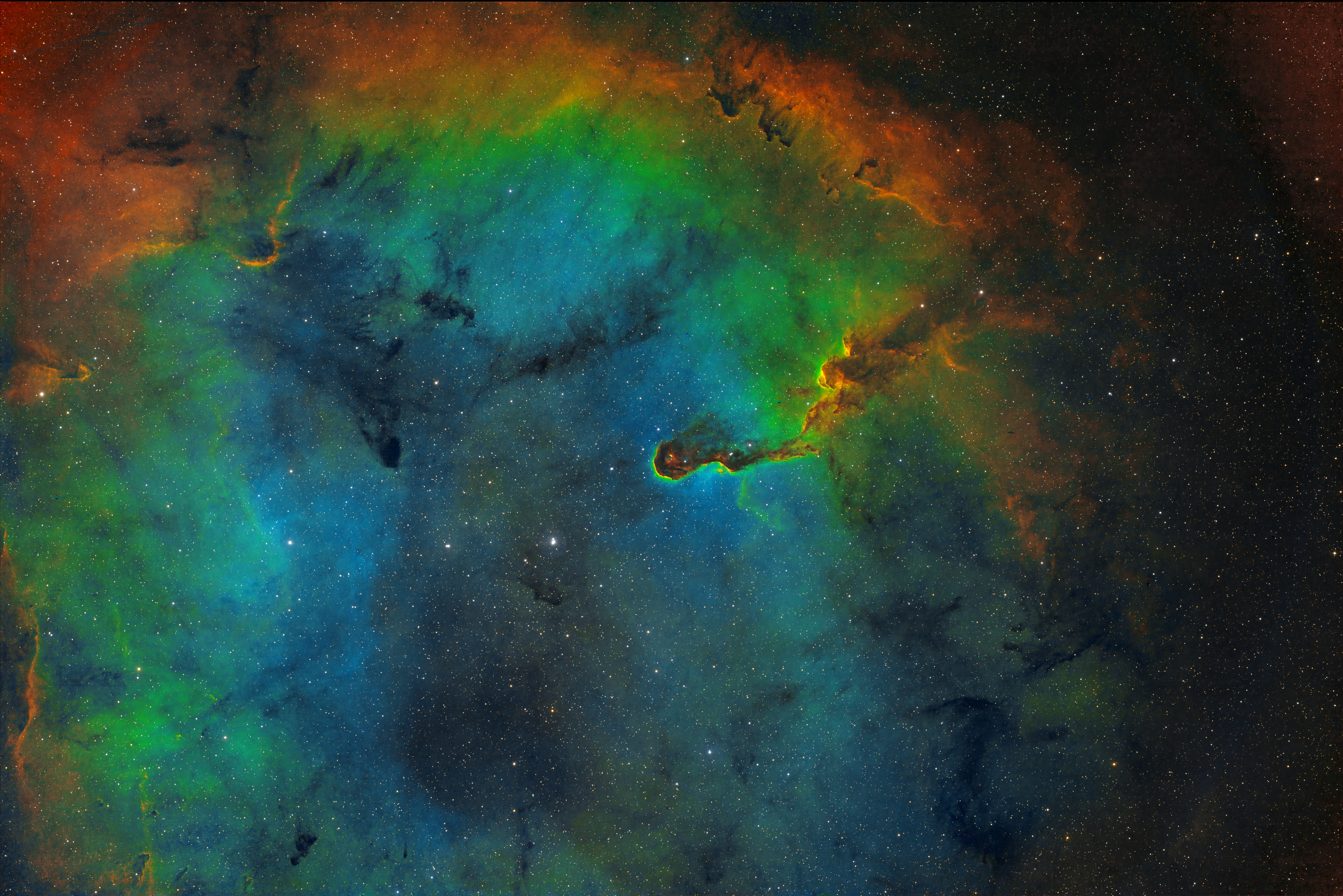
Licence: for personal use, credit Damon Scotting. Both JPEGs 4,096 x 2,733 px.
-10 C sensor set point the set point I run every cooled camera at
504 mm focal length, plate solved through the Askar SQA106 (Askar states 509 mm)
2.67 x 1.78° field of view 6,248 x 4,176 px on ASI2600MM Pro
26.1 MP ASI2600MM Pro 6,248 x 4,176 px, 23.5 x 15.7 mm
Should you buy it?
62/100 Stars for Your Buck
Pros
- A 26 MP APS-C IMX571 mono sensor, 6248 x 4176 pixels of 3.76 microns: on the Askar SQA106 it plate-solves to a 2.67 x 1.78 degree field at 504 mm.
- Narrowband from a garden: my North America and Elephant's Trunk nebulae are each one and a half hours of Ha, SII and OIII.
- ZWO quote a 16-bit ADC, a 91% QE peak, zero amp glow and two-stage cooling 30 to 35 C below ambient.
- It works at long focal lengths too: the Horsehead and the Crab through the C11 EdgeHD at 1,956 mm.
- ZWO's 2025 version on sale doubles the buffer to 512 MB and comes with a sensor tilt plate.
Cons
- At £2,059 for the camera alone, a filter wheel and filters come on top.
- The APS-C sensor outgrows 1.25 inch filters: mine vignetted the corners and left off-centre halos round bright stars.
- At 0.7 kg plus a filter wheel on the back, my SQA106 rig comes to about 10.2 kg: a JUWEI-17-class load.
- Every colour image needs a filter per channel and more processing than a one-shot colour camera.
We have an Askar SQA106 partnered with an ASI2600MM. Together, they are capable of producing some incredibly beautiful shots.
Who the ASI2600MM is for
Narrowband in a light-polluted town
Buy
Ha, SII and OIII filters on this mono sensor cut through street light and moonlight.
Owner of a 500 mm astrograph
Buy
At 504 mm the 26 MP sensor gives 1.54 arcsec per pixel over a 2.7 x 1.8 degree field.
Long focal length imager
Buy
On a C11 EdgeHD with the 0.7x reducer it frames the Horsehead and the Crab at 0.4 arcsec per pixel.
Guiding and Wi-Fi in one camera
Skip
My recommendation is the ZWO ASI2600MM Air: the same IMX571 mono sensor with a guide sensor and ASIAIR built in.
One-shot colour imager
Skip
My recommendation is the SVBONY SC571CC: the same IMX571 sensor in colour, £1,029.
Owner of 1.25 inch filters
Skip
My recommendation is the ZWO ASI533MM Pro: ZWO sell it in kits with 1.25 inch filters, and its 16 mm diagonal sensor suits them.
Three alternatives I have reviewed
- ZWO ASI2600MM Air the same IMX571 mono sensor with a guide sensor, Wi-Fi and an ASIAIR built in, £2,499 84/100 £2,499 Read the review
- ToupTek ATR2600MM the same IMX571 mono sensor from ToupTek, £1,488 73/100 £1,488 Read the review
- ZWO ASI533MM the 1 inch square mono sensor for 1.25 inch filters, 9 MP, £999 66/100 £999 Read the review
Questions and more about this review
Reviewed by
Damon Scotting
The Telescope Man Verified
BSc (Hons) Physics with Astrophysics and Cosmology, Loughborough University PGCE / QTS, University of Nottingham
About Damon About Damon Damon Scotting is The Telescope Man. He holds a BSc (Hons) in Physics with Astrophysics and Cosmology from Loughborough University and a PGCE with QTS from the University of Nottingham, and taught physics in secondary schools before becoming an astronomy creator. He is a contributing writer for BBC Sky at Night Magazine and the author of 42 Wonders of Our Night Sky, and his photograph of the galaxy M100 with the dwarf planet Ceres was Highly Commended in the Astronomy Photographer of the Year 2024 competition run by Royal Observatory Greenwich. He has appeared on the BBC's Blue Peter. More than 750,000 people follow his astronomy channels on YouTube, Instagram and TikTok, and he has reviewed more than 140 telescopes, mounts, cameras, filters and accessories hands-on for this site. More about Damon · How I test · Damon's book
I review all kinds of gear: most of it I buy, some is gifted and some is loaned, and all of it is reviewed the same way. How this site is funded
Seven questions, answered
Questions about the ZWO ASI2600MM
Reviewed 19 May 2026 ·Updated 24 September 2026
I review all kinds of gear. Most of it I buy, some is gifted and some is loaned, and all of it is reviewed the same way: no company sees or approves a review before it is published. Shop links marked Ad are affiliate links: I earn a commission when you buy through them, at no extra cost to you. How this site is funded
- Is the ZWO ASI2600MM Pro good for narrowband imaging? Yes. Through the Askar SQA106 it gave me the North America and Elephant's Trunk nebulae from one and a half hours of Ha, SII and OIII each, and the Dumbbell from 45 minutes, from my garden. What I captured ↓
- Can I use 1.25 inch filters with the ASI2600MM? Not well. My 1.25 inch Laida filters vignetted the corners of this APS-C sensor and left off-centre halos round bright stars. Flats fixed most of the corners; the halos needed star removal and a touch-up. Use 36 mm or 2 inch filters. The raw stacks against the finished images ↓
- What field of view does it give on the Askar SQA106? 2.67 x 1.78 degrees. My plate solve gives 1.54 arcsec per pixel, 504 mm against Askar's 509 mm. Tested numbers and the download ↓
- Which ASI2600MM is on sale today? ZWO's 2025 version, sold as the ASI2600MM P25: the same IMX571 mono sensor with a sensor tilt plate and a 512 MB buffer. My images were taken with the earlier ASI2600MM Pro. The specifications and the comparison table ↓
- What mount does the ASI2600MM need? With the SQA106, a filter wheel, a 50 mm guide scope and a guide camera the rig comes to about 10.2 kg, so a mount such as the JUWEI-17, which carries 13 kg without a counterweight. The rig on the mount ↓
- ASI2600MM Pro or ASI2600MM Air? The same IMX571 mono sensor. The Air adds a guide sensor, Wi-Fi and an ASIAIR inside the camera, at £2,499 against £2,059.
- What have I not tested on the ASI2600MM? I have not measured the ASI2600MM Pro's read noise, full well, dark current or cooling myself, and I have not imaged with ZWO's 2025 P25 version: my captures were taken with the earlier ASI2600MM Pro.