ZWO FF80 APO review: a flat-field quadruplet for travel rigs
Where does it rank on our leaderboard
| Rank | Telescope | Stars for Your Buck | Recorded UK price |
|---|---|---|---|
| 1 | Askar 50P | 95 out of 100 | £299 |
| 2 | ToupTek Hope D60 | 93 out of 100 | £749 |
| 8 | Askar 60F | 87 out of 100 | £498 |
| 15 | Askar 140APO | 80 out of 100 | £2,098 |
| 23 | ZWO FF80 APO | 73 out of 100 | £1,175 |
| 29 | William Optics RedCat 51 | 69 out of 100 | £849 |
| 39 | Celestron C5 | 49 out of 100 | £850 |
| 41 | Celestron 114 LCM | 42 out of 100 | £361 |
| 42 | Celestron AstroMaster LT 76 | 13 out of 100 | £200 |
Contents
- 01 Where does it rank on our leaderboard
- 02 Specifications and features
- 03 In the hand
- 04 How good is it? Here's what I captured
- 05 Raw against finished
- 06 The rig on the mount
- 07 What is it for
- 08 Watch the review
- 09 Tested numbers and the download
- 10 Should you buy it?
- 11 Questions and more about this review
In 30 seconds
Stars for Your Buck 73/100
Reviewed 26 Jan 2024 Updated 23 Sep 2026
- Rank
- #23 of 42 telescopes
- Verdict
- Worth a look
Written by Damon Scotting 5 min read
Buy it if
- You want a flat-field quadruplet that covers full frame without buying a separate flattener.
- You are building an all-ZWO imaging rig and want the matched 0.76x reducer as an option.
- You want an 80 mm astrograph that rides a strain-wave mount without a counterweight.
Skip it if
- You want the most aperture for the money: the Askar 91F gives 91 mm for £995.
- You want to image the planets: 600 mm at f/7.5 is a wide-field focal length.
- You want a fast astrograph out of the box without adding a reducer.
The ever favourite ZWO FF80 is a quadruplet refractor telescope, and it is the main telescope on top of an all-in-one ZWO rig.
Specifications and features
Against the telescopes I have reviewed
Compare with
| ZWO FF80 APO reviewed #23 of 42 | Askar 91F #6 of 42 | Askar SQA85 #7 of 42 | Askar 71F #14 of 42 | Askar 60F #8 of 42 | |
|---|---|---|---|---|---|
| Recorded UK price | £1,175 | £995 | £2,395 | £599 | £498 |
| Stars for Your Buck | 73/100 | 89/100 | 88/100 | 81/100 | 87/100 |
| Aperture | 80 mm | 91 mm | 85 mm | 71 mm | 60 mm |
| Focal length | 600 mm | 609 mm | 408 mm | 490 mm | 408 mm |
| Focal ratio | f/7.5 | f/6.7 | f/4.8 | f/6.9 | f/6.8 |
| Optical design | Air-spaced quadruplet APO, 3+1 layout, two ED elements, built-in flat field | Air-spaced quadruplet APO, one ED element, self-flattening | Quintuplet Petzval APO, two SD elements | Air-spaced quadruplet APO, one ED element, self-flattening | Air-spaced quadruplet APO, one ED element, self-flattening |
| Image circle | 44 mm | 44 mm | 44 mm | 44 mm | 44 mm |
| Back focus | 115 mm from M48, 135 mm from M54, 155 mm from M68, 168.5 mm from M76 | 45 to 75 mm from M48 | 40 to 70 mm; 55 mm recommended | Up to 82.5 mm from M48 | 31 to 81 mm from M48 |
| Focuser | 3 inch dual-speed rack and pinion, 1:10, 360 degree rotator | 3 inch dual-speed rack and pinion, 1:10 | 2.8 inch dual-speed rack and pinion, 32 mm travel | 2.4 inch dual-speed rack and pinion, 1:10, 360 degree rotator | 2.4 inch dual-speed rack and pinion, 1:10, 360 degree rotator |
| Weight, tube | 3.9 kg tube; 4.7 kg with rings and accessories | 3.92 kg tube; 4.52 kg with rings and dovetail | 3.64 kg tube; 4.62 kg with ring and dovetail | 2.5 kg tube; 3.0 kg with rings and dovetail | 2.36 kg tube; 2.86 kg with rings and dovetail |
| Length, tube | 450 to 570 mm | 513 to 599 mm | 403 to 439 mm | 372.5 to 430.9 mm | 289 to 323 mm |
| Dew shield | Retractable, detachable | Retractable | Retractable | Retractable | Retractable |
| In the box | Tube, rings with carry handle, Vixen dovetail, M48, M54, M68 and M76 camera adapters, manual | Tube, rings, handle, 230 mm Vixen dovetail, photographic adapters | Tube, ring, dovetail, Oxford cloth case | Tube, rings, handle, Vixen dovetail, photographic adapters | Tube, rings, handle, 230 mm Vixen dovetail, photographic adapters |
In the hand
How good is it? Here's what I captured
Six targets
IC 1805 Heart Nebula, ASI2600MC Duo
- Integration
- 1 h (20 x 180 s)
- Field
- 2.79 x 1.85 degrees
- Telescope
- ZWO FF80 APO
- Camera
- ZWO ASI2600MC Duo
- Mount
- ZWO AM5
- Target
- IC 1805 Heart Nebula
- Type
- Emission nebula
- Location
- Bortle 4
M 16 and M 17 Eagle and Swan Nebulae, ASI2600MC Duo
- Integration
- 1 h 4 min (64 x 60 s)
- Field
- 2.81 x 1.87 degrees
- Telescope
- ZWO FF80 APO
- Camera
- ZWO ASI2600MC Duo
- Mount
- ZWO AM5
- Target
- M 16 and M 17 Eagle and Swan Nebulae
- Type
- Emission nebulae
- Location
- Bortle 4
NGC 6960 and NGC 6992 Veil Nebula, ASI2600MC Duo
- Integration
- 42 min (42 x 60 s)
- Field
- 2.81 x 1.82 degrees
- Telescope
- ZWO FF80 APO
- Camera
- ZWO ASI2600MC Duo
- Mount
- ZWO AM5
- Target
- NGC 6960 and NGC 6992 Veil Nebula
- Type
- Supernova remnant
- Location
- Bortle 4
M 31 Andromeda Galaxy, ASI2600MC Duo
- Integration
- 24 min (24 x 60 s)
- Field
- 2.78 x 1.83 degrees
- Telescope
- ZWO FF80 APO
- Camera
- ZWO ASI2600MC Duo
- Mount
- ZWO AM5
- Target
- M 31 Andromeda Galaxy
- Type
- Galaxy
- Location
- Bortle 4
IC 434 Horsehead and NGC 2024 Flame Nebulae, ASI2600MC Duo
- Integration
- 42 min (21 x 120 s)
- Field
- 2.92 x 1.92 degrees
- Telescope
- ZWO FF80 APO + 0.76x reducer
- Camera
- ZWO ASI2600MC Duo
- Mount
- ZWO AM5
- Target
- IC 434 Horsehead and NGC 2024 Flame Nebulae
- Type
- Dark and emission nebulae
- Location
- Bortle 4
M 45 Pleiades, ASI2600MC Duo
- Integration
- 56 min (28 x 120 s)
- Field
- 2.97 x 1.98 degrees
- Telescope
- ZWO FF80 APO + 0.76x reducer
- Camera
- ZWO ASI2600MC Duo
- Mount
- ZWO AM5
- Target
- M 45 Pleiades
- Type
- Open cluster and reflection nebula
- Location
- Bortle 4
Raw against finished
The rig on the mount
The 2 targets, the raw combined stack against my finished image, each with its integration, the camera and the palette:
- IC 434 Horsehead and NGC 2024 Flame Nebulae: 42 min (21 x 120 s) of light, ASI2600MC Duo, the raw combined stack with one automatic stretch
- M 45 Pleiades: 56 min (28 x 120 s) of light, ASI2600MC Duo, the raw combined stack with one automatic stretch
On the JUWEI-17, then on six other mounts
What is it for
Three things it is for
A quadruplet at the heart of an all-in-one rig
If you enjoy ZWO's equipment and want to put it all together like I have here in an all-in-one rig, it looks quite aesthetically pleasing.
Built to travel
I'm very impressed by this entire setup. Carrying it a long way from home is a testament to how durable, capable and travel friendly this equipment really is, and it does pack a punch.
Comets
With the FF80 on the JUWEI-17, Comet Tsuchinshan-ATLAS turned into a lovely treat to image.
Watch the review
This is the BEST TELESCOPE MOUNT I've ever used! · published 13 June 2024 · 6:47 · Watch on YouTube · 9,151 views, 370 likes on 2 Oct 2026
Jump to
- 0:30 A mount with no counterweight bar
- 0:51 13 kg without a counterweight
- 1:31 Carry case and carbon fibre tripod
- 1:58 The FF80 and the ASI2600MC on top
- 2:44 Four inputs and the ASIAIR
- 3:11 An all-in-one ZWO rig
- 3:36 Go to the Andromeda Galaxy
- 3:56 How quiet the mount is
- 4:52 Final verdict on the AM5
- 5:57 Durable, capable and travel friendly
Transcript of the review video 1,364 words · 11 chapters · searchable
Press a time stamp to play from there.
0:00 The opening
0:02 this is my new favourite mount it is the AM5 and perhaps my favourite feature of it is that it does not require a counterweight bar or any counterweights 0:08 so if you traveling somewhere remote like the edge of a volcano perhaps you won't need to lug around all this heavy equipment with you all you need is this 0:14 5 kg mount it is jam-packed with lots of cool features that I'm going to Showcase in tonight's video I'm Damon Scotting and this is 0:23 astronomical so a telescope mount without counterweight bar might seem a little bit suspicious you might want to know what kind of Witchcraft is going on well
0:30 A mount with no counterweight bar
0:36 this is a harmonic Drive telescope Mount and it doesn't require the counterweight structure that a typical telescope Mount would you are able to add a 0:44 counterweight bar to it if you want to and that means you can increase the payload by itself the mount is a mere 5.5 kg which is easy enough to carry in
0:51 13 kg without a counterweight
0:52 your backpack the mount alone can support a payload of up to 13 kg but you can increase your payload up to a very generous 20 kg which is a tremendous 1:01 amount of telescope weight that means that you can mount your C11 Schmidt-Cassegrain telescope on top of this Mount which is quite a hefty Beast it includes 1:09 attaching a camera and a finder scope to that as well but if you want to take things further maybe you do want to step 1:15 up to an even bigger telescope or add a second telescope on top and then a bunch of additional accessories then very easy you just screw in a counterweight bar 1:22 down here and add on a couple of counter weights so I like the fact that you do have the option to increase the payload 1:27 but even without a counterweight bar it is capable of carrying a lot included in your purchase of the AM5 mount is a carry case roughly a foot in length and
1:31 Carry case and carbon fibre tripod
1:35 width which means from the get-go you are ready to Travel and Transport your new Mount take that heavy duty tripods hey speaking of tripods normally you 1:42 would have to pay extra money to afford a tripod but as of right now ZWO and it suppliers are running a special promotion which means you get that Ultra 1:50 lightweight carbon fiber tripod included for free now this entire setup might look quite messy and that's because I've got loads of different things attached
1:58 The FF80 and the ASI2600MC on top
1:58 to it I of course have the main telescope on top which is the FF80 from ZWO is a quadruplet refractor telescope and in the back just around here we have 2:07 the ASI2600MC which is making quite a bit of noise right now because a large portion of this camera is actually a cooling fan and it's trying to reduce it 2:16 now to -20° C where here on the edge of the volcano it's about 10° C so it's got its work cut out we want to cool it 2:24 because we want to reduce the amount of hot pixels that turn up in our image so by cooling our camera we actually get a 2:28 much cleaner final result image so with all these things attached it does mean that there are a lot of cables that you're looking at but this is good this 2:35 means that even though the mount itself is very simplified with just these four different inputs at the front down here you can actually do a lot in terms of 2:42 controlling it so we do have four different inputs the first one is the USB which I have plugged into the ASI air which is the computer that just
2:44 Four inputs and the ASIAIR
2:49 controls everything to the right of it you have an autoguide port and then further right you have HC which stands for hand controller which is this little 2:57 joystick down here and the last one is the power that's it it's very Compact and also at the same time quite stylish which isn't something you normally say 3:05 about telescope mounts I do like the red and black design of the mount itself and it goes along with everything else ZWO produces so if you do enjoy
3:11 An all-in-one ZWO rig
3:14 their equipment and want to put it all together like I have here in a all-in-one rig then it looks quite aesthetically pleasing the entire setup 3:21 is by no means cheap but it is arguably one of the most cost-effective professional travel astrophotography rigs on the market you get precisely what you pay for like change it to point 3:30 at anything that I want in the night sky so I'm going to pan away from Polaris and I'm going to look at something nearby and would you look at that just
3:36 Go to the Andromeda Galaxy
3:36 over here we have M31 the Andromeda galaxy so I'm actually going to pinch him and I'm going to hover over it and press go 3:44 to and then just like that the telescope's going to point towards it but it's not just going to go yeah I think it's about here 3:50 this will do it's actually going to Plate solve your image immediately afterwards and figure out exactly where its location is and I have to add that
3:56 How quiet the mount is
3:57 I'm very impressed by how quiet the mount is we are in the location where it's so quiet it's almost scary but if I put this Mount onto the max speed 4:05 setting and I start moving it you can hear for yourself how loud it actually is which is very nice because for me and many of us who are backyard astronomers 4:24 we don't like to annoy our neighbours with the annoying whirring sounds that cause them to look out their windows and think oh my God what is that crazy man 4:30 doing and then the last thing I think I'm going to talk about whilst I'm outside here is just the carbon fiber tripod that it's standing on now this is 4:37 incredibly lightweight uh and also compact yeah I managed to fit the entire Mount itself and the tripod legs in my carryon so it's very travel friendly at 4:47 the same time setting it up every single night this is the dream because it makes it so much easier this is a very lightweight setup okay so final verdict
4:52 Final verdict on the AM5
4:55 the bottom line in terms of the AM5 mount is that it is simple everything about it is so straightforward it can take Vixen and Losmandy dovetail mounts 5:04 it's controllable by Wi-Fi or by a heavily simplified rocket style hand controller its guiding error is between 0.6 to 0.8 which is Tiny and although it 5:13 is extremely portable and lightweight it is still capable of payloads as high as 13 kg without any counterweight which is just perfect I'm sure if you've watched 5:22 anyone else's review on the AM5 mount you will have also seen that it is a well-loved Mount and an instant favourite so there we have it the AM5 mount I'm 5:32 very impressed by it and depending on your location on our planet the price may vary slightly but it should be about $2,000 which puts it within the budget 5:41 of people that are quite serious about this hobby but I will say it's a very good investment if you like keeping things simple but also being able to do 5:49 a lot thank you very much ZWO for sending me this telescope Mount and the rest of the equipment you see here I'm going to be doing reviews for all of 5:56 these objects that you can see right here I'm very impressed by this entire setup and the fact that I've been able to bring it all the way up here to one
5:57 Durable, capable and travel friendly
6:02 of the most remote locations on our planet is a testament to how durable capable and travel friendly this equipment really is and it does 6:10 pack a punch wait until you see the images that I've captured with this setup if you'd like to purchase the ZWO AM5 mount for yourself I've attached the 6:19 product Linked In the description below thanks for watching I'm Damon Scotting and this was astronomical
Check out more videos on the ZWO FF80 APO
WAS this the BEST week of STARGAZING EVER?!
29 Oct 2024
Tested numbers and the download
Finished image
- Download the raw stack JPEG · 3.7 MB · 4,096 x 2,687
- Download the finished image JPEG · 1.8 MB · 4,096 x 2,687
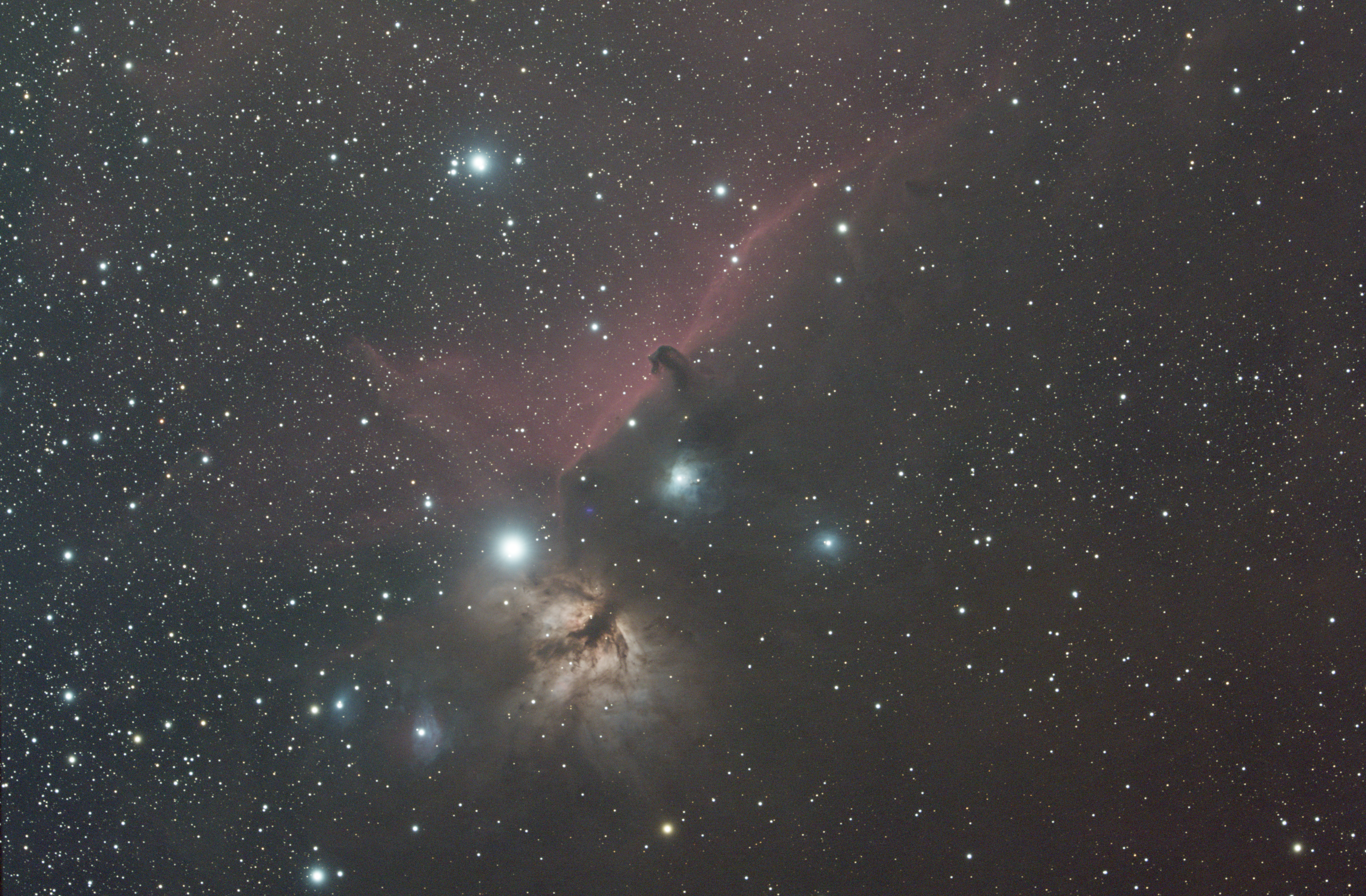
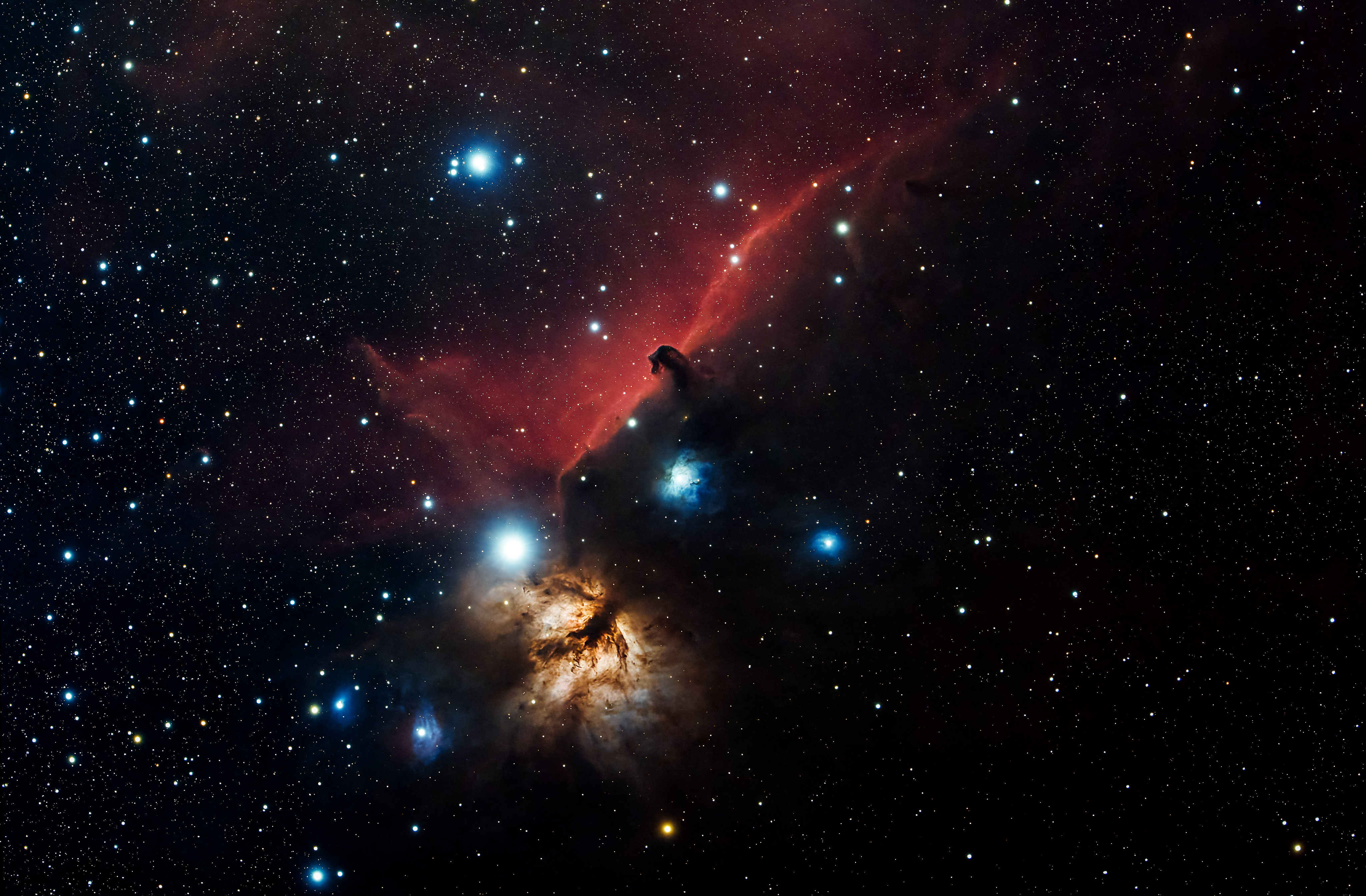
Licence: for personal use, credit Damon Scotting. Both JPEGs 4,096 x 2,687 px.
-10 C sensor temperature during imaging
453 mm focal length, plate solved ZWO states 600 mm, measured with the 0.76x reducer
2.97 x 1.98° field of view 6,248 x 4,176 px on ASI2600MC Duo
26 MP ASI2600MC Duo 6,248 x 4,176 px, 23.5 x 15.7 mm
Should you buy it?
73/100 Stars for Your Buck
Pros
- It is a flat-field quadruplet: a 3+1 layout with two ED elements and a 44 mm image circle, so it covers full frame with no separate flattener.
- ZWO's own 0.76x reducer turns it into a 454 mm f/5.7 astrograph with a 3 x 2 degree field on an APS-C sensor.
- Under dark skies it delivers in about an hour: the Heart Nebula took 60 minutes and the Horsehead and Flame only a very modest 42.
- It comes ready to image, with M48, M54, M68 and M76 camera adapters, rings with a carry handle, a Vixen dovetail and a retractable dew shield.
- The 3 inch dual-speed rack and pinion focuser turns on a 360 degree rotator and takes ZWO's EAF without an extra adapter.
- At 4.7 kg with rings it rides a strain-wave mount such as the AM5 or the JUWEI-17 without a counterweight.
Cons
- At £1,175 it is dear for 80 mm of aperture.
- At f/7.5 it is slow for broadband deep sky, and the 0.76x reducer that makes it f/5.7 is a separate purchase at $299.
- It is heavy for an 80 mm: 3.9 kg for the tube alone and 4.7 kg with rings, against 3.0 kg for the Askar 71F with rings.
- Back focus changes with each supplied adapter, from 115 mm on the M48 thread to 168.5 mm on the M76, so camera spacing needs care.
The entire setup is by no means cheap, but it is arguably one of the most cost-effective professional travel astrophotography rigs on the market. You get precisely what you pay for.
Who the FF80 APO is for
All-ZWO rig builder
Buy
The FF80 finishes an all-ZWO imaging rig: it rides an AM5 without a counterweight, and ZWO makes the matched 0.76x reducer.
Full-frame imager
Buy
It covers a full-frame sensor with no extra corrector to buy or space.
Travelling astrophotographer
Buy
An 80 mm quadruplet on a strain-wave mount makes a compact rig to carry to dark skies, with no counterweight to pack.
Budget first astrograph
Skip
My recommendation is the Askar 71F at £599: a quadruplet flat-field astrograph with the same 44 mm image circle for about half the price.
Askar 91F owner
Skip
Stay with what you have: the 91F has more aperture, a similar 609 mm focal length and the same 44 mm image circle.
Planet imager
Skip
At 600 mm the planets are tiny. My recommendation is the Celestron 8 EdgeHD.
Three alternatives I have reviewed
- Askar 91F 91 mm f/6.7, air-spaced quadruplet APO, one ED element, self-flattening 89/100 £995 Read the review
- Askar 71F 71 mm f/6.9, air-spaced quadruplet APO, one ED element, self-flattening 81/100 £599 Read the review
- ZWO FF110 110 mm f/7.0, four-element air-spaced apochromat 73/100 £1,499 Read the review
Questions and more about this review
Reviewed by
Damon Scotting
The Telescope Man Verified
BSc (Hons) Physics with Astrophysics and Cosmology, Loughborough University PGCE / QTS, University of Nottingham
About Damon About Damon Damon Scotting is The Telescope Man. He holds a BSc (Hons) in Physics with Astrophysics and Cosmology from Loughborough University and a PGCE with QTS from the University of Nottingham, and taught physics in secondary schools before becoming an astronomy creator. He is a contributing writer for BBC Sky at Night Magazine and the author of 42 Wonders of Our Night Sky, and his photograph of the galaxy M100 with the dwarf planet Ceres was Highly Commended in the Astronomy Photographer of the Year 2024 competition run by Royal Observatory Greenwich. He has appeared on the BBC's Blue Peter. More than 750,000 people follow his astronomy channels on YouTube, Instagram and TikTok, and he has reviewed more than 140 telescopes, mounts, cameras, filters and accessories hands-on for this site. More about Damon · How I test · Damon's book
I review all kinds of gear: most of it I buy, some is gifted and some is loaned, and all of it is reviewed the same way. How this site is funded
Eight questions, answered
Questions about the ZWO FF80 APO
Reviewed 26 January 2024 ·Updated 23 September 2026
I review all kinds of gear. Most of it I buy, some is gifted and some is loaned, and all of it is reviewed the same way: no company sees or approves a review before it is published. Shop links marked Ad are affiliate links: I earn a commission when you buy through them, at no extra cost to you. How this site is funded
- Is the ZWO FF80 good for astrophotography? Yes. It is built for imaging, and through it I captured the Heart Nebula, the Veil, the Eagle and Swan and the Andromeda Galaxy in about an hour or less each under dark skies. What I captured ↓
- Does the FF80 need a field flattener? No. The flattener is built into the quadruplet, and ZWO quote a 44 mm image circle: enough for a full-frame sensor. The specifications and the comparison table ↓
- Can I use a reducer with the FF80? Yes. ZWO's 0.76x reducer takes it to 454 mm at f/5.7. My stacks through it plate-solve at 453 mm, a field of 2.97 x 1.98 degrees on an APS-C sensor. Tested numbers and the download ↓
- What mount does the ZWO FF80 need? The tube is 3.9 kg, or 4.7 kg with rings and accessories. I imaged with it on the ZWO AM5 and on the JUWEI-17; each carries 13 kg without a counterweight, so neither needs one for this telescope. The rig on the mount ↓
- What back focus does the FF80 need? It depends on the adapter: 115 mm from the base of the M48 thread, 135 mm from M54, 155 mm from M68 and 168.5 mm from M76. With the 0.76x reducer it is the standard 55 mm. The specifications and the comparison table ↓
- Should I buy the ZWO FF80 or the Askar 91F? The 91F has 11 mm more aperture, a similar 609 mm focal length and the same 44 mm image circle for £995 against £1,175, and it scores 89 on my board to the FF80's 73. Choose the FF80 for ZWO's matched reducer and an all-ZWO rig.
- What camera did you use with the FF80? The ZWO ASI2600MC Duo, a 26 megapixel cooled colour camera, on the ZWO AM5. What I captured ↓
- What have I not tested on the FF80 APO? I have not imaged with the FF80 at its native 600 mm f/7.5, on a full-frame sensor, on the planets or visually: every capture on this page was taken at a reduced focal length with an APS-C camera.