ASI 4400MC review: the Goldilocks full-frame colour camera
Where does it rank on our leaderboard
| Rank | Camera | Stars for Your Buck | Recorded UK price |
|---|---|---|---|
| 1 | SVBONY SV705C | 93 out of 100 | £229 |
| 2 | SVBONY SC571CC | 90 out of 100 | £1,029 |
| 4 | ZWO ASI2600MC Air | 88 out of 100 | £2,149 |
| 10 | ToupTek ATR2600C | 80 out of 100 | £1,127 |
| 17 | ZWO ASI120MM | 75 out of 100 | £199 |
| 20 | ASI 4400MC | 72 out of 100 | £3,299 |
| 23 | ZWO ASI220MM | 67 out of 100 | £299 |
| 28 | ZWO ASI183MC | 38 out of 100 | £549 |
| 29 | Nikon COOLPIX P1000 | 32 out of 100 | £787 |
Contents
- 01 Where does it rank on our leaderboard
- 02 Specifications and features
- 03 In the hand
- 04 The rig on the mount
- 05 How good is it? Here is what it captured
- 06 Raw against finished
- 07 What is it for
- 08 Versus the ZWO ASI6200MM Pro
- 09 Watch the review
- 10 Tested numbers and the download
- 11 Should you buy it?
- 12 Questions and more about this review
In 30 seconds
Stars for Your Buck 72/100
Reviewed 30 Jan 2026 Updated 24 Sep 2026
- Rank
- #20 of 29 cameras
- Verdict
- Worth a look
Written by Damon Scotting 7 min read
Buy it if
- You want one-shot colour on a full-frame astrograph with an image circle of 44 mm or more
- You like building mosaics: 44 megapixels per panel means fewer panels
- You want colour images without a filter wheel and a stack of filters
Skip it if
- Your telescope covers only APS-C: most of the sensor goes to waste
- You image narrowband through heavy light pollution: a mono camera and filters go deeper
- You are budget conscious: an APS-C colour camera costs far less
“You could possibly think of this as the Goldilocks camera, where its imaging specs are not too small or too big in any area. They are just right.”
Specifications and features
Against the cameras I have reviewed
Compare with
| ASI 4400MC reviewed #20 of 29 | ToupTek SkyEye 24AC #5 of 29 | ZWO ASI6200MC #27 of 29 | ZWO ASI6200MM Pro #18 of 29 | ZWO ASI2600MC Air #4 of 29 | ToupTek ATR2600C #10 of 29 | |
|---|---|---|---|---|---|---|
| Recorded UK price | £3,299 | £1,804 | £3,999 | £3,999 | £2,149 | £1,127 |
| Stars for Your Buck | 72/100 | 85/100 | 59/100 | 74/100 | 88/100 | 80/100 |
| Sensor | Sony IMX366, back-illuminated | Sony IMX410, full frame | Sony IMX455, back-illuminated | Sony IMX455, back-illuminated | Sony IMX571, with a built-in SC2210 guide sensor | Sony IMX571 colour, back-illuminated |
| Format | Full frame, 36 x 24 mm (43.3 mm diagonal) | Full frame | Full frame, 36 x 24 mm | Full frame, 36 x 24 mm | APS-C, 23.5 x 15.7 mm | APS-C, 23.4 x 15.7 mm |
| Colour or mono | Colour | Colour | Colour | Mono | Colour | Colour |
| Resolution | 8192 x 5460, 44.7 MP | 6064 x 4040, 24.5 MP | 9576 x 6388, 61.2 MP | 9576 x 6388, 61.2 MP | 6248 x 4176, 26.1 MP | 6224 x 4168, 25.9 MP |
| Pixel size | 4.4 um | 5.94 um | 3.76 um | 3.76 um | 3.76 um | 3.76 um |
| Cooling | Two-stage TEC, 30 to 35 C below ambient | Two-stage TEC, 30 to 35 C below ambient | Two-stage TEC, 30 to 35 C below ambient | Two-stage TEC, 30 to 35 C below ambient | 30 to 35 C below ambient | Two-stage TEC, 35 to 42 C below ambient |
| Read noise | 1.1 e- | 0.3 to 4.48 e- | 0.86 e- | 0.86 e- | 0.9 to 4.2 e- | 0.79 to 2.77 e- |
| Full well | 74.6 ke- | 104 ke- | 51.4 ke- | 51.4 ke- | 50 ke- | 51 ke- |
| ADC | 14-bit | 14-bit | 16-bit | 16-bit | 16-bit | 16-bit |
| Weight | 700 g | 718 g | 700 g | 700 g | 775 g | 577 g |
| Back focus | 17.5 mm (55 mm with the boxed extenders) | 17.5 mm | 17.5 mm | 17.5 mm | 12.5 or 17.5 mm | 17.5 mm |
| Interface | USB 3.0, two USB 2.0 hub ports, 512 MB DDR3 buffer | USB 3.0, a two-port USB hub, DC 12 V | USB 3.0, two USB 2.0 hub ports, 512 MB DDR3 buffer | USB 3.0, two USB 2.0 hub ports, 512 MB DDR3 buffer | Wi-Fi 5, four USB 2.0 hub ports, 256 GB eMMC | USB 3.0, two USB 2.0 hub ports, 512 MB DDR3 buffer |
| In the box | The camera, a 2 inch silicone dust cover, M48-M48 16.5 mm and M54-M48 21 mm extenders, an M42M-M48F adapter, two 0.5 m USB 2.0 cables, a 2 m USB 3.0 cable, a hex key, a quick guide and a camera bag | The camera, a power adapter (rating not confirmed), a 1.5 m USB 3.0 cable, a CD, a hex key, M54M-M48F 21 mm and M48M-M48F 16.5 mm extenders and an M48M-M42F adapter | The camera, M48-M48 16.5 mm and M54-M48 21 mm extenders, an M42M-M48F adapter, a dust cover, a 2 m USB 3.0 cable, two 0.5 m USB 2.0 cables, a hex key, a quick guide and a camera bag | The camera, M48-M48 16.5 mm and M54-M48 21 mm extenders, an M42M-M48F adapter, a dust cover, a 2 m USB 3.0 cable, two 0.5 m USB 2.0 cables, a hex key, a quick guide and a camera bag | Camera, external antenna, two 1 m DC power cords, 1.5 m DC extension, two 0.5 m USB 2.0 cables, 16.5 mm and 21 mm M54 spacers, M48 to M54 ring, cable strap, hex wrench, quick start guide, soft bag | The camera, a 12 V 3.3 A power adapter and cable, a 1.5 m USB 3.0 cable, M48-M42 0 mm, 16.5 mm and 21 mm extenders, a 12.5 mm M42 adapter and a cover |
In the hand
The rig on the mount
On the JUWEI-17, then on six other mounts
How good is it? Here is what it captured
Six targets
Horsehead, Flame and Orion Nebulae, ZWO ASI4400MC Pro
- Integration
- 2 h 21 min (47 x 180 s)
- Field
- 4.0 x 2.6 degrees
- Telescope
- Askar SQA106
- Camera
- ZWO ASI4400MC Pro
- Mount
- Unknown
- Target
- Horsehead, Flame and Orion Nebulae (IC 434, NGC 2024 and M 42)
- Type
- Emission and reflection nebulae
- Location
- Bortle 6.8 (in my garden)
Just over 2 hours from my light polluted garden and I've managed to capture three stunning deep sky objects for the price of one.
North America Nebula, ZWO ASI4400MC Pro
- Integration
- 2 h
- Field
- 3.3 x 2.2 degrees
- Telescope
- Askar SQA130
- Camera
- ZWO ASI4400MC Pro
- Mount
- Unknown
- Target
- North America Nebula (NGC 7000)
- Type
- Emission nebula
- Location
- Bortle 6.8 (in my garden)
Iris Nebula, ZWO ASI4400MC Pro
- Integration
- Unknown
- Field
- 3.3 x 2.2 degrees
- Telescope
- Askar SQA130
- Camera
- ZWO ASI4400MC Pro
- Mount
- Unknown
- Target
- Iris Nebula (NGC 7023)
- Type
- Reflection nebula
- Location
- Bortle 6.8 (in my garden)
Lagoon and Trifid Nebulae, ZWO ASI4400MC Pro
- Integration
- 1 h 30 min (30 x 180 s)
- Field
- 6.7 x 4.4 degrees
- Telescope
- ToupTek Hope D60
- Camera
- ZWO ASI4400MC Pro
- Mount
- ZWO AM3N
- Target
- Lagoon and Trifid Nebulae (M 8 and M 20)
- Type
- Emission nebulae
Heart and Soul Nebulae, ZWO ASI4400MC Pro
- Integration
- 2 h 6 min (42 x 180 s)
- Field
- 6.7 x 4.4 degrees
- Telescope
- ToupTek Hope D60
- Camera
- ZWO ASI4400MC Pro
- Mount
- ZWO AM3N
- Target
- Heart and Soul Nebulae (IC 1805 and IC 1848)
- Type
- Emission nebulae
Andromeda Galaxy, ZWO ASI4400MC Pro
- Integration
- 8 h 42 min (174 x 180 s)
- Field
- 6.7 x 4.4 degrees
- Telescope
- ToupTek Hope D60
- Camera
- ZWO ASI4400MC Pro
- Mount
- ZWO AM3N
- Target
- Andromeda Galaxy (M 31)
- Type
- Galaxy
Raw against finished
What is it for
The 6 targets, the raw combined stack against my finished image, each with its integration, the camera and the palette:
- Horsehead, Flame and Orion Nebulae (IC 434, NGC 2024 and M 42): 2 h 21 min (47 x 180 s) of light, ASI4400MC Pro, the raw combined stack with one automatic stretch
- Lagoon and Trifid Nebulae (M 8 and M 20): 1 h 30 min (30 x 180 s) of light, ASI4400MC Pro, the raw combined stack with one automatic stretch
- Andromeda Galaxy (M 31): 8 h 42 min (174 x 180 s) of light, ASI4400MC Pro, the raw combined stack with one automatic stretch
- Heart and Soul Nebulae (IC 1805 and IC 1848): 2 h 6 min (42 x 180 s) of light, ASI4400MC Pro, the raw combined stack with one automatic stretch
- North America Nebula (NGC 7000): 2 h of light, ASI4400MC Pro, the raw combined stack with one automatic stretch
- Iris Nebula (NGC 7023): Unknown of light, ASI4400MC Pro, the raw combined stack with one automatic stretch
Five things it is for
Three nebulae in one frame
In the 2 hour and 20 minute clear window I had, I captured both the Horsehead Nebula and the Orion Nebula within the same single shot.
Bigger than 8K
Forget 4K images: at 44 megapixels, this is 33% better than an 8K image.
Mosaics planned for you
All I have to do is connect my ASI4400MC to the ASIAIR, start a new plan, and size up how big I want my shot to be and how much each panel overlaps.
Full frame for big objects
Full-frame sensors like these are ideal because they maximise your imaging capabilities: I can stitch together objects that do not fit in one shot without surrendering any quality or detail.
Detail when you zoom in
Even at this incredibly narrow field of view, what you are seeing is a full HD view of the Horsehead and Flame Nebula, an absolutely mad level of detail when you zoom out and view the entire image.
Versus the ZWO ASI6200MM Pro
The North America Nebula on both, plate-solved and star-aligned (residual 0.02 px per 1000)
| Target | Telescope | Integration | Subs | Filter | Nights |
|---|---|---|---|---|---|
| North America Nebula (NGC 7000) | Askar SQA130 + ZWO ASI4400MC Pro | 120 min | 40 x 180 s | not recorded | 1 night, 2026 |
| North America Nebula (NGC 7000) | Askar SQA130 + ZWO ASI6200MM Pro | 240 min | 80 x 180 s | SHO (Antlia 2.5 nm) | 2026-03-26, 2026-03-29 |
Watch the review
I Captured a Gigapixel Orion Mosaic! - ASI 4400MC Review · published 30 January 2026 · 6:48 · Watch on YouTube · 49,686 views, 1,148 likes on 2 Oct 2026
Jump to
- 0:24 Specifications
- 1:34 3-in-1 Nebulae
- 2:13 Mosaic imaging
- 2:58 SOD IT!?
- 3:33 Mosaic imaging 2
- 4:00 Images
- 5:00 A full HD view of the Horsehead and Flame from the mosaic
- 5:41 Andromeda, the Monkey Head, the Veil and the Pleiades
Transcript of the review video 1,120 words · 9 chapters · searchable
Press a time stamp to play from there.
0:00 Intro
0:00 Tonight, I'm going to be reviewing the biggest astronomy camera released in the last year. 0:04 It is the absolute unit, the ASI 4400MC. 0:06 I'm going to be putting it to the ultimate test as I try and create a 1,000 megapixel mosaic image of Orion the Hunter. 0:14 I'm Damon Scotting and this is Astronomical. 0:20 So, this is the ASI 4400MC. 0:20 It is the latest camera to come out of ZWO's illustrious warehouse.
0:24 Specifications
0:25 And it has a staggering resolution of 8,192x 5,460 pixels, capturing 44 megapixel images with a whopping pixel size of 4.4. 0:36 It utilizes a full-frame colour sensor capable of capturing 14bit images. 0:41 It is comparable in many ways to the ASI 2400MC and the ASI6200MC. 0:43 You could possibly think of this as the Goldilocks camera, where its imaging specs are not too small or too big in any area. 0:53 They are just right. 0:53 With the ASI 2400MC Pro and the ASI 4400MC Pro costing the exact same amount at $2,999, and the ASI6200MC Pro costing $3,799, making it by far the most expensive of the three options. 1:09 Now, I love making mosaic shots of our night sky. 1:11 I love stitching together objects that you can't quite fit into one single shot whilst not surrendering any quality or detail. 1:19 And that's why full-frame sensors like these are ideal because they maximize your imaging capabilities. 1:25 Exhibit A. 1:25 This was my first time trying out this new camera. 1:27 I set it up in my garden and for the 2hour and 20 minute clear window that I had, I managed to capture both the Horsehead Nebula and the Orion Nebula within the same single shot.
1:34 3-in-1 Nebulae
1:39 I did this by using an Askar SQA 106 telescope, which is a similar price to the camera. 1:44 But how about that? 1:44 Just over 2 hours from my light polluted garden and I've managed to capture three stunning deep sky objects for the price of one. 1:51 Forget 4K images. 1:51 This right here is 33% better than an 8K image. 1:53 And it got me thinking. 1:57 Without the small hassle of switching between filters and adding a few extra steps in the processing, I could make a very quick and efficient gigapixel shot of the entire constellation. 2:06 All I have to do is connect my ASI 4400MC to the ASIAIR, start a new plan, and precisely size up how big I want my shot to be and how much I want each of the panels to overlap.
2:13 Mosaic imaging
2:17 And you see, now this part of astrophotography has become super easy and straightforward. 2:21 But the part that's remained just as frustrating as always, is finding a window of opportunity to image your desired target. 2:26 And for those of my fellow Brits, particularly in the middle of England, you will know all too well how poor these last two months have been. 2:33 I've tallied up just seven clear nights over the last 62, three of which were during a full moon, or at least 80% illuminated. 2:41 All I needed for this project was 16 hours worth of imaging time without the moon. 2:45 Was that really too much to ask for? 2:46 Just half an hour per panel should be enough. 2:48 But even on the nights when the skies were clear, my imaging window for the constellation of Orion was just over three hours. 2:54 So in the end, I just said sod this.
2:58 SOD IT!?
3:10 With the constellation of Orion higher overhead, and the quality of the skies about four times better, I'm going to be imaging each panel for just 15 minutes. 3:17 Now, I know that's not very long, but I'm on a strict time limit. 3:20 So, that's five 3 minute long exposures each. 3:22 I've swapped out the Askar SQA 106 for this project with a ToupTek Hope D60 telescope, which has a significantly wider field of view, meaning I can now fit the entire constellation within just 10 image panels.
3:33 Mosaic imaging 2
3:34 So, it should be very quick and easy. 3:42 I'm going to be using the JUWEI-14 mount with an SVBONY 30mm guide scope and an ASI 120 monochrome guide camera all attached to the tiny Hope D60 telescope. 3:54 So, it's a very portable and powerful setup. 3:56 And here's how the top left panel has turned out. 3:59 That insanely bright star in the middle is Betelgeuse, the red super giant.
4:00 Images
4:03 It is the 10th brightest star in our night sky. 4:05 Now, this telescope rig is going to be phenomenal at picking up faint dust. 4:12 And to prove my point, here's the bottom right shot of our 10 panel mosaic. 4:16 This includes the Witches Head Nebula alongside the seventh brightest star in our entire night sky, Rigel. 4:20 But the best shot of the entire mosaic will undoubtedly be of Orion's belt. 4:25 This time with a wider field of view, we can see not one, not two, not even three Nebula, but a fourth has also been included in our wider field of view. 4:34 I actually think this image looks better portrait and would make a decent phone background. 4:39 It is however 44 megapixels. 4:42 So if you would like to download the full resolution copy, you can find it on my Patreon. 4:45 But yeah, I think the camera is amazing and has made putting together this immense mosaic image a piece of cake. 4:50 Granted, in the end, the final resolution was about 400 megapixels due to the smaller telescope and less mosaic panels needed, which is a lot less compared to the original plan, which was to capture it in even more detail.
5:00 A full HD view of the Horsehead and Flame from the mosaic
5:00 But I'm very happy with the final product. 5:04 Even at this incredibly narrow field of view, what you are currently seeing is a full HD view of the Horsehead and Flame Nebula, which is an absolutely mad level of detail when you zoom out and view the entire image. 5:14 So, this is my final shot, and I'm very happy to say it took less than 3 hours to capture the entirety of it.
5:41 Andromeda, the Monkey Head, the Veil and the Pleiades
5:45 I didn't stop there, of course. 5:47 We still had plenty of the night left. 5:48 So, I decided to point a telescope at some other incredible deep sky objects, including the Andromeda Galaxy, the Monkey Head Nebula, and a few of its neighbours, the supernova remnant, that is the Veil Nebula, and of course, the Pleiades, otherwise known as the seven sisters. 6:24 So, in conclusion, this is a powerful camera. 6:27 You can download all of the images for yourself from my Patreon, and you can check out the camera as well as the telescopes featured by clicking on the links in the description down below. 6:35 What do you think of the ASI 4400MC's price and performance? 6:38 Let me know your comments down below. 6:40 Thanks for watching. 6:42 I'm Damon Scotting and this was Astronomical.
Check out more videos on the ASI 4400MC
I Tested the $3,395 Askar SQA 106 (f/4.8), Pinpoint Stars, Full-Frame Ready
12 Feb 2026
Tested numbers and the download
Finished image
- Download the raw stack JPEG · 3.5 MB · 4,096 x 2,677
- Download the finished image JPEG · 2.0 MB · 4,096 x 2,677
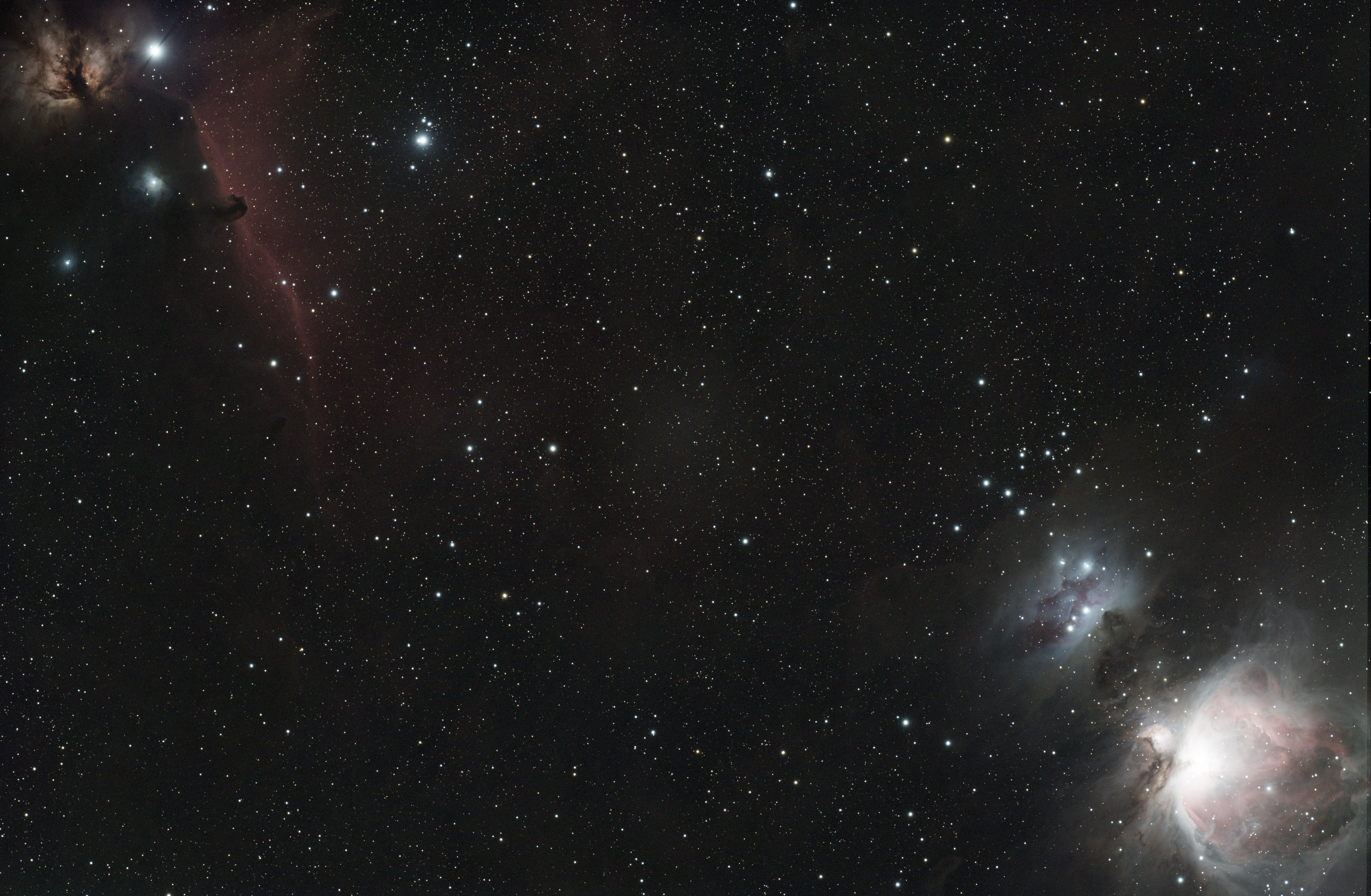
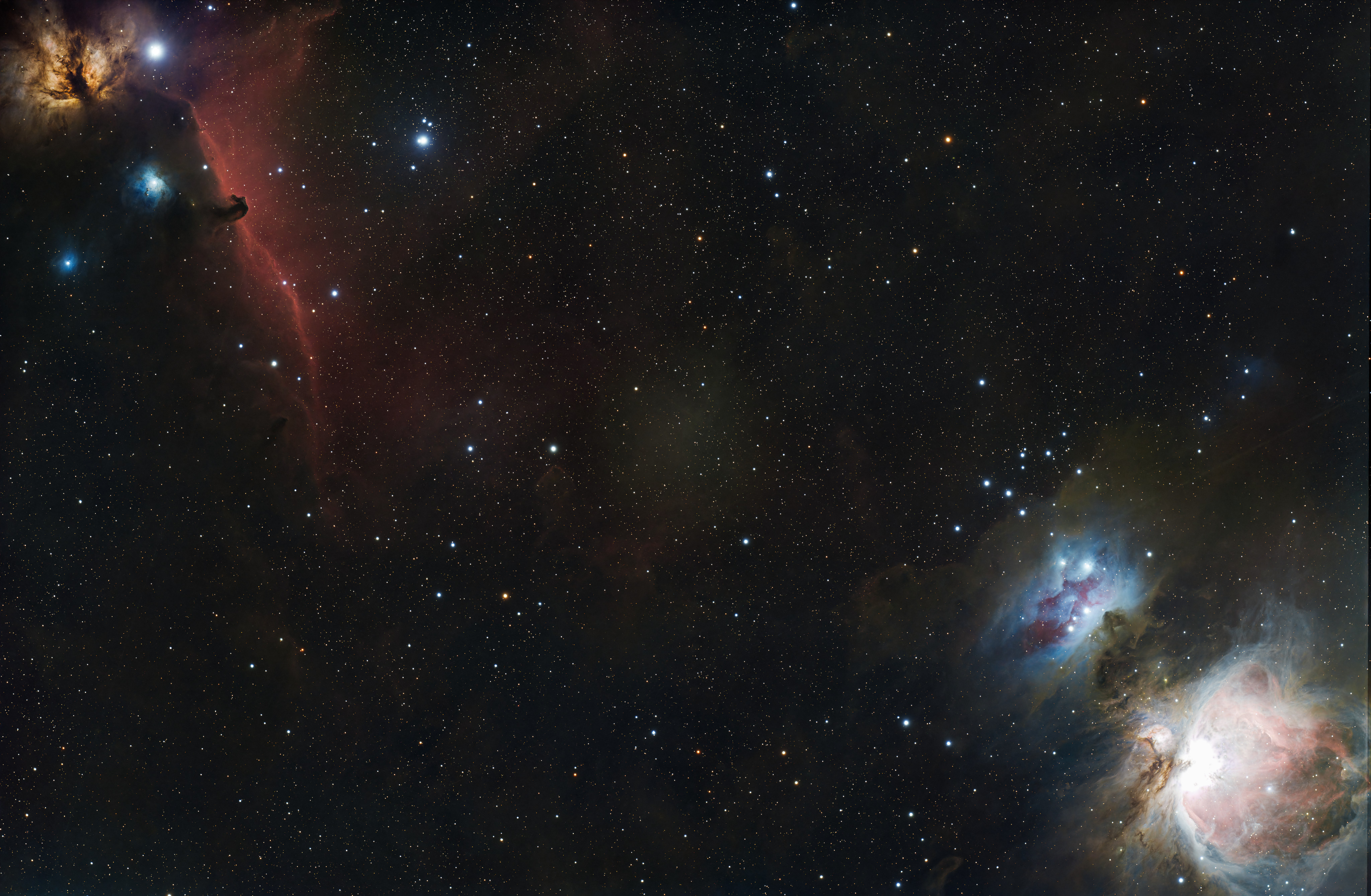
Licence: for personal use, credit Damon Scotting. Both JPEGs 4,096 x 2,677 px.
-10 C sensor set point the set point I run every cooled camera at
279 mm focal length, plate solved on the ToupTek Hope D60, which ToupTek states at 280 mm
7.39 x 4.93° field of view 8,192 x 5,460 px on ASI4400MC Pro
44.7 MP ASI4400MC Pro 8,192 x 5,460 px, 36 x 24 mm
Should you buy it?
72/100 Stars for Your Buck
Pros
- 44 megapixels of full frame: the Horsehead, the Flame and the Orion Nebula fit in one frame on the Askar SQA106.
- Big 4.4 micron pixels with a 74.6 ke- full well, for bright cores without clipping.
- Mosaics are easy: plan the panels and their overlap in the ASIAIR and let it run.
- It held the -10 C set point: my 487 July subs read a median -10.0 C.
- The same $2,999 as the ASI2400MC Pro with 44.7 megapixels against 24.
Cons
- It needs a telescope whose image circle covers a 43.3 mm diagonal to use the whole sensor.
- One-shot colour: every frame is broadband unless you add a dual-band filter, so narrowband detail through light pollution is harder than with mono.
- A little amp glow remains: ZWO says Glow Suppression reduces it but does not remove it, so dark frames stay part of the job.
- A 14-bit ADC where the ASI6200 has 16 bits.
- Each 180 s sub is an 89 MB file (8192 x 5460 at 16 bits).
I think the camera is amazing and has made putting together this immense mosaic image a piece of cake.
Who the ASI4400MC is for
Wide-field imager with a full-frame astrograph
Buy
The sensor fills a 44 mm image circle; on the Askar SQA106 it framed the Horsehead, the Flame and the Orion Nebula together.
Mosaic maker
Buy
At 44 megapixels a panel, a whole constellation takes far fewer panels, and the ASIAIR plans them for you.
Complete beginner
Skip
Start with an APS-C colour camera: it costs far less and suits the telescopes most people start with.
Narrowband imager under heavy light pollution
Skip
A mono camera with narrowband filters goes deeper: my recommendation is the ZWO ASI6200MM Pro on a full-frame astrograph.
Owner of an ASI2600MC on an APS-C telescope
Skip
Do not upgrade unless your telescope covers full frame: the extra sensor would sit outside the image circle.
Imager who wants full-frame colour for less
Skip
My recommendation is the ToupTek SkyEye 24AC: a full-frame colour sensor that scores higher on my board.
Three alternatives I have reviewed
- ToupTek SkyEye 24AC Full-frame colour with bigger 5.94 micron pixels 85/100 £1,804 Read the review
- ZWO ASI2600MC Air APS-C colour with guiding and wireless control built in 88/100 £2,149 Read the review
- SVBONY SC571CC A cooled APS-C colour camera for a fraction of the price 90/100 £1,029 Read the review
Questions and more about this review
Reviewed by
Damon Scotting
The Telescope Man Verified
BSc (Hons) Physics with Astrophysics and Cosmology, Loughborough University PGCE / QTS, University of Nottingham
About Damon About Damon Damon Scotting is The Telescope Man. He holds a BSc (Hons) in Physics with Astrophysics and Cosmology from Loughborough University and a PGCE with QTS from the University of Nottingham, and taught physics in secondary schools before becoming an astronomy creator. He is a contributing writer for BBC Sky at Night Magazine and the author of 42 Wonders of Our Night Sky, and his photograph of the galaxy M100 with the dwarf planet Ceres was Highly Commended in the Astronomy Photographer of the Year 2024 competition run by Royal Observatory Greenwich. He has appeared on the BBC's Blue Peter. More than 750,000 people follow his astronomy channels on YouTube, Instagram and TikTok, and he has reviewed more than 140 telescopes, mounts, cameras, filters and accessories hands-on for this site. More about Damon · How I test · Damon's book
I review all kinds of gear: most of it I buy, some is gifted and some is loaned, and all of it is reviewed the same way. How this site is funded
Seven questions, answered
Questions about the ASI 4400MC
Reviewed 30 January 2026 ·Updated 24 September 2026
I review all kinds of gear. Most of it I buy, some is gifted and some is loaned, and all of it is reviewed the same way: no company sees or approves a review before it is published. Shop links marked Ad are affiliate links: I earn a commission when you buy through them, at no extra cost to you. How this site is funded
- Is the ZWO ASI4400MC Pro worth it? On a full-frame astrograph, yes: 44 megapixels of colour made my Orion mosaic a piece of cake. On an APS-C telescope, no: most of the sensor sits outside the image circle and an APS-C camera costs far less. What I captured ↓
- Is the ASI 4400MC full frame? Yes. It is a 36 x 24 mm colour sensor (Sony IMX366) with 8192 x 5460 pixels of 4.4 microns. The specifications and the comparison table ↓
- Which telescopes did I use it on? The Askar SQA106, the Askar SQA130 and the ToupTek Hope D60, which carried it for 487 subs of 180 s in July 2026. What I captured ↓
- How cold does it run? I run it at a -10 C set point and my 487 July subs read a median of -10.0 C. ZWO rates the cooling at 30 to 35 C below ambient. Tested numbers and the download ↓
- ASI4400MC Pro or ASI6200MM Pro? The ASI4400MC Pro gives colour in one exposure with 4.4 micron pixels; the ASI6200MM Pro has 61 megapixels of mono and goes deeper through narrowband filters, but needs a filter wheel and costs more. Both need a full-frame image circle. Versus the ZWO ASI6200MM Pro ↓
- How much does the ASI4400MC Pro cost and where can I buy it? The prices I recorded: £3,299 at First Light Optics (UK), awaiting stock; $2,999 at Agena Astro (US), in stock; $2,999 at ZWO store (Global), in stock. A record, not a live price The verdict, the readers and the sellers ↓
- What have I not tested on the ASI4400MC? Read noise, full well and amp glow: I quote ZWO figures and have not measured them.