ToupTek SkyEye 24AC review: a full-frame taster, two scopes
Where does it rank on our leaderboard
| Rank | Camera | Stars for Your Buck | Recorded UK price |
|---|---|---|---|
| 1 | SVBONY SV705C | 93 out of 100 | £229 |
| 2 | SVBONY SC571CC | 90 out of 100 | £1,029 |
| 5 | ToupTek SkyEye 24AC | 85 out of 100 | £1,804 |
| 8 | ZWO ASI2600MC Duo | 83 out of 100 | £1,849 |
| 12 | ZWO ASI533MC | 77 out of 100 | £859 |
| 21 | ZWO ASI2600MC | 72 out of 100 | £1,599 |
| 25 | ZWO ASI2600MM | 62 out of 100 | £2,059 |
| 28 | ZWO ASI183MC | 38 out of 100 | £549 |
| 29 | Nikon COOLPIX P1000 | 32 out of 100 | £787 |
Contents
- 01 Where does it rank on our leaderboard
- 02 Specifications and features
- 03 In the hand
- 04 The rig on the mount
- 05 How good is it? Here is what it captured
- 06 Raw against finished
- 07 Watch the review
- 08 Tested numbers and the download
- 09 Should you buy it?
- 10 Questions and more about this review
In 30 seconds
Stars for Your Buck 85/100
Reviewed 24 Oct 2025 Updated 21 Sep 2026
- Rank
- #5 of 29 cameras
- Verdict
- Damon's pick
Written by Damon Scotting 4 min read
Buy it if
- You want a cooled full-frame colour camera: 24 megapixels of 5.94 um pixels on a 36 x 24 mm sensor, for wide fields and big pixels
- Your telescope can light a full-frame sensor: a 43.3 mm image circle or more, with 17.5 mm of back focus to spare (55 mm with the boxed extenders)
Skip it if
- Your telescope has a small image circle or you image at long focal lengths: an APS-C body like the same maker's ATR2600C costs £1,127 against £1,804
- You want a computer or wireless control inside the camera: this one runs from a laptop or a controller over USB 3.0 and 12 V
“This week I'm testing out the monstrous camera sensor of the new ToupTek SkyEye 24AC camera.”
Specifications and features
Against the cameras I have reviewed
Compare with
| ToupTek SkyEye 24AC reviewed #5 of 29 | ASI 4400MC #20 of 29 | ZWO ASI6200MC #27 of 29 | ToupTek ATR2600C #10 of 29 | |
|---|---|---|---|---|
| Recorded UK price | £1,804 | £3,299 | £3,999 | £1,127 |
| Stars for Your Buck | 85/100 | 72/100 | 59/100 | 80/100 |
| Sensor | Sony IMX410, full frame (36.0 x 24.0 mm) | Sony IMX366, full frame | Sony IMX455, full frame | Sony IMX571, APS-C |
| Format | Full frame | Full frame, 36 x 24 mm | Full frame, 36 x 24 mm | APS-C, 23.4 x 15.7 mm, 28.3 mm diagonal |
| Colour or mono | Colour | Colour | Colour | Colour |
| Resolution | 6064 x 4040, 24.5 MP | 8192 x 5460, 44.7 MP | 9576 x 6388, 61.2 MP | 6248 x 4176, 26.1 MP |
| Pixel size | 5.94 um | 4.4 um | 3.76 um | 3.76 um |
| Cooling | Two-stage TEC, 30 to 35 C below ambient, -10 C set point | TEC; -10 C set point on my nights | TEC, 35 C below ambient by the site data | Two-stage TEC, 35 C below ambient (short exposures) to 42 C (long) |
| Read noise | 4.48 to 1.95 e- in low gain, 0.68 to 0.3 e- in high gain | 1.1 e- | 0.86 e- | 0.79 to 2.77 e- |
| Full well | 104 ke- | 74.6 ke- | 51.4 ke- | 51 ke- |
| ADC | 14-bit | 14-bit | 16-bit | 16-bit |
| Weight | 0.718 kg (maker), not on my scale | 700 g | 700 g | 577 g |
| Back focus | 17.5 mm (55 mm with the boxed extenders) | 17.5 mm | 17.5 mm, 55 mm with the boxed extenders | 17.5 mm |
| Interface | USB 3.0, a two-port USB hub, DC 12 V | USB 3.0 | USB 3.0 | USB 3.0 |
| In the box | The camera, a 12 V 3 A adapter, a 1.5 m USB 3.0 cable, a CD, a hex key, M54M-M48F 21 mm and M48M-M48F 16.5 mm extenders, an M48M-M42F adapter; the product page adds a free tilt plate (the manual's packing list, the maker's product image) | The camera, a 2 inch silicone dust cover, M48-M48 16.5 mm and M54-M48 21 mm extenders, an M42M-M48F adapter, two 0.5 m USB 2.0 cables, a 2 m USB 3.0 cable, a hex key, a quick guide and a camera bag | The camera, M48-M48 16.5 mm and M54-M48 21 mm extenders, an M42M-M48F adapter, a dust cover, a 2 m USB 3.0 cable, two 0.5 m USB 2.0 cables, a hex key, a quick guide and a camera bag | Camera with its 2 inch adapter, 12 V 3.3 A power adapter and cable, 1.5 m USB 3.0 cable, M48 to M42 adapter, 16.5 mm and 21 mm extenders, 12.5 mm M42 adapter, cover |
In the hand
Six frames of my 4K turntable clip, 4 Sep 2025
The rig on the mount
On the JUWEI-17, then on six other mounts
How good is it? Here is what it captured
Two wide fields on the Hope D60
M31 Andromeda Galaxy
- Integration
- 60 min (12 x 5 min)
- Field
- 7.40 x 4.76 degrees
- Telescope
- ToupTek Hope D60
- Camera
- SkyEye 24AC
- Mount
- EM31 Pro
- Target
- M31 Andromeda Galaxy
- Type
- galaxy
- Location
- Bortle 6.8 (in my garden)
NGC 7000 North America Nebula
- Integration
- Unknown
- Field
- 7.40 x 4.76 degrees
- Telescope
- ToupTek Hope D60
- Camera
- SkyEye 24AC
- Mount
- EM31 Pro
- Target
- NGC 7000 North America Nebula
- Type
- emission nebula
- Location
- Bortle 6.8 (in my garden)
Raw against finished
Watch the review
The 3 targets, the raw combined stack against my finished image, each with its integration, the camera and the palette:
- NGC 7000 North America Nebula: 30 min (10 x 180 s) of light, SkyEye 24AC, the raw combined stack with one automatic stretch
- M31 Andromeda Galaxy: 30 min (10 x 180 s) of light, SkyEye 24AC, the raw combined stack with one automatic stretch
- IC 1805 Heart Nebula: 9 min (3 x 180 s) of light, SkyEye 24AC, the raw combined stack with one automatic stretch
I tried out this Monsterous $2400 Camera from ToupTek astro! · published 24 October 2025 · 0:52 · Watch on YouTube · 54,232 views, 1,260 likes on 2 Oct 2026
Jump to
- 0:17 On the Hope D60: Andromeda and the North America Nebula, one hour each by my captions
- 0:30 On the Askar 91F: three targets, very short exposures
- 0:44 What do you think of this little taster?
Transcript of the review video 176 words · 3 chapters · searchable
Press a time stamp to play from there.
0:00 The monstrous sensor: full-frame IMX410, 24 megapixels, 5.94 um pixels
0:00 This week I'm testing out the monstrous camera sensor of the new Tooptech SkyEye 24 AC camera. 0:06 It uses the full-frame Sony IMX410 sensor which means it boasts 24 megapixel images with a huge pixel size of 5.94. 0:15 But how does it fare when it comes to our night sky?
0:17 On the Hope D60: Andromeda and the North America Nebula, one hour each by my captions
0:17 To start with I paired the camera with Tooptech's new HOPE D60 telescope. 0:21 It's 5-element F4.66 design creates a bright and wide view of our night sky. 0:26 As you can see from these images of the Andromeda Galaxy and the North American Nebula. 0:30 So since the camera is so large, I decided to partner it with a larger scope and capture these very short exposure images of the Andromeda Galaxy, the North America Nebula and three different 3 minute exposures of the Hart Nebula stacked together.
0:30 On the Askar 91F: three targets, very short exposures
0:44 Let me know what you think of the camera in the comments down below, I've attached a link to their product page where you can read the full list of specifications but what do you think of this little taster?
Check out more videos on the ToupTek SkyEye 24AC
I tried out this BRAND NEW $849 telescope from ToupTek astro!
23 Oct 2025
Tested numbers and the download
Finished image
- Download the raw stack JPEG · 3.9 MB · 4,096 x 2,729
- Download the finished image JPEG · 3.9 MB · 4,096 x 2,729
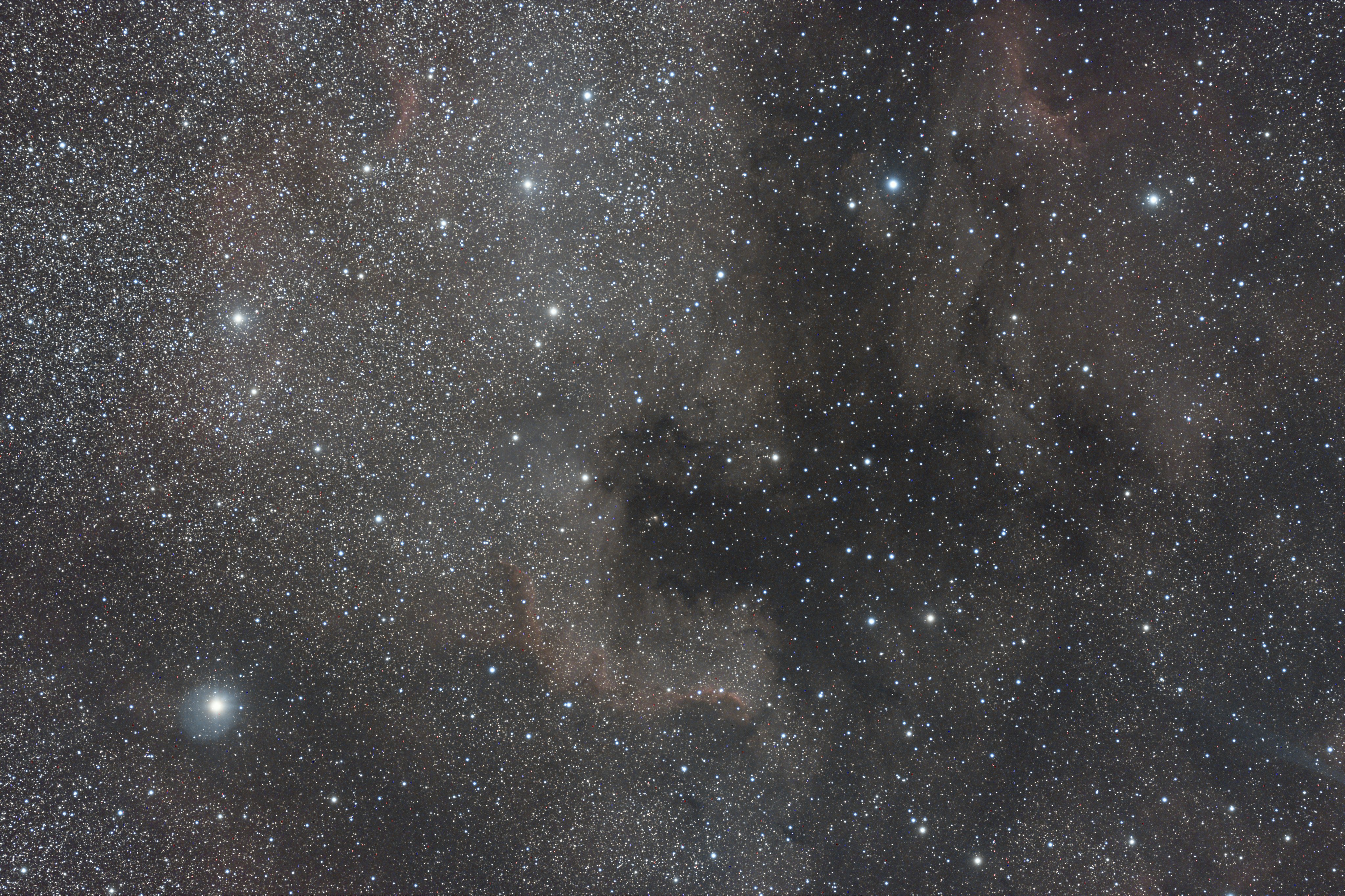
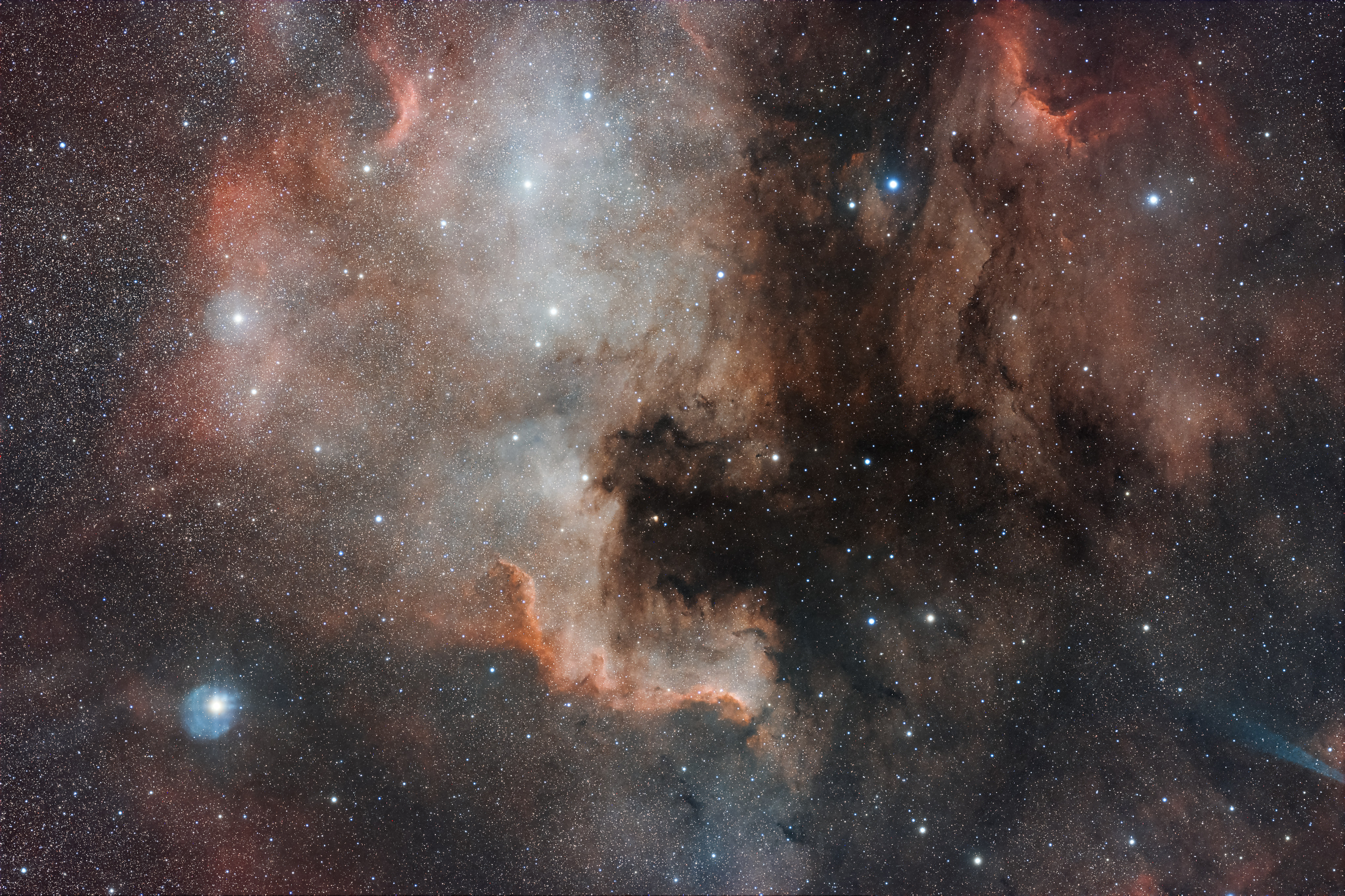
Licence: for personal use, credit Damon Scotting. Both JPEGs 4,096 x 2,729 px.
-10 C sensor set point the set point I run every cooled camera at
611 mm focal length, plate solved 279 mm on the Hope D60 (its tube says 280 mm)
3.38 x 2.25° field of view 6,064 x 4,040 px on SkyEye 24AC, full frame
24.5 MP SkyEye 24AC, full frame 6,064 x 4,040 px, 36.0 x 24.0 mm
Should you buy it?
85/100 Stars for Your Buck
Pros
- “It boasts 24 megapixel images with a huge pixel size of 5.94 µm.”
- “The field of view produced with this telescope and camera is huge.”
- Full frame at £1,804: the ASI 4400MC on my board is £3,299 and the ASI6200MC £3,999 (13 Sep 2026).
Cons
- Full frame needs a telescope with a 43.3 mm image circle and the back focus to match: 17.5 mm from the flange, 55 mm with the boxed extenders.
- £677 more than the same maker's APS-C ATR2600C (£1,127 at Dark Clear Skies, 13 Sep 2026) for the bigger sensor.
- No computer or wireless control inside: a laptop or a controller on USB 3.0 and a 12 V supply every night.
- Sold out at the maker's own store on 21 Sep 2026; the UK price is one retailer's.
Let me know what you think of the camera in the comments down below, I've attached a link to their product page where you can read the full list of specifications but what do you think of this little taster?
Who the SkyEye 24AC is for
Wide-field imager whose telescope lights a full-frame sensor
Buy
“Then I went for the Andromeda Galaxy, and as you can see, the field of view produced with this telescope and camera is huge.”
Owner of a fast, wide astrograph who images in short windows
Buy
“All of the exposure times for these targets were really short since I had to make the most of it before the clouds rolled in.”
Laptop or mini PC imager who runs ASCOM, SharpCap or PHD2
Buy
ASCOM and the desktop capture programs are the maker's software list; USB 3.0 and 12 V are the only connections.
Owner of a small refractor or a scope with an image circle under 43 mm
Skip
The 43.3 mm diagonal wants a full-frame image circle and 17.5 mm of back focus, 55 mm with the boxed extenders.
Imager on a budget who would take APS-C
Skip
The same maker's ATR2600C was £1,127 at Dark Clear Skies on 13 Sep 2026 against £1,804 for this camera.
Anyone who wants a computer or wireless control in the camera
Skip
No computer or Wi-Fi inside: it is a USB 3.0 camera run from a laptop or a controller.
Three alternatives I have reviewed
- ASI 4400MC the other reviewed full-frame colour camera near this price: 44.7 MP of 4.4 um pixels, the camera on my Hope D60 72/100 £3,299 Read the review
- ZWO ASI6200MC the 61 MP full-frame colour camera of my Askar comparison video 59/100 £3,999 Read the review
- ToupTek ATR2600C the same maker's APS-C body at well under the price, with a dedicated review video 80/100 £1,127 Read the review
Questions and more about this review
Reviewed by
Damon Scotting
The Telescope Man Verified
BSc (Hons) Physics with Astrophysics and Cosmology, Loughborough University PGCE / QTS, University of Nottingham
About Damon About Damon Damon Scotting is The Telescope Man. He holds a BSc (Hons) in Physics with Astrophysics and Cosmology from Loughborough University and a PGCE with QTS from the University of Nottingham, and taught physics in secondary schools before becoming an astronomy creator. He is a contributing writer for BBC Sky at Night Magazine and the author of 42 Wonders of Our Night Sky, and his photograph of the galaxy M100 with the dwarf planet Ceres was Highly Commended in the Astronomy Photographer of the Year 2024 competition run by Royal Observatory Greenwich. He has appeared on the BBC's Blue Peter. More than 750,000 people follow his astronomy channels on YouTube, Instagram and TikTok, and he has reviewed more than 140 telescopes, mounts, cameras, filters and accessories hands-on for this site. More about Damon · How I test · Damon's book
I review all kinds of gear: most of it I buy, some is gifted and some is loaned, and all of it is reviewed the same way. How this site is funded
Nine questions, answered
Questions about the ToupTek SkyEye 24AC
Reviewed 24 October 2025 ·Updated 21 September 2026
I review all kinds of gear. Most of it I buy, some is gifted and some is loaned, and all of it is reviewed the same way: no company sees or approves a review before it is published. Shop links marked Ad are affiliate links: I earn a commission when you buy through them, at no extra cost to you. How this site is funded
- Is the ToupTek SkyEye 24AC an all-in-one camera with a computer inside? No. It is a cooled full-frame colour camera on USB 3.0 with a 12 V jack, run from a laptop or a controller: the maker's manual lists ASCOM and the desktop capture programs, and my night frame shows the laptop on the table beside the Askar 91F. The production page's "built-in computer" and "StellaVita" wording describes a different product and is not used here. The specifications and the comparison table ↓
- What sensor is in the SkyEye 24AC? It uses the full-frame Sony IMX410 sensor which means it boasts 24 megapixel images with a huge pixel size of 5.94 µm. 6064 x 4040 pixels on every export of mine, 36.0 x 24.0 mm, 14 bit, by my spec card and the maker's manual. From my video review The specifications and the comparison table ↓
- Which telescopes did I use the SkyEye 24AC on? To start with I paired the camera with ToupTek's new HOPE D60 telescope. So since the camera is so large, I decided to partner it with a larger scope and capture these very short exposure images of the Andromeda Galaxy, the North America Nebula and three different 3 minute exposures of the Heart Nebula stacked together. The larger scope is the Askar 91F: my captions read "ToupTek Skyeye 24AC + Askar 91F", and my plate solves give 611 mm on it and 279 mm on the Hope D60. From my video review The rig on the mount ↓
- How long were the exposures? By my captions: 12 x 5 min (one hour) on the Hope D60 for Andromeda, and on the Askar 91F 10 x 3 min (half an hour) each for Andromeda and the North America Nebula and 3 x 3 min (nine minutes) for the Heart. The D60 North America frame is captioned 12 x 5 min but its file name says 10 x 3 min, so its integration is not recorded. The raw stacks against the finished images ↓
- How much does the SkyEye 24AC cost? The prices I recorded: £1,804 at Dark Clear Skies (UK), in stock; $2,199 at Agena Astro (US), in stock; $2,199 at ToupTek Astro (Global), out of stock. My Short captioned it $2,400 in October 2025. First Light Optics does not stock ToupTek. A record, not a live price The verdict, the readers and the sellers ↓
- How does the SkyEye 24AC compare with the ASI 4400MC? Both are cooled full-frame colour cameras I have reviewed. The ASI 4400MC scores 72 on my board to the SkyEye's 85 and cost £3,299 at First Light Optics against £1,804 at Dark Clear Skies on 13 Sep 2026; its IMX366 sensor packs 8192 x 5460 pixels of 4.4 µm where the SkyEye has 6064 x 4040 of 5.94 µm. No side-by-side of the two was filmed or stacked. The specifications and the comparison table ↓
- Was the cooling tested? No cooling log, sensor temperature, dark or bias frame from this camera exists on disk. The maker's manual claims 30 C below ambient on short exposures and 35 C on long ones; the Dark Clear Skies listing says 40 C. Neither figure is mine. Tested numbers and the download ↓
- Why does the SkyEye 24AC score 85? 85 of 100 Stars for Your Buck, rank 5 of the 29 cameras on my board. Its full-frame IMX410 sensor with big 5.94 µm pixels gives a huge field of view for £1,804, well under the other full-frame colour cameras I have reviewed; against it, it needs a telescope with a full-frame image circle and a laptop or controller every night. The verdict, the readers and the sellers ↓
- What have I not tested on the SkyEye 24AC? No cooling log, sensor temperature, dark, bias or flat frame from this camera exists: the cooling, noise and amp glow are not measured.