Askar SQA85 review: f/4.8 speed, pinpoint stars to the corners
Where does it rank on our leaderboard
| Rank | Telescope | Stars for Your Buck | Recorded UK price |
|---|---|---|---|
| 1 | Askar 50P | 95 out of 100 | £299 |
| 2 | ToupTek Hope D60 | 93 out of 100 | £749 |
| 4 | Askar SQA106 | 91 out of 100 | £3,395 |
| 7 | Askar SQA85 | 88 out of 100 | £2,395 |
| 19 | Sky-Watcher Heliostar 76Ha | 74 out of 100 | £2,399 |
| 24 | Celestron NexStar 6SE | 72 out of 100 | £1,199 |
| 35 | Celestron 8 inch RASA | 53 out of 100 | £2,595 |
| 41 | Celestron 114 LCM | 42 out of 100 | £361 |
| 42 | Celestron AstroMaster LT 76 | 13 out of 100 | £200 |
Contents
- 01 Where does it rank on our leaderboard
- 02 Specifications and features
- 03 In the hand
- 04 How good is it? Here's what I captured
- 05 Raw against finished
- 06 The rig on the mount
- 07 What is it for
- 08 Watch the review
- 09 Tested numbers and the download
- 10 Should you buy it?
- 11 Questions and more about this review
In 30 seconds
Stars for Your Buck 88/100
Reviewed 20 Jan 2025 Updated 23 Sep 2026
- Rank
- #7 of 42 telescopes
- Verdict
- Damon's pick
Written by Damon Scotting 5 min read
Buy it if
- You image from light-polluted skies and want f/4.8 speed with the flattener already built in.
- You want round stars into the corners without buying a separate reducer or flattener.
- You travel with your kit and want an 85 mm astrograph that packs into its own soft case.
Skip it if
- Your budget is nearer £800: the SQA55 is the smaller model from the same range.
- You mainly image planets or small galaxies: 408 mm is a wide-field focal length.
The Askar SQA85 has lived up to its price tag: it produces very premium images, with pinpoint, round stars and especially vibrant colours.
Specifications and features
Against the telescopes I have reviewed
Compare with
| Askar SQA85 reviewed #7 of 42 | Askar SQA106 #4 of 42 | Askar 91F #6 of 42 | Askar 103APO #13 of 42 | Askar 71F #14 of 42 | |
|---|---|---|---|---|---|
| Recorded UK price | £2,395 | £3,395 | £995 | £999 | £599 |
| Stars for Your Buck | 88/100 | 91/100 | 89/100 | 81/100 | 81/100 |
| Aperture | 85 mm | 106 mm | 91 mm | 103 mm | 71 mm |
| Focal length | 408 mm | 509 mm | 609 mm | 700.4 mm | 490 mm |
| Focal ratio | f/4.8 | f/4.8 | f/6.7 | f/6.8 | f/6.9 |
| Optical design | Quintuplet Petzval APO, two SD elements | Quintuplet Petzval APO, two SD elements | Quadruplet APO, one ED element, self-flattening | Triplet APO, one ED element | Quadruplet APO, one ED element, self-flattening |
| Image circle | Full frame | 44 mm full frame, 55 mm rated | 44 mm | 44 mm with the optional flattener | 44 mm |
| Back focus | 40 to 70 mm, 55 mm recommended | 48 to 78 mm, 55 mm recommended | 45 to 75 mm from M48 | 55 mm with the optional flattener | Up to 82.5 mm from M48 |
| Focuser | 2.8 inch dual-speed rack and pinion, 32 mm travel | 2.8 inch dual-speed, 30 mm travel | 3 inch dual-speed rack and pinion, 30 mm travel | 3.3 inch dual-speed rack and pinion | 2.4 inch dual-speed rack and pinion |
| Weight, tube | 3.64 kg; 4.62 kg with ring and dovetail | 5.82 kg; 8.12 kg with ring and dovetail | 3.92 kg; 4.52 kg with rings and dovetail | 4.75 kg; 5.5 kg with rings and dovetail | 2.5 kg; 3.0 kg with rings and dovetail |
| Length, tube | 403 mm; 439 mm dew shield out | 516 mm; 586 mm dew shield out | 513 mm; 599 mm dew shield out | 600 mm; 711 mm dew shield out | 372.5 mm; 430.9 mm dew shield out |
| Dew shield | Retractable | Retractable | Retractable | Retractable | Retractable |
| In the box | OTA in an Oxford cloth case | OTA in an Oxford cloth case | OTA, rings, handle, Vixen dovetail, adapters | OTA, rings, handle, Vixen dovetail, cloth case | OTA, rings, handle, Vixen dovetail, adapters |
In the hand
Six frames from my videos
On the JUWEI-17
On the ZWO AM5N
With the ZWO ASI2600MC Duo
Close up of the Askar SQA85
The engraved rotator scale
Imaging the North America Nebula
How good is it? Here's what I captured
Three targets
NGC 2237 Rosette Nebula, ASI2600MC Duo
- Integration
- 35 min (7 x 300 s)
- Field
- 3.24 x 2.17 degrees
- Telescope
- Askar SQA85
- Camera
- ZWO ASI2600MC Duo
- Mount
- ZWO AM5N
- Target
- NGC 2237 Rosette Nebula
- Type
- Emission nebula with an open cluster
- Location
- Bortle 6.8 (in my garden)
I only took seven five-minute exposures to create this stacked image, but I love the abundance of contrasting red and blue.
NGC 2264 Christmas Tree Cluster and Hubble's Variable Nebula, ASI2600MC Duo
- Integration
- 2 h (24 x 300 s)
- Field
- 3.29 x 2.20 degrees
- Telescope
- Askar SQA85
- Camera
- ZWO ASI2600MC Duo
- Mount
- ZWO AM5N
- Target
- NGC 2264 Christmas Tree Cluster and Hubble's Variable Nebula
- Type
- Open cluster with emission and reflection nebulae
- Location
- Bortle 6.8 (in my garden)
I pushed targets to the edges to test how uniform the view is, and the colours translate very well into the corners.
NGC 2174 Monkey Head Nebula and IC 443 Jellyfish Nebula, ASI2600MC Duo
- Integration
- 1 h 30 min (18 x 300 s)
- Field
- 3.28 x 2.18 degrees
- Telescope
- Askar SQA85
- Camera
- ZWO ASI2600MC Duo
- Mount
- ZWO AM5N
- Target
- NGC 2174 Monkey Head Nebula and IC 443 Jellyfish Nebula
- Type
- Emission nebula and supernova remnant
- Location
- Bortle 6.8 (in my garden)
Two deep-sky objects at opposite corners, and the corners hold sharp, pinpoint stars.
Raw against finished
The rig on the mount
The 3 targets, the unprocessed side against my finished image, each with its integration, the camera and the palette:
- NGC 2237 Rosette Nebula: 35 min (7 x 300 s) of light, ASI2600MC Duo, the stacked image with GraXpert background extraction and denoising and one stretch, before my processing
- NGC 2264 Christmas Tree Cluster and Hubble's Variable Nebula: 2 h (24 x 300 s) of light, ASI2600MC Duo, the stacked image with one stretch, before my processing
- NGC 2174 Monkey Head Nebula and IC 443 Jellyfish Nebula: 1 h 30 min (18 x 300 s) of light, ASI2600MC Duo, the stacked image with GraXpert background extraction and denoising and one stretch, before my processing
On the JUWEI-17, then on six other mounts
What is it for
Five things it is for
No reducer to buy
It has an aperture of 85 mm and a focal length a little over 400 mm, and it is a quintuplet Petzval refractor.
Two targets, two corners
To really test the SQA85 I framed my first target with two deep-sky objects at opposite corners: the Monkey Head Nebula at one end, the star Propus and the Jellyfish Nebula, a supernova remnant, at the other. From a single five-minute exposure with a colour camera and no filters, the corners show sharp, pinpoint stars.
Round stars every single time
I analysed a single frame from each target with the PixInsight aberration tool, so it is not a fluke or a hand-picked best frame: this telescope delivers pinpoint stars every single time.
Built to travel
It is very small, which makes it easy to travel with, and it arrives in its own soft foam carry case. With a camera and a mount the whole setup stays lightweight and portable.
Room for accessories
There are two dovetail mounting options on the SQA85 for accessories such as a mini PC or a finderscope.
Watch the review
Askar SQA85 Review · published 20 January 2025 · 7:36 · Watch on YouTube · 19,330 views, 593 likes on 2 Oct 2026
Jump to
- 0:38 Specifications
- 0:57 Small enough to carry on board
- 1:21 My imaging setup
- 2:09 Two targets, two corners: Monkey Head and Jellyfish
- 3:04 The Rosette Nebula
- 3:26 The aberration check: round stars every time
- 4:00 The Christmas Tree field
- 5:26 Verdict
- 5:54 The SQA55 alternative
Transcript of the review video 1,373 words · 11 chapters · searchable
Press a time stamp to play from there.
0:00 The price question
0:00 Over the last couple of months, you will have been seeing this telescope featured a lot in my recent videos. 0:05 It is the Askar SQA85, a super quintuplet astrograph telescope, and it is stunning. 0:12 But let's first address the elephant in the room, the cost. 0:15 In my most recent video, What Telescope Should You Buy in 2025, the most expensive pick on my list was this telescope, currently priced at $2,395, which certainly puts it into the more premium budget category. 0:28 But does the quality of the telescope justify its cost? 0:31 Let's find out. 0:31 I'm Damon Scotting and this is Astronomical.
0:38 Specifications
0:39 So first things first, let's learn about the specifications of this telescope. 0:43 It's got an aperture of 85 millimetres and a focal length a little over 400 millimetres, making this a very fast telescope, which means there's no need for purchasing any additional expensive focal reducers and flatteners. 0:52 It's a quintuplet Petzval refractor telescope very small in size making it super easy to travel with.
0:57 Small enough to carry on board
0:57 The telescope arrived packaged inside its very own soft foam carry case which is unbelievably handy since if and when I travel with my telescope gear I much prefer to take my telescope on board with me as carry-on. 1:07 The telescope is full frame which means it's compatible with 48, 54 and 68 millimetre camera adapters.
1:11 Full frame: 48, 54 and 68 mm adapters
1:17 So, so far so good. 1:17 The specifications of the telescope are very appealing.
1:21 My imaging setup
1:22 So let's get it set up and taking images of our night sky. 1:22 Here's the equipment I chose to pair this telescope with. 1:26 I decided to install a budget-friendly autofocuser that matched the colour scheme of the SQA85. 1:31 You can see how I did so in my other video. 1:31 I then attached an ASI 2600MC Duo camera and placed the telescope upon an AM5N mount, which all in all still makes the entirety of this setup very lightweight and portable. 1:47 There are two dovetail mounting options on the scope for you to attach accessories such as your mini PC or finderscope, but since I'm using the ASI 2600MC Duo I don't actually need a finderscope. 1:55 On the advertisements for the SQA85 it boasts about its superior star performance. 2:00 Well now let's see how good it really is. 2:00 Here are some of the single unprocessed images I captured with this telescope from my back garden in England.
2:09 Two targets, two corners: Monkey Head and Jellyfish
2:09 So in order to really test the scope my first target has been framed to include two different DSOs at opposite corners of the image. 2:13 We're hoping for pinpoint stars and accurate colours across the board. 2:17 To show you precisely what that doesn't look like here's an aberration spotter image that showcases the corners and centre part of an image that I took of the Andromeda Galaxy last year. 2:28 As you can see the stars towards the middle are fine, nice and round, but those in a corner are gradually more and more horrific. 2:35 This is a single 5 minute long exposure image captured with a colour camera, no filters used. 2:40 In the top left hand corner you can see the monkey head nebula, whilst towards the bottom right you can see the star Propus and the jellyfish nebula, a supernova remnant also known as IC 443. 2:51 I like it, and as you can see from the corners of the image, the telescope does a really good job of providing you with sharp pinpoint stars. 2:57 I carried on imaging this area and stacked 18 5 minute long exposures to give me this one and a half hour stacked image.
3:04 The Rosette Nebula
3:04 Next up I decided to go for the beautiful Rosette Nebula. 3:07 At 408mm focal length the SQA85 boasts a relatively wide field of view, which I suppose you could argue for this image is a little too wide, but I'd prefer it. 3:17 since we can see a rich variety of colourful stars surrounding this open star cluster. 3:22 Once again beautiful round stars throughout the image. 3:22 Yeah I don't really see star shapes being a problem at all with this telescope, but I will use the PixInsight aberration tool to analyse a single frame from each of today's targets purely because it helps illustrate that it's not a fluke or a one off or I've specifically chosen the best frame.
3:26 The aberration check: round stars every time
3:39 This telescope is in fact delivering pinpoint stars every single time. 3:39 I only took 7 5 minute long exposures to create this stacked image but it's very nice. 3:44 The colours that the SQA85 and the ASI 2600MC duo have managed to bring out together make this a gorgeous astro image. 3:53 I love it when you get a high abundance of contrasting red and blue colours throughout your image.
4:00 The Christmas Tree field
4:00 And then lastly for the final image I picked the most decorated deep sky field of view that I could find in the skies and that included a Christmas tree, a star cluster and a variable nebula. 4:08 I bet you can't spot the last one. 4:13 When testing out this telescope, I've been very keen to push targets to the edges of the image. 4:16 I really want to test how uniform the views are with the scope. 4:16 How nice will the colours translate when they are put right in the corners? 4:21 Well, as you can see from a single 5 minute long exposure, very well indeed. 4:28 Let's switch to the view of the stacked image. 4:28 This is 24 x 5 minute long exposures. 4:33 I've bumped up the colours a little bit so now you can really see this variance across the image. 4:36 On the right here we have the Christmas tree nebula, but I'd argue that it's only real similarity to a Christmas tree is that there's a star on top and there are bright lights going around it. 4:44 But here's the real question, can you spot Hubble's Variable Nebula? 4:49 It looks like a small white ghostly cape around a white star. 4:54 Here's an image of it that I captured the other night with my 8 inch Celestron SCT and a 0.7x reducer. 5:20 So have you found it yet? 5:23 right it's at the very top of your screen or the bottom if you live in Australia.
5:26 Verdict
5:26 Wait what? 5:26 So the first thing that we noted at the start of this review video was that this telescope was listed at a premium price of $2,395 but it's safe to say that it's lived up to its price tag as it is producing very premium images. 5:41 The stars are pinpoint and round and the colours are especially vibrant. 5:45 The scope is lightweight and portable enough that I will be taking it with me on my next trip and all I'll have to do is pop it into its included carry case. 5:51 But what if you're watching this and thinking oh that's amazing I would love to have that telescope but it's three times my budget.
5:54 The SQA55 alternative
5:55 Well then I would strongly recommend that you check out the SQA55 priced at just $795. 5:59 It is being dubbed as the new successor to the immensely popular Redcat 51. 6:07 Based on other users reviews that I've seen online the SQA55 is not only cheaper than the Redcat 51 but it's producing even better images. 6:19 This telescope is simply a smaller model from the same range as the SQA85. 6:23 I actually really like my Redcat so to see this opinion from so many other astrophotographers is really exciting to hear. 6:28 If you'd like to check out the SQA85 telescope for yourself then I've included a link to it in the description below, as well as a link for its smaller brother the SQA55. 6:36 The bottom line is, Sharpstar have released another beautiful little scope capable of capturing exceptional images. 6:42 If you haven't seen my review on the Askar 71F which is $599, I'd highly recommend checking that out. 6:47 I use the same camera as the one in this video so the results themselves are somewhat comparable. 6:52 Thanks for watching. 6:59 I know we're only two weeks into 2025 but I have a very strong feeling that this right here is going to be one of the best buys of the year. 7:06 So subscribe to see how I get on with this telescope in the future. 7:10 Thanks for watching, I'm Damon Scotting and this was Astronomical.
Check out more videos on the Askar SQA85
What Telescope should you BUY in 2025?
20 Dec 2024
CHEAP v.s EXPENSIVE Telescope Gear?!
18 Dec 2024
Tested numbers and the download
Finished image
- Download the raw stack JPEG · 4.2 MB · 4,096 x 2,733
- Download the finished image JPEG · 4.0 MB · 4,096 x 2,733
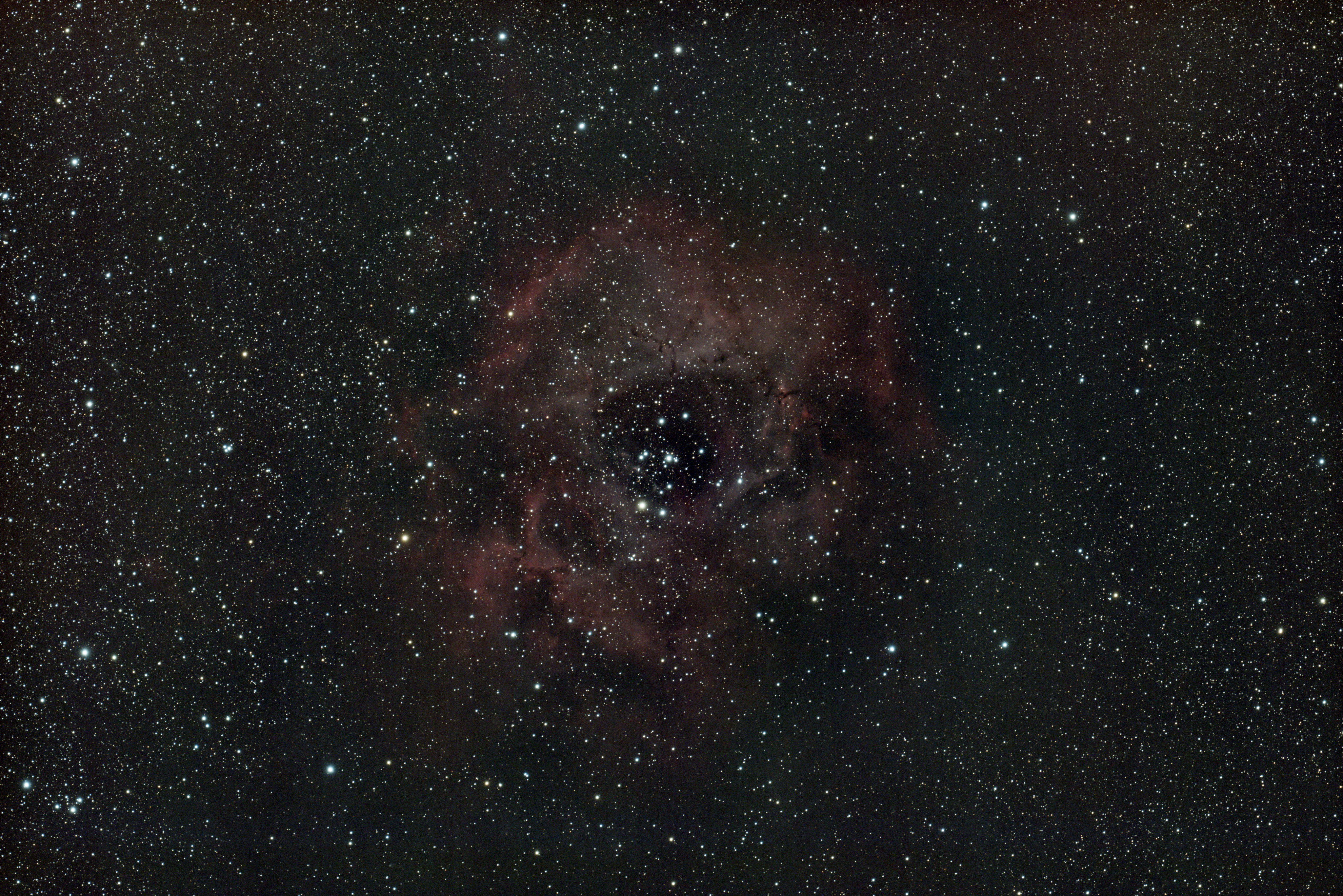
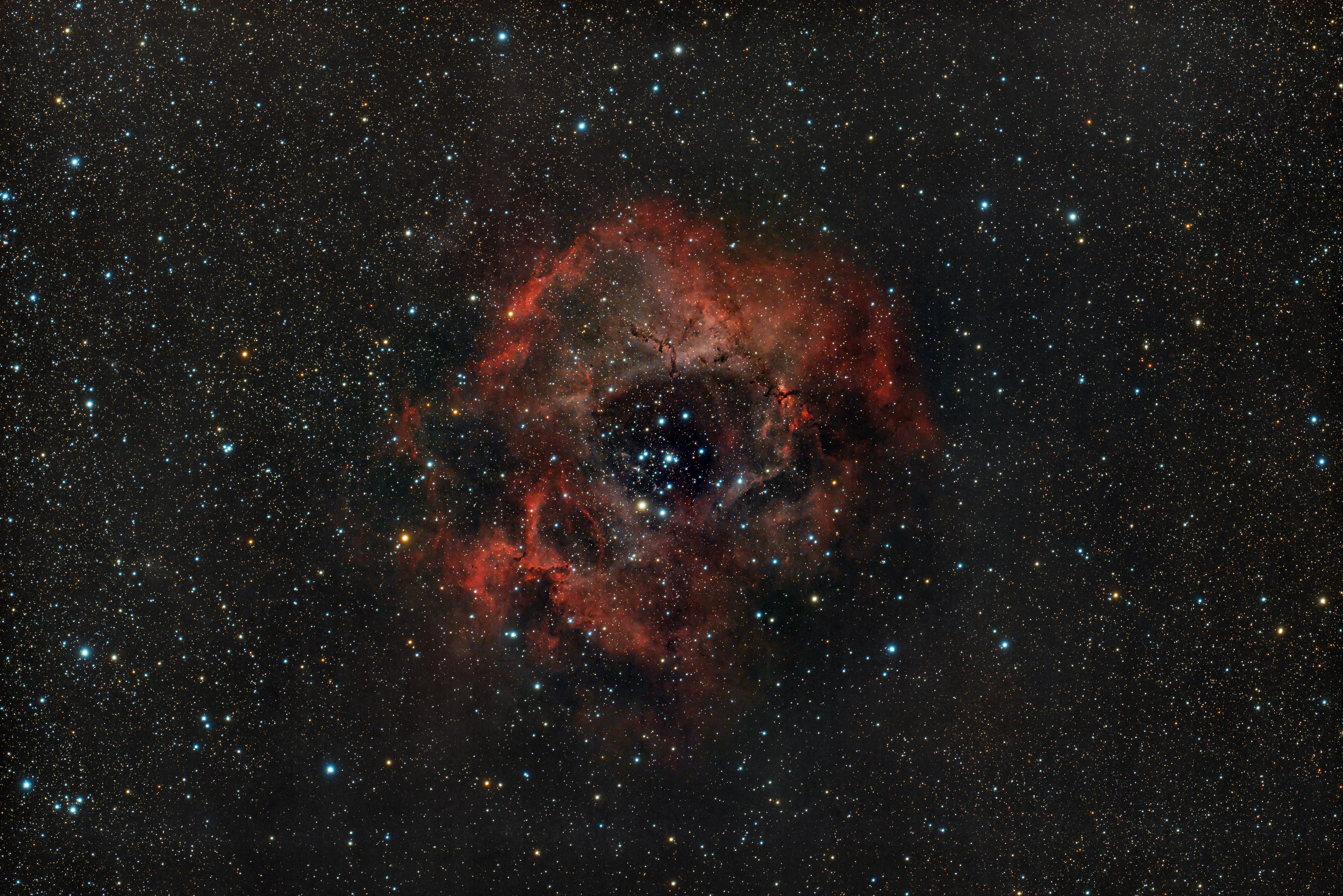
Licence: for personal use, credit Damon Scotting. Both JPEGs 4,096 x 2,733 px.
-10 C sensor temperature during imaging set point -10 C
408 mm focal length, plate solved Askar states 408 mm
3.30 x 2.21° field of view 6,248 x 4,176 px on ASI2600MC Duo
26.1 MP ASI2600MC Duo 6,248 x 4,176 px, 23.5 x 15.7 mm
Should you buy it?
88/100 Stars for Your Buck
Pros
- “A very fast telescope, so there is no need to buy an additional, expensive focal reducer or flattener.”
- “Pinpoint, round stars every single time, including in the corners of the frame.”
- “Especially vibrant colours: seven five-minute exposures gave me a Rosette full of contrasting reds and blues.”
- “Very small for an 85 mm astrograph and easy to travel with; it arrives in its own soft foam carry case.”
- “Full frame, with 48, 54 and 68 mm camera adapters.”
- “Two dovetail mounting points for accessories such as a mini PC or a finderscope.”
Cons
- “The elephant in the room is the cost: at £2,395 it sits firmly in the premium budget category.”
- “At 408 mm the field is wide: for the Rosette you could argue it is a little too wide, and small targets stay small.”
- 4.62 kg with its ring and dovetail before any camera, so it needs a proper imaging mount.
The stars were pinpoint and the colours were more vibrant than any other telescope I'd ever used before.
Who the SQA85 is for
Imager under light-polluted skies
Buy
f/4.8 with the flattener built in gathers signal quickly: 35 minutes gave me a colourful Rosette.
Travelling astrophotographer
Buy
It is small, arrives in its own soft foam carry case, and I would happily take it on board as hand luggage.
Full-frame camera owner
Buy
Askar rates it for full frame, it takes 48, 54 and 68 mm adapters, and back focus can sit anywhere from 40 to 70 mm.
Beginner on a budget
Skip
My recommendation is the Askar SQA55 at £795: the smaller model from the same range, at a third of the price.
Planetary and small-galaxy imager
Skip
408 mm is a wide-field focal length; planets, the Moon's detail and small galaxies need far more.
SQA106 owner
Skip
The SQA106 is the same quintuplet Petzval design with more aperture; the SQA85 would be a sidegrade, not an upgrade.
Three alternatives I have reviewed
- Askar SQA55 55 mm f/4.8 quintuplet Petzval at 264 mm, the smaller model from the same range 82/100 £795 Read the review
- Askar 91F 91 mm f/6.7 self-flattened quadruplet at 609 mm, for less than half the money 89/100 £995 Read the review
- Askar SQA106 106 mm f/4.8 quintuplet Petzval at 509 mm, the bigger brother 91/100 £3,395 Read the review
Questions and more about this review
Reviewed by
Damon Scotting
The Telescope Man Verified
BSc (Hons) Physics with Astrophysics and Cosmology, Loughborough University PGCE / QTS, University of Nottingham
About Damon About Damon Damon Scotting is The Telescope Man. He holds a BSc (Hons) in Physics with Astrophysics and Cosmology from Loughborough University and a PGCE with QTS from the University of Nottingham, and taught physics in secondary schools before becoming an astronomy creator. He is a contributing writer for BBC Sky at Night Magazine and the author of 42 Wonders of Our Night Sky, and his photograph of the galaxy M100 with the dwarf planet Ceres was Highly Commended in the Astronomy Photographer of the Year 2024 competition run by Royal Observatory Greenwich. He has appeared on the BBC's Blue Peter. More than 750,000 people follow his astronomy channels on YouTube, Instagram and TikTok, and he has reviewed more than 140 telescopes, mounts, cameras, filters and accessories hands-on for this site. More about Damon · How I test · Damon's book
I review all kinds of gear: most of it I buy, some is gifted and some is loaned, and all of it is reviewed the same way. How this site is funded
Nine questions, answered
Questions about the Askar SQA85
Reviewed 20 January 2025 ·Updated 23 September 2026
I review all kinds of gear. Most of it I buy, some is gifted and some is loaned, and all of it is reviewed the same way: no company sees or approves a review before it is published. Shop links marked Ad are affiliate links: I earn a commission when you buy through them, at no extra cost to you. How this site is funded
- Is the Askar SQA85 worth the money? Yes. The Rosette on this page took only seven five-minute exposures, and the aberration check shows the stars staying round into the corners. What I captured ↓
- Do I need a reducer or field flattener with the SQA85? No. It is a fast f/4.8 quintuplet Petzval with the flattening built in, so there is nothing extra to buy; set the camera 40 to 70 mm behind the rear thread, 55 mm recommended. The specifications and the comparison table ↓
- Are the stars round in the corners? Yes. I checked a single five-minute frame from each target with the PixInsight aberration tool and the stars stay pinpoint and round into the corners. What is it for ↓
- What field of view does the SQA85 give? On an APS-C ZWO ASI2600MC Duo my frames plate-solve at 408 mm and cover 3.3 x 2.2 degrees, enough to frame the Rosette with room to spare. Tested numbers and the download ↓
- Which camera and mount did you use? A ZWO ASI2600MC Duo on a ZWO AM5N, with a budget electronic focuser added to the SQA85. Because I used the ASI2600MC Duo, I did not need a finderscope. The rig on the mount ↓
- Can I take the SQA85 on a plane? It is small enough and arrives in its own soft foam carry case; when I travel with telescope gear I much prefer to take the telescope on board with me as hand luggage. In the hand ↓
- Is there a cheaper alternative to the SQA85? The Askar SQA55 at £795 is simply a smaller model from the same range, and the Askar 71F at £599 is a flat-field astrograph I imaged with the same camera. The verdict, the readers and the sellers ↓
- How much does the Askar SQA85 cost? The prices I recorded: £2,395 at First Light Optics (UK), awaiting stock; $2,395 at Agena Astro (US), in stock; $3,109 at AliExpress (Global), listed. A record, not a live price The verdict, the readers and the sellers ↓
- What have I not tested on the SQA85? I have not tested the SQA85 on a full-frame sensor, with narrowband filters, or visually; every image here comes from an APS-C colour camera.