Celestron 8″ EdgeHD review: planets and deep sky at 2,032 mm
Where does it rank on our leaderboard
| Rank | Telescope | Stars for Your Buck | Recorded UK price |
|---|---|---|---|
| 1 | Askar 50P | 95 out of 100 | £299 |
| 2 | ToupTek Hope D60 | 93 out of 100 | £749 |
| 3 | Sky-Watcher HAC125DX | 92 out of 100 | £589 |
| 5 | Celestron 8" EdgeHD | 90 out of 100 | £1,999 |
| 19 | Sky-Watcher Heliostar 76Ha | 74 out of 100 | £2,399 |
| 26 | Askar SQA60 Pro | 71 out of 100 | £1,249 |
| 36 | Nakoh 60GT | 52 out of 100 | £899 |
| 41 | Celestron 114 LCM | 42 out of 100 | £361 |
| 42 | Celestron AstroMaster LT 76 | 13 out of 100 | £200 |
Contents
- 01 Where does it rank on our leaderboard
- 02 Specifications and features
- 03 In the hand
- 04 How good is it? Here's what I captured
- 05 Planets and the Moon
- 06 Raw against finished
- 07 The rig on the mount
- 08 What is it for
- 09 Versus the Celestron C5
- 10 Watch the review
- 11 Tested numbers and the download
- 12 Should you buy it?
- 13 Questions and more about this review
In 30 seconds
Stars for Your Buck 90/100
Reviewed 12 Jul 2025 Updated 29 Sep 2026
- Rank
- #5 of 42 telescopes
- Verdict
- Damon's pick
Written by Damon Scotting 6 min read
Buy it if
- You want the planets and the Moon at 2,032 mm without a Barlow
- You will add the 0.7x reducer for galaxies and globular clusters
- You want one telescope for small nebulae, galaxies and planets
Skip it if
- You want wide fields: even with the reducer the field is 0.90 x 0.60 degrees on an APS-C sensor
- You have not budgeted for the reducer, a guided equatorial mount and a camera
- You want one telescope for the whole night sky, big nebulae included
“The EdgeHD line of Celestron telescopes is perfect for both imaging the planets and deep sky objects.”
Specifications and features
Against the telescopes I have reviewed
Compare with
| Celestron 8″ EdgeHD reviewed #5 of 42 | Celestron C11 EdgeHD #18 of 42 | Celestron 8 inch RASA #35 of 42 | Sky-Watcher Skymax 180 #33 of 42 | |
|---|---|---|---|---|
| Recorded UK price | £1,999 | £4,845 | £2,595 | £1,021 |
| Stars for Your Buck | 90/100 | 75/100 | 53/100 | 58/100 |
| Aperture | 203.2 mm (8 in) | 279.4 mm (11 in) | 203.2 mm (8 in) | 180 mm |
| Focal length | 2,032 mm | 2,800 mm | 400 mm | 2,700 mm |
| Focal ratio | f/10 | f/10 | f/2.0 | f/15 |
| Optical design | EdgeHD aplanatic Schmidt-Cassegrain | EdgeHD aplanatic Schmidt-Cassegrain | Rowe-Ackermann Schmidt Astrograph, 93 mm central obstruction | Maksutov-Cassegrain |
| Image circle | APS-C sensors with the 0.7x reducer | 42 mm with the 0.7x reducer | 22 mm, 3.15 degrees | 1 inch |
| Back focus | 105 mm with the 0.7x reducer | 146 mm with the 0.7x reducer | 25 mm from the supplied adapters, 29 mm from the threaded collar | not recorded |
| Focuser | Moving primary mirror with mirror clutches | Moving primary mirror with mirror clutches | Ultra-Stable Focus System on precision linear ball bearings | Twist-knob focusing by an internally moving primary mirror; integrated T2 thread |
| Weight, tube | 6.35 kg (14 lb) optical tube | 13 kg (28 lb) optical tube | 7.7 kg (17 lb) optical tube | 7.8 kg tube |
| Length, tube | 432 mm (17 in) | 610 mm (24 in) | 628 mm tube, 235 mm diameter | 520 mm tube |
| Dew shield | not included | not included | Not included | Not included |
| In the box | 40 mm Plossl 1.25 in eyepiece, 9x50 finderscope, 1.25 in star diagonal, CGE dovetail bar | 9x50 finderscope, 2 in mirror diagonal with 1.25 in adapter, 23 mm Luminos 2 in eyepiece, CGE dovetail bar | 42 mm T-thread and C-thread camera adapters, fan battery pack, CGE dovetail bar | 9x50 finder, 2 in star diagonal with 1.25 in and 2 in adaptors, fitted 45 mm dovetail bar, 10 mm and 25 mm eyepieces (UK) or a 28 mm 2 in eyepiece (USA) |
In the hand
How good is it? Here's what I captured
Six targets
NGC 6888, ASI2600MC Duo, L-Ultimate
- Integration
- 3 h (60 x 180 s)
- Field
- 0.64 x 0.43 degrees
- Telescope
- Celestron 8″ EdgeHD
- Camera
- ZWO ASI2600MC Duo
- Mount
- ZWO AM5
- Target
- NGC 6888 Crescent Nebula
- Type
- Emission nebula around a Wolf-Rayet star
- Location
- Bortle 6.8 (in my garden)
NGC 6960, ASI2600MC Duo, L-Ultimate
- Integration
- 1 h 6 min (22 x 180 s)
- Field
- 0.64 x 0.43 degrees
- Telescope
- Celestron 8″ EdgeHD
- Camera
- ZWO ASI2600MC Duo
- Mount
- ZWO AM5
- Target
- NGC 6960 Western Veil Nebula
- Type
- Supernova remnant
- Location
- Bortle 6.8 (in my garden)
NGC 3628, ASI2600MC Duo
- Integration
- 29 min (29 x 60 s)
- Field
- 0.90 x 0.60 degrees
- Telescope
- Celestron 8″ EdgeHD with the 0.7x reducer
- Camera
- ZWO ASI2600MC Duo
- Mount
- Celestron Advanced VX
- Target
- NGC 3628 Hamburger Galaxy
- Type
- Edge-on spiral galaxy
- Location
- Bortle 6.8 (in my garden)
M 51, ASI2600MC Duo
- Integration
- 1 h 27 min (87 x 60 s)
- Field
- 0.90 x 0.60 degrees
- Telescope
- Celestron 8″ EdgeHD with the 0.7x reducer
- Camera
- ZWO ASI2600MC Duo
- Mount
- Celestron Advanced VX
- Target
- M 51 Whirlpool Galaxy
- Type
- Interacting spiral galaxy
- Location
- Bortle 6.8 (in my garden)
M 101, ASI2600MC Duo
- Integration
- 1 h 30 min (90 x 60 s)
- Field
- 0.90 x 0.60 degrees
- Telescope
- Celestron 8″ EdgeHD with the 0.7x reducer
- Camera
- ZWO ASI2600MC Duo
- Mount
- Celestron Advanced VX
- Target
- M 101 Pinwheel Galaxy
- Type
- Face-on spiral galaxy
- Location
- Bortle 6.8 (in my garden)
M 13, ASI2600MC Duo
- Integration
- 34 min (34 x 60 s)
- Field
- 0.90 x 0.60 degrees
- Telescope
- Celestron 8″ EdgeHD with the 0.7x reducer
- Camera
- ZWO ASI2600MC Duo
- Mount
- Celestron Advanced VX
- Target
- M 13 Hercules Globular Cluster
- Type
- Globular star cluster
- Location
- Bortle 6.8 (in my garden)
Planets and the Moon
The planets and the Moon
Jupiter, the Great Red Spot and the four Galilean moons
- Date
- 5 Mar 2025
- Gear
- Celestron 8″ EdgeHD at 2,032 mm, ZWO ASI585MC, no Barlow
This will go down as one of my favourite ever shots of Jupiter, simply because of the fact that not only does it have Jupiter's Great Red Spot showing, but all four of the Galilean moons at the same time.
Jupiter and its moons, the first run of the night
- Date
- 5 Mar 2025
- Gear
- Celestron 8″ EdgeHD at 2,032 mm, 533-class camera, no Barlow
Mars
- Date
- 25 Feb 2025
- Gear
- Celestron 8″ EdgeHD at 2,032 mm, the best 1,000 of 5,000 frames
Mars turning
- Date
- 5 and 8 Mar 2025
- Gear
- Celestron 8″ EdgeHD at 2,032 mm, ZWO ASI585MC
The Moon at first quarter: Copernicus and the Apennines
- Date
- 8 Mar 2025
- Gear
- Celestron 8″ EdgeHD at 2,032 mm, live-stack frame
Archimedes and the Apennine terminator
- Date
- 8 Mar 2025
- Gear
- Celestron 8″ EdgeHD at 2,032 mm, live-stack frame
The waxing crescent at the limb
- Date
- 5 Mar 2025
- Gear
- Celestron 8″ EdgeHD at 2,032 mm, live-stack frame
Raw against finished
The rig on the mount
The 6 targets, the raw combined stack against my finished image, each with its integration, the camera and the palette:
- NGC 6888 Crescent Nebula: 3 h (60 x 180 s) of light, ASI2600MC Duo, Optolong L-Ultimate, the raw combined stack with one automatic stretch
- NGC 6960 Western Veil Nebula: 1 h 6 min (22 x 180 s) of light, ASI2600MC Duo, Optolong L-Ultimate, the raw combined stack with one automatic stretch
- NGC 3628 Hamburger Galaxy: 29 min (29 x 60 s) of light, ASI2600MC Duo, the raw combined stack with one automatic stretch
- M 51 Whirlpool Galaxy: 1 h 27 min (87 x 60 s) of light, ASI2600MC Duo, the raw combined stack with one automatic stretch
- M 101 Pinwheel Galaxy: 1 h 30 min (90 x 60 s) of light, ASI2600MC Duo, the raw combined stack with one automatic stretch
- M 13 Hercules Globular Cluster: 34 min (34 x 60 s) of light, ASI2600MC Duo, the raw combined stack with one automatic stretch
On the JUWEI-17, then on six other mounts
What is it for
Three things it is for
Coma and field curvature corrected
Thanks to the EdgeHD optical design, it fully corrects for coma and field curvature, delivering a truly flat field.
Jupiter without a Barlow
Here's a time-lapse that I made over a couple of hours from imaging the largest planet in our solar system. I didn't even bother to use a Barlow lens for this shot, which is crazy.
Galaxies and clusters through the reducer
It's captured some really nice images of some galaxies and star clusters.
Versus the Celestron C5
M 101 on both, plate-solved and star-aligned (residual 0.96 px per 1000)
| Target | Telescope | Integration | Subs | Filter | Nights |
|---|---|---|---|---|---|
| M 101 Pinwheel Galaxy | Celestron 8″ EdgeHD + 0.7x reducer | 118 min | 118 x 60 s | not recorded | not recorded |
| M 101 Pinwheel Galaxy | Celestron C5 + 0.63x reducer | 30 min | 30 x 60 s | not recorded | 2025-03-26 |
Watch the review
What YOU can SEE with a £2000 "USED" Telescope setup?! · published 12 July 2025 · 12:12 · Watch on YouTube · 9,098 views, 506 likes on 2 Oct 2026
Jump to
- 1:04 The EdgeHD optical design and its flat field
- 1:09 Why it needs the 0.7x reducer
- 2:37 Unboxing the EdgeHD 8
- 5:30 First light with the ASI585MC
- 6:16 Adding the 0.7x reducer
- 7:49 Galaxies and star clusters through the reducer
- 8:19 The L-Ultimate filter and a guide scope
- 9:33 The Ring Nebula and the Veil
- 9:58 Jupiter without a Barlow
Transcript of the review video 234 words · 2 chapters · searchable
Press a time stamp to play from there.
9:33 The Ring Nebula and the Veil
9:34 You can really tell in this shot of the Ring Nebula that you're getting your money's worth with the filter. 9:37 There's almost a second layer of surrounding nebulosity that standard setups can't really pick up. 9:40 Of course you always have the option to also create mosaic shots of larger objects like the Veil Nebula and then combine them later on. 9:48 Overall as far as it goes in terms of imaging deep sky objects I think this setup does a terrific job at a budget of two thousand British pounds but what about when it comes to the planets?
9:58 Jupiter without a Barlow
9:59 Well obviously you're not going to be surprised here. 9:59 The Celestron C8 EdgeHD test scope knocks it out of the park. 10:03 Here's a time lapse that I made over a couple of hours from imaging the largest planet in our solar system with this scope and a 533 sensor. 10:14 I didn't even bother to use a Barlow lens for this shot which is crazy. 10:14 This will go down as one of my favourite ever shots of Jupiter simply because of the fact that not only does it have Jupiter's great red spot showing but all four of the Galilean moons at the same time. 10:29 I like it. 10:29 In reality at this playback the time-lapse only lasts about three seconds and yet I've watched it loop for probably an hour in total. 10:34 I'm absolutely mesmerized by it.
Check out more videos on the Celestron 8″ EdgeHD
Is BIGGER always BETTER? (Askar 103 v 140 v 185 Telescope)
24 Jul 2025
I Pointed a £200 TELESCOPE at JUPITER!? (+ Bonus stuff)
9 Jul 2025
Tested numbers and the download
Finished image
- Download the raw stack JPEG · 0.9 MB · 1,916 x 1,278
- Download the finished image JPEG · 0.4 MB · 1,916 x 1,278
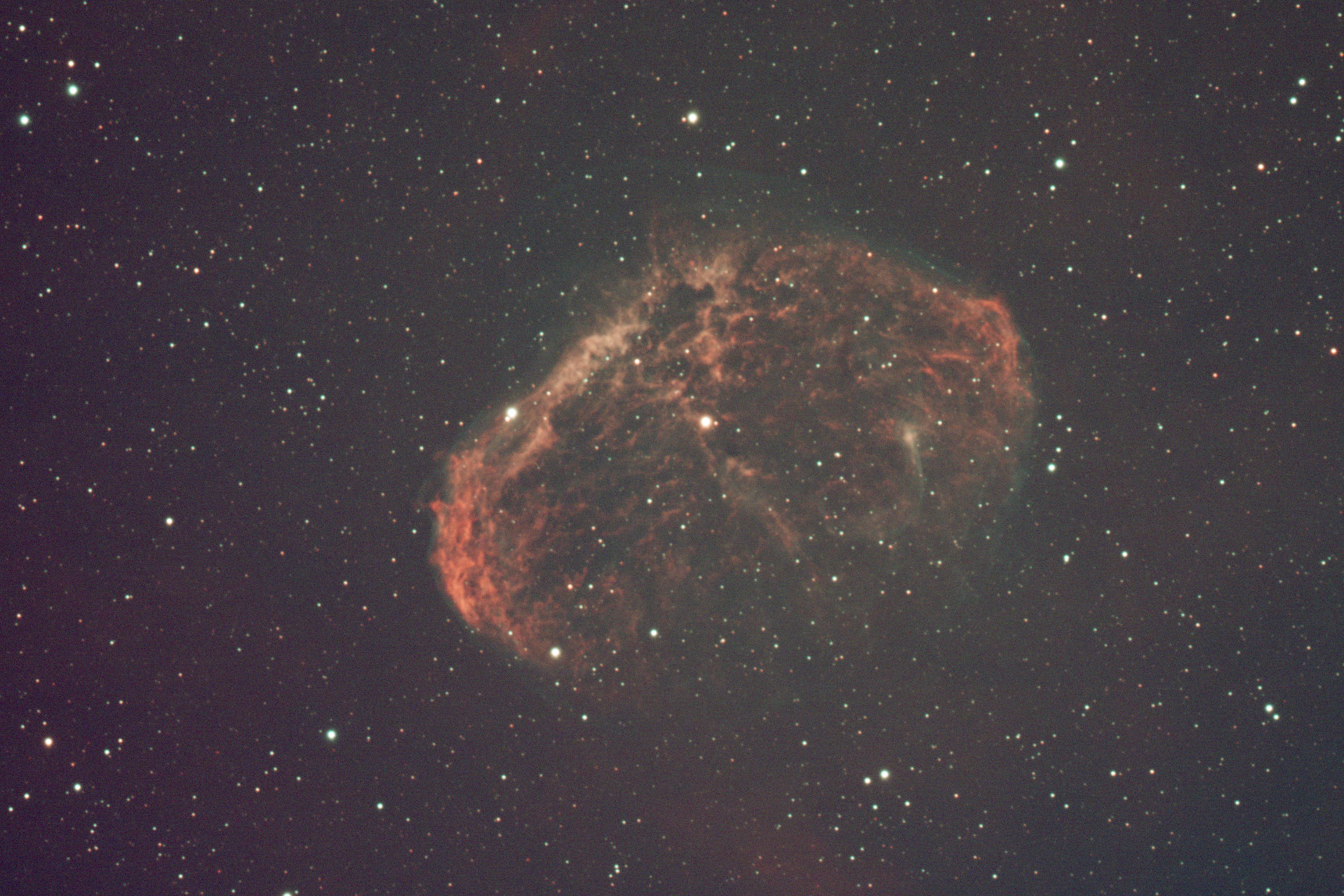
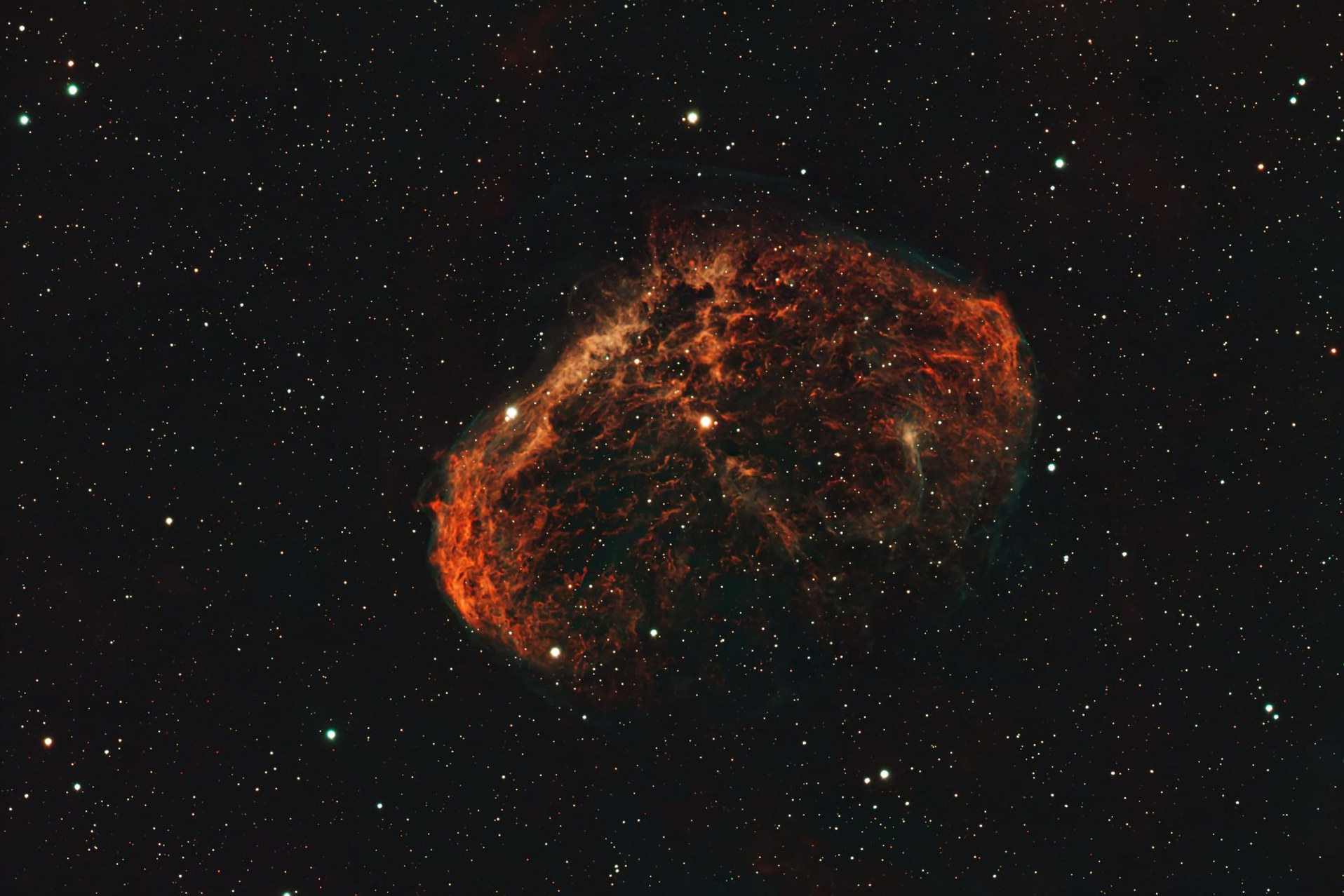
Licence: for personal use, credit Damon Scotting. Both JPEGs 1,916 x 1,278 px.
-10 C sensor temperature during imaging set point -10 C
2097 mm focal length, plate solved Celestron states 2032 mm
0.64 x 0.43° field of view 6,248 x 4,176 px on ASI2600MC Duo
26 MP ASI2600MC Duo 6,248 x 4,176 px, 23.5 x 15.7 mm
Should you buy it?
90/100 Stars for Your Buck
Pros
- An aplanatic design: the EdgeHD corrector takes out the coma and field curvature of a standard Schmidt-Cassegrain.
- Jupiter at 2,032 mm without a Barlow: the Great Red Spot and all four Galilean moons in one time-lapse.
- With the 0.7x reducer the Whirlpool, the Pinwheel, the Hamburger and M 13 each took 29 to 90 minutes.
- At 6.35 kg the tube is half the weight of the 11 inch EdgeHD.
Cons
- To really take advantage of this telescope, you need to buy the focal reducer, which is expensive to say the least.
- The field is small: 0.64 x 0.43 degrees at f/10 on an APS-C sensor, so larger objects like the Veil Nebula need mosaics.
- It comes as a bare tube: the mount, the reducer, a guide scope and a camera are all extra.
The Celestron C8 EdgeHD telescope knocks it out of the park.
Who the EdgeHD 8 is for
Planetary and lunar imager
Buy
At 2,032 mm Jupiter's Great Red Spot and the four Galilean moons show without a Barlow, and the Moon fills the frame.
Deep-sky imager adding the 0.7x reducer
Buy
Through the reducer the Whirlpool, the Pinwheel, the Hamburger and M 13 each took under an hour and a half.
Buyer weighing a used tube
Buy
There is very little difference between a new and a used telescope, so a used EdgeHD 8 is worth a look.
Imager at f/10 with no reducer planned
Skip
Every galaxy and cluster on this page went through the 0.7x reducer: budget for it or pick a faster telescope.
Wide-field nebula imager
Skip
0.64 x 0.43 degrees crops the big nebulae to their cores. My recommendation is the Askar 140.
Three alternatives I have reviewed
- Celestron C11 EdgeHD 279 mm EdgeHD at 2,800 mm, the same design at 11 inches and 13 kg 75/100 £4,845 Read the review
- Askar 140APO 140 mm triplet refractor, the one I prefer for the whole night sky 80/100 £2,098 Read the review
- Sky-Watcher HAC125DX 125 mm f/2 astrograph, the fast wide-field choice in the same group 92/100 £589 Read the review
Questions and more about this review
Reviewed by
Damon Scotting
The Telescope Man Verified
BSc (Hons) Physics with Astrophysics and Cosmology, Loughborough University PGCE / QTS, University of Nottingham
About Damon About Damon Damon Scotting is The Telescope Man. He holds a BSc (Hons) in Physics with Astrophysics and Cosmology from Loughborough University and a PGCE with QTS from the University of Nottingham, and taught physics in secondary schools before becoming an astronomy creator. He is a contributing writer for BBC Sky at Night Magazine and the author of 42 Wonders of Our Night Sky, and his photograph of the galaxy M100 with the dwarf planet Ceres was Highly Commended in the Astronomy Photographer of the Year 2024 competition run by Royal Observatory Greenwich. He has appeared on the BBC's Blue Peter. More than 750,000 people follow his astronomy channels on YouTube, Instagram and TikTok, and he has reviewed more than 140 telescopes, mounts, cameras, filters and accessories hands-on for this site. More about Damon · How I test · Damon's book
I review all kinds of gear: most of it I buy, some is gifted and some is loaned, and all of it is reviewed the same way. How this site is funded
Eight questions, answered
Questions about the Celestron 8″ EdgeHD
Reviewed 12 July 2025 ·Updated 29 September 2026
I review all kinds of gear. Most of it I buy, some is gifted and some is loaned, and all of it is reviewed the same way: no company sees or approves a review before it is published. Shop links marked Ad are affiliate links: I earn a commission when you buy through them, at no extra cost to you. How this site is funded
- What focal length does the Celestron 8″ EdgeHD really reach? Celestron states 2,032 mm at f/10. The plate solves written into my native stacks read 2,096 to 2,098 mm, 0.370 arcsec per pixel on 3.76 micron pixels. With the 0.7x reducer my stacks solve at 1,467 to 1,501 mm, 0.72x to 0.74x at my spacing. Tested numbers and the download ↓
- Do you need the 0.7x reducer with the EdgeHD 8? For galaxies and clusters, yes: the Whirlpool, the Pinwheel, the Hamburger and M 13 on this page all went through Celestron's 0.7x reducer. The Crescent and the Western Veil were taken at the native f/10. What I captured ↓
- Which camera and mount did you use with the EdgeHD 8? The deep-sky frames are on the ZWO ASI2600MC Duo. The Celestron Advanced VX carried the Whirlpool, the Hamburger, the Pinwheel and M 13; the ZWO AM5 carried the Crescent and the Western Veil. The planets and the Moon are on a ZWO ASI585MC. What I captured ↓
- How good is the EdgeHD 8 on the planets? My Jupiter time-lapse shows the Great Red Spot and all four Galilean moons at 2,032 mm with no Barlow, and my Mars shows its dark surface markings. I have not imaged Saturn with it. Planets and the Moon ↓
- Should I buy the EdgeHD 8 or the Askar 140? Now, presented with these planetary imaging comparisons, I think I'd still say that the C8 EdgeHD is the favourite. But for that telescope, planetary imaging is its main purpose. I personally still prefer the Askar 140 over it when it comes to imaging the entirety of our night sky. From my Askar 103 v 140 v 185 video Versus the Celestron C5 ↓
- What field of view does the EdgeHD 8 give? 0.64 x 0.43 degrees at f/10 on a 26 MP APS-C sensor, and 0.90 x 0.60 degrees with the 0.7x reducer. M 13, the Crescent and the Whirlpool fit; the Veil needs a mosaic. Tested numbers and the download ↓
- Where can I buy the Celestron 8″ EdgeHD? The prices I recorded: £1,999 at First Light Optics (UK), in stock; $1,499 at Agena Astro (US), in stock; $1,930 at AliExpress (Astronomical Outdoor Equipment Store), Global, listed. A record, not a live price The verdict, the readers and the sellers ↓
- What have I not tested on the EdgeHD 8? I have not measured guiding, corner stars or tilt on the EdgeHD 8, used it visually on camera, or imaged Saturn with it.