Celestron C5 review: the five-inch SCT that nailed the planets
Where does it rank on our leaderboard
| Rank | Telescope | Stars for Your Buck | Recorded UK price |
|---|---|---|---|
| 1 | Askar 50P | 95 out of 100 | £299 |
| 2 | ToupTek Hope D60 | 93 out of 100 | £749 |
| 9 | SVBONY SV545 | 85 out of 100 | £459 |
| 16 | SVBONY SV555 | 79 out of 100 | £509 |
| 26 | Askar SQA60 Pro | 71 out of 100 | £1,249 |
| 36 | Nakoh 60GT | 52 out of 100 | £899 |
| 39 | Celestron C5 | 49 out of 100 | £850 |
| 41 | Celestron 114 LCM | 42 out of 100 | £361 |
| 42 | Celestron AstroMaster LT 76 | 13 out of 100 | £200 |
Contents
- 01 Where does it rank on our leaderboard
- 02 Specifications and features
- 03 In the hand
- 04 How good is it? Here's what I captured
- 05 Planets and the Moon
- 06 Raw against finished
- 07 The rig on the mount
- 08 What is it for
- 09 Versus the Celestron 8" EdgeHD
- 10 Watch the review
- 11 Tested numbers and the download
- 12 Should you buy it?
- 13 Questions and more about this review
In 30 seconds
Stars for Your Buck 49/100
Reviewed 9 Jul 2025 Updated 23 Sep 2026
- Rank
- #39 of 42 telescopes
- Verdict
- With reservations
Written by Damon Scotting 6 min read
Buy it if
- You want to image Mars, Jupiter and the Moon at 1,250 mm from a small, light tube
- You already have a tracking mount and a small-sensor camera and want long focal length for the money
- You will add a 0.63x reducer to reach galaxies and globular clusters
Skip it if
- You want wide nebulae: even with a reducer the field is under a degree on a 1 inch sensor
- You want a complete telescope: the C5 comes with no mount
- You want the sharpest galaxies: a larger SCT such as the 8 inch EdgeHD resolves more
“As far as I'm concerned I am very impressed by its quality; it really surprised me when it came to imaging the planets.”
Specifications and features
Against the telescopes I have reviewed
Compare with
| Celestron C5 reviewed #39 of 42 | Celestron NexStar 6SE #24 of 42 | Celestron 8" EdgeHD #5 of 42 | Celestron C11 EdgeHD #18 of 42 | |
|---|---|---|---|---|
| Recorded UK price | £850 | £1,199 | £1,999 | £4,845 |
| Stars for Your Buck | 49/100 | 72/100 | 90/100 | 75/100 |
| Aperture | 127 mm (5 in) | 150 mm | 203.2 mm (8 in) | 279.4 mm (11 in) |
| Focal length | 1,250 mm | 1,500 mm | 2,032 mm | 2,800 mm |
| Focal ratio | f/10 | f/10 | f/10 | f/10 |
| Optical design | Schmidt-Cassegrain, StarBright XLT coatings | Schmidt-Cassegrain | EdgeHD aplanatic Schmidt-Cassegrain | EdgeHD aplanatic Schmidt-Cassegrain |
| Image circle | 1 inch (25.4 mm) | 1 inch | APS-C sensors with the 0.7x reducer | 42 mm with the 0.7x reducer |
| Back focus | 127 mm (5 in) from the rear baffle tube lock ring | 127 mm from rear baffle tube lock ring, native f/10 | 105 mm with the 0.7x reducer | 146 mm with the 0.7x reducer |
| Focuser | Internal moving primary mirror; rear manual focus knob | Manual rear focus knob | Moving primary mirror with mirror clutches | Moving primary mirror with mirror clutches |
| Weight, tube | 2.72 kg (96 oz) | 3.6 kg tube; 12.7 kg kit | 6.35 kg (14 lb) optical tube | 13 kg (28 lb) optical tube |
| Length, tube | 330 mm (13 in) | 406 mm | 432 mm (17 in) | 610 mm (24 in) |
| Dew shield | Not included | Not supplied | not included | not included |
| In the box | 25 mm Plossl eyepiece, 45 degree diagonal, 6x30 finder, lens covers, carrying case | Tube, SE mount and tripod, accessory tray, StarPointer finder, NexStar+ hand control, 25 mm eyepiece, 1.25 in diagonal | 40 mm Plossl 1.25 in eyepiece, 9x50 finderscope, 1.25 in star diagonal, CGE dovetail bar | 9x50 finderscope, 2 in mirror diagonal with 1.25 in adapter, 23 mm Luminos 2 in eyepiece, CGE dovetail bar |
In the hand
How good is it? Here's what I captured
Six targets
M 101 Pinwheel Galaxy, ASI533MC Pro
- Integration
- 30 min (30 x 60 s)
- Field
- 0.63 x 0.42 degrees
- Telescope
- Celestron C5
- Camera
- ZWO ASI533MC Pro
- Mount
- JUWEI-14
- Target
- M 101 Pinwheel Galaxy
- Type
- Spiral galaxy
- Location
- Bortle 6.8 (in my garden)
M 13 Great Globular Cluster in Hercules, ASI533MC Pro
- Integration
- 57 min (57 x 60 s)
- Field
- 0.63 x 0.42 degrees
- Telescope
- Celestron C5
- Camera
- ZWO ASI533MC Pro
- Mount
- JUWEI-14
- Target
- M 13 Great Globular Cluster in Hercules
- Type
- Globular star cluster
- Location
- Bortle 6.8 (in my garden)
NGC 4565 Needle Galaxy, ASI533MC Pro
- Integration
- 12 min (12 x 60 s)
- Field
- 0.63 x 0.42 degrees
- Telescope
- Celestron C5
- Camera
- ZWO ASI533MC Pro
- Mount
- JUWEI-14
- Target
- NGC 4565 Needle Galaxy
- Type
- Edge-on spiral galaxy
- Location
- Bortle 6.8 (in my garden)
M 81 Bode's Galaxy, ASI533MC Pro
- Integration
- 2 h 21 min (47 x 180 s)
- Field
- 0.61 x 0.41 degrees
- Telescope
- Celestron C5
- Camera
- ZWO ASI533MC Pro
- Mount
- JUWEI-14
- Target
- M 81 Bode's Galaxy
- Type
- Spiral galaxy
- Location
- Bortle 6.8 (in my garden)
M 3 globular cluster, ASI533MC Pro
- Integration
- 15 min (46 x 20 s)
- Field
- 0.63 x 0.42 degrees
- Telescope
- Celestron C5
- Camera
- ZWO ASI533MC Pro
- Mount
- JUWEI-14
- Target
- M 3 globular cluster
- Type
- Globular star cluster
- Location
- Bortle 6.8 (in my garden)
Mizar and Alcor, Unknown
- Integration
- 21 min
- Field
- 0.62 x 0.41 degrees
- Telescope
- Celestron C5
- Camera
- Unknown
- Mount
- JUWEI-14
- Target
- Mizar and Alcor
- Type
- Double star
- Location
- Bortle 6.8 (in my garden)
Planets and the Moon
The planets and the Moon
Mars rotating
- Date
- Published 9 Jul 2025
- Gear
- Celestron C5, ZWO ASI585MC, 3x Barlow
A Martian day is 24 hours 39 minutes and 35 seconds, so over two hours of imaging you can see it rotate.
Jupiter and its moons
- Date
- Published 9 Jul 2025
- Gear
- Celestron C5, ZWO ASI585MC, 3x Barlow
A day on Jupiter is only 9 hours 55 minutes and 30 seconds, so it spins on its axis a lot faster than Mars.
The Moon
- Date
- not recorded
- Gear
- Celestron C5, an eyepiece and a Samsung Galaxy S20 Ultra phone
Raw against finished
The rig on the mount
The 3 targets, the raw combined stack against my finished image, each with its integration, the camera and the palette:
- M 101 Pinwheel Galaxy: 30 min (30 x 60 s) of light, ASI533MC Pro, the raw combined stack with one automatic stretch
- M 13 Great Globular Cluster in Hercules: 57 min (57 x 60 s) of light, ASI533MC Pro, the raw combined stack with one automatic stretch
- M 81 Bode's Galaxy: 2 h 21 min (47 x 180 s) of light, ASI533MC Pro, the raw combined stack with one automatic stretch
On the JUWEI-17, then on six other mounts
What is it for
Five things it is for
The Moon in depth
Between 50 and 75% illumination is the sweet spot: you really get a sense of depth, thanks to the sunlight casting huge shadows across the craters and mountains. Zooming in on the footage and increasing the sharpness makes it look even better.
Mars rotating on its axis
A 3x Barlow lens makes it much easier to resolve the planet without reducing the resolution of my video. I recorded three-minute videos of Mars for two hours, stacked the best 30% of the frames from each, sharpened them and played them back to back: a short looping video of the red planet rotating on its axis.
Jupiter and its moons
Jupiter reveals a whole lot more detail than Mars. An hour of three-minute recordings made a time-lapse of the planet and its moons, and in the two visible moons you can make out a faint hint of their colours: a yellowy orange Io and a greyish, icy blue Europa.
Galaxies with a focal reducer
For galaxies I added a 0.63x focal reducer, which shortens the focal length so that in the same exposure time objects appear much brighter. That let me tackle the Needle Galaxy, a perfectly side-on galaxy, the Pinwheel Galaxy with its long, spiralling arms, and the great globular cluster in Hercules.
Light enough to share a mount
The scope is very lightweight, and that's why I've now mounted it alongside another one of my telescopes.
Versus the Celestron 8" EdgeHD
M 101 Pinwheel Galaxy on both, plate-solved and star-aligned (residual 1.99 px per 1000)
| Target | Telescope | Integration | Subs | Filter | Nights |
|---|---|---|---|---|---|
| M 101 Pinwheel Galaxy | Celestron C5 | 30 min | 30 x 60 s | not recorded | 2025-03-26 |
| M 101 Pinwheel Galaxy | Celestron 8" EdgeHD | not recorded | not recorded | not recorded | not recorded |
Watch the review
I Pointed a £200 TELESCOPE at JUPITER!? (+ Bonus stuff) · published 9 July 2025 · 8:52 · Watch on YouTube · 21,158 views, 991 likes on 2 Oct 2026
Jump to
- 0:18 The C5 and its NexStar Evolution plate
- 1:01 The Moon
- 1:49 Mars through a 3x Barlow
- 2:39 Mars rotating, the polar ice cap
- 3:20 Jupiter's bands
- 4:39 Jupiter and its moons in motion
- 6:01 Galaxies with a 0.63x reducer
- 7:28 Against the 8 inch EdgeHD
- 8:00 My verdict
Transcript of the review video 1,672 words · 10 chapters · searchable
Press a time stamp to play from there.
0:00 Introduction
0:00 Astrophotography can be a very expensive hobby, but not today, because today I'm going to be using a £200 telescope from AliExpress to image the night sky and even capture some jaw-dropping videos of our brightest planets. 0:10 I'm Damon Scotting and this is Astronomical.
0:18 The C5 and its NexStar Evolution plate
0:19 £200 really does not get you much in astrophotography, but thanks to a rather suspiciously looking off-brand listing I've got my hands on a 5-inch Celestron telescope. 0:28 Now purchasing a seemingly off-brand telescope from a Chinese website is always going to be a bit of a gamble. 0:32 But I've gambled with unknown products from AliExpress before and it's paid dividends, so I'm eager to give this a shot. 0:36 It arrived with a NexStar Evolution branding plate, indicating that this is the same telescope used in the very pricey go-to mount setup. 0:45 Except, you know, without the mount, this is £1,000 cheaper. 0:49 PS, if you're looking for a really good mount for excellent value, check out my other video on the JUWEI-14 and JUWEI-17 mounts which are pound for pound the best value mounts on the market. 0:58 Now naturally the first object I was going to test the telescope upon was going to be our big old lunar companion, the Moon!
1:01 The Moon
1:02 As you can see for yourself it's doing a very impressive job. 1:07 This is one of my favourite times to observe the Moon between 50 to 75% illumination is the sweet spot. 1:12 You really get a sense of depth about it thanks to the sunlight casting these huge shadows across the craters and mountains. 1:16 Zooming in on the footage and increasing the sharpness makes it look even better. 1:20 But the Moon is a relatively beginner target. 1:25 I want to really push the limits of the scope. 1:25 So how about pointing it towards the red planet Mars? 1:29 If you're wondering why the footage is so wobbly and fuzzy, well that's largely down to our own atmosphere. 1:35 This is what gives stars their twinkling effect. 1:39 One way to eradicate this is to take lots and lots of video frames and stack a small percentage of the best quality shots to create a much sharper final image.
1:49 Mars through a 3x Barlow
1:49 We'll do that shortly, but for now, the main change I want to make is to add a 3x Barlow lens. 1:55 This makes it much easier for me to resolve the planet without having to reduce the resolution of my video. 1:59 You can now just about make out the Martian surface detail. 2:02 Perhaps you can even note the different shades of colour, a contrasting red and brown. 2:06 Now we can take this one huge step further. 2:09 I'm now going to record lots and lots of videos of Mars for 2 hours. 2:13 Each video will be precisely 3 minutes long. 2:16 I'm then going to input this video into a free planetary stacking software and tell it to stack the best 30% of my images. 2:20 Which doesn't sound like much but it's actually taking about 50 pictures per second. 2:24 And once that's done I'm going to aggressively sharpen the image to reveal as much detail as possible. 2:29 And then this is the really mind-blowingly cool part, I'm going to play each of my newly stacked and sharpened pictures back to back to make this.
2:39 Mars rotating, the polar ice cap
2:39 A short looping video of the red planet rotating on its axis. 2:39 Now a Martian day is precisely 24 hours 39 minutes and 35 seconds which isn't much longer than it is here on Earth so over the short time period that I've been imaging the planet we can see it rotate. 2:51 The super cool part is that thanks to our new sharpening techniques we can actually see the Martian polar ice caps that right there is where the Martian Santa Claus lives or actually I think the image might be inverted so really that right there might be where the Martian penguins live. 3:11 Either way, insane levels of detail to be made out with a £200 telescope. 3:16 We are only at the halfway stage of this video and I always save the very best till last.
3:20 Jupiter's bands
3:21 It's time for us to level up and go after the god of all planets, Jupiter. 3:27 Despite being roughly 3.5 times further away on average from the Earth than Mars, Jupiter is still significantly better than Mars through our telescope and reveals a whole lot more detail. 3:36 And with the unaided eye, or our raw footage here, you can clearly see Jupiter's distinct atmospheric bands running around the planet. 3:44 But the truly jaw-dropping aspect is that whenever you look at Jupiter through a telescope, you always see these faint points of light dancing around it. 3:52 These are not in fact stars, they are four of Jupiter's largest moons. 3:55 The Galilean Moons. 3:58 They were discovered by Stephen Hawking himself. 4:00 Nah, I'm kidding, they were discovered by Galileo Galilei. 4:03 Each of them shines brighter in our night sky than the planet Uranus. 4:03 How crazy is that? 4:09 You won't always see all four simply due to the fact that sometimes they are orbiting behind Jupiter, but I tell you what, how cool would it be to see not only the gas giant Jupiter rotating on its axis, but also the motion of these moons as they dance around it. 4:22 I've now taken one hour's worth of three minute recordings in order to produce a time lapse of the planet and moons, which I know what you're thinking, that's not as long as what you did for Mars, but that's okay, because a day on Jupiter is only 9 hours 55 minutes and 30 seconds, so it spins on its axis a lot faster.
4:39 Jupiter and its moons in motion
4:39 Okay, so applying the sharpening effect on top of our new images, and here we go. 4:51 How beautiful is that? 4:51 Not only are the bands of Jupiter gorgeous, but the opposing orbiting motions of the moons is a stunning display of the universe in motion. 4:56 We are witnessing a celestial ballet take place through the help of a £200 telescope that the likes of Galileo could only have dreamt of. 5:06 In fact, what can only be described as by far the coolest aspect of all of this is that if you look closely at the two visible Galilean moons, then you can even make out a faint hint of their colours. 5:19 On the lower left, we can see this yellowy orangey tinge. 5:19 That is Io, the most volcanic world in our solar system. 5:24 Thanks to Io's lower gravity and its intense volcanic activity, its lava fountains can shoot 300km up into space. 5:29 Now that would almost be far enough to reach the International Space Station from the surface here on Earth. 5:39 And then the other moon, which seems to be more of a greyish icy blue colour, is widely regarded as one of our best chances of finding life elsewhere in our solar system. 5:47 This is Europa. 5:47 So there we go, a mind-blowing level of detail for such a cheap telescope. 5:52 But now I'm going to do something even crazier. 5:52 I'm going to try and image a couple of galaxies and an immense cluster of stars with this telescope.
6:01 Galaxies with a 0.63x reducer
6:01 So to help me out I'm using a focal reducer. 6:01 With the help of this little attachment I'm going to reduce my focal ratio from f/10 to f/6.3. 6:05 Which in short means that under the same exposure times objects will now appear precisely two and a half times brighter than before. 6:14 Which is a huge plus. 6:14 Allowing me to try and tackle the Needle Galaxy, a perfectly viewed side-on galaxy, which is a super cool, rare perspective of a galaxy. 6:26 It makes it seem super neat and tidy, with a slight but noticeable bulge around the centre of it, where likely lies a supermassive black hole, helping keep this massive collection of stars together. 6:36 But just to remind ourselves of what a galaxy generally looks like face on, here's my shot of the Pinwheel Galaxy, with its long, spiralling arms. 6:45 And then lastly I've decided to try and image one of the gems of our night sky, the great globular cluster in Hercules, Messier object 13. 6:53 This immense collection of over 700,000 stars is an easy target for amateur astronomers. 6:58 These stars are packed so tightly together that some of them often collide and produce new stars. 7:04 Our nearest stellar neighbour is about four and a quarter light years away, meanwhile these stars are on average just 0.1 to 0.3 light years apart. 7:13 So close in fact, that any planets orbiting these stars would suffer from highly chaotic orbits and therefore have a very slim chance of forming any life. 7:18 Which is extra interesting considering the globular cluster is about 11.65 billion years old, making it almost as old as our galaxy itself.
7:28 Against the 8 inch EdgeHD
7:28 So just out of interest to give you all a reference point as to the quality of this £200 telescope, here are shots I captured of the Pinwheel galaxy and the great globular cluster in Hercules through a £2,000 Celestron 8 inch EdgeHD telescope and a 0.7x reducer with the same camera as the £200 C5 telescope and its £50 0.63x reducer. 7:50 Obviously the images from the £2,000 telescope are better, but are they 10x better? 7:50 Where would you rather invest your money? 7:56 Let me know what your final thoughts are on the £200 C5 telescope in the comments down below.
8:00 My verdict
8:01 As far as I'm concerned I am very impressed by its quality, it really surprised me when it came to imaging the planets. 8:06 The scope is very lightweight and that's why I've now mounted it alongside another one of my telescopes. 8:11 I've attached a link to the telescope and accessories in the description down below, but fair warning, the telescope has recently gone out of stock. 8:18 I'll be sure to add a note to my link once it's come back into availability or when there's another seller selling it. 8:23 Thanks for watching, and make sure you're subscribed for more videos like this in the future. 8:27 I'm Damon Scotting, and this was Astronomical.
Tested numbers and the download
Finished image
- Download the raw stack JPEG · 1.6 MB · 2,925 x 2,896
- Download the finished image JPEG · 0.9 MB · 2,925 x 2,896
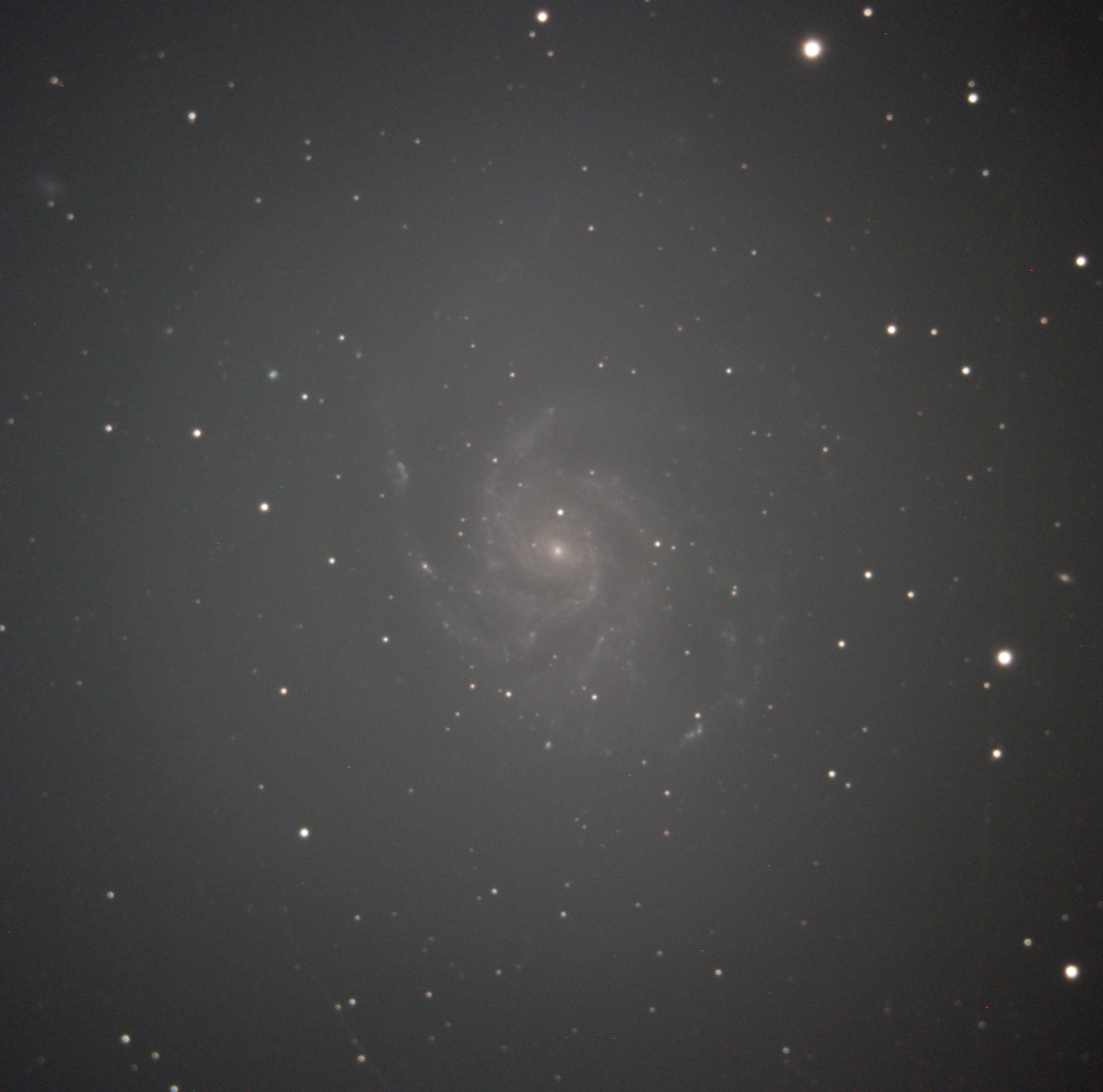
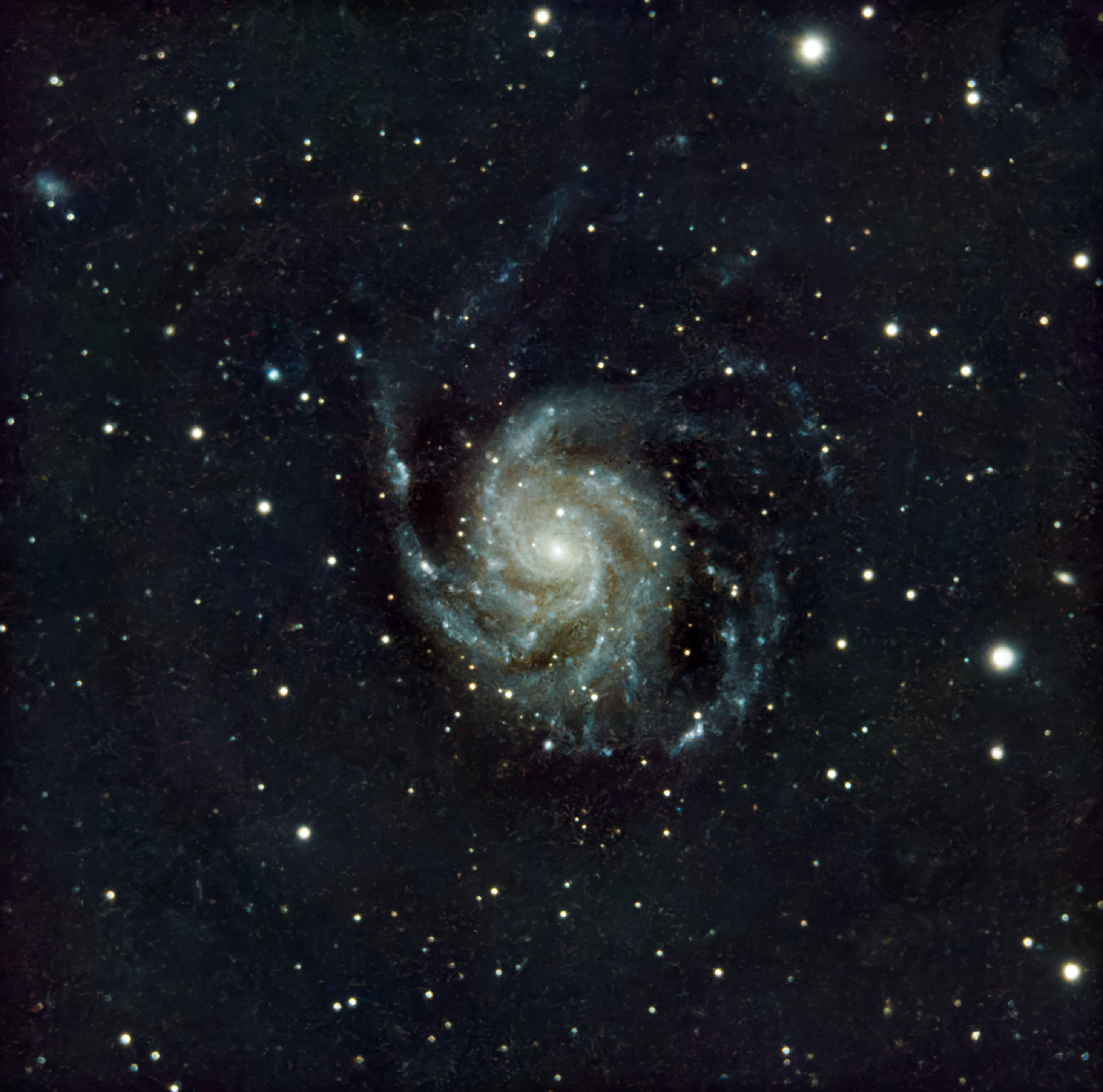
Licence: for personal use, credit Damon Scotting. Both JPEGs 2,925 x 2,896 px.
-10 C sensor temperature during imaging set point -10 C
996 mm focal length, plate solved Celestron states 1250 mm, measured with the 0.63x reducer
0.65 x 0.65° field of view 3,008 x 3,008 px on ASI533MC Pro
9 MP ASI533MC Pro 3,008 x 3,008 px, 11.3 x 11.3 mm
Should you buy it?
49/100 Stars for Your Buck
Pros
- “Thanks to our new sharpening techniques we can actually see the Martian polar ice caps.”
- “You can clearly see Jupiter's distinct atmospheric bands running around the planet.”
- As you can see for yourself, it's doing a very impressive job on the Moon.
- With a 0.63x focal reducer it reaches galaxies: the Needle, the Pinwheel and M 13 each took under an hour of exposure.
Cons
- At its native f/10 it is slow for deep sky: I used a reducer for these galaxies, and they still needed plenty of exposure.
- With the same camera, the 8 inch EdgeHD makes better galaxy and cluster images.
- The field is small: 0.65 degrees on a 1 inch sensor even with the reducer, too tight for large nebulae.
- No dew shield comes in the box, and Celestron publishes no image circle for planning a camera train, only its 127 mm back focus.
A mind-blowing level of detail for such a cheap telescope.
Who the C5 is for
Budget planetary imager
Buy
1,250 mm of focal length in a 2.7 kg tube: after stacking, Mars showed its polar ice cap and Jupiter its bands and moons.
Owner of a small tracking mount
Buy
At about 2.7 kg by Celestron's figures it rides a small harmonic mount easily, even beside a second telescope.
Galaxy imager with a 1 inch camera
Buy
With a 0.63x reducer and an IMX533 sensor, the Needle, the Pinwheel, M 81 and M 13 each came through in 14 minutes to 2 hours 21 minutes.
Wide-field nebula imager
Skip
My field was 0.65 degrees even with the reducer. My recommendation is the Sky-Watcher HAC125DX, a 125 mm f/2 astrograph at 250 mm.
Complete beginner
Skip
The C5 is a tube with no mount, and my results needed a tracking mount, a camera and stacking software. My recommendation is the Celestron NexStar 6SE, the same design on its own GoTo mount.
Owner of an 8 inch SCT
Skip
You already own the better galaxy telescope; the C5 is a light second telescope for the planets, not an upgrade.
Three alternatives I have reviewed
- Sky-Watcher HAC125DX 125 mm f/2 Honders astrograph for wide deep-sky fields 92/100 £589 Read the review
- Sky-Watcher Skymax 180 180 mm f/15 Maksutov at 2,700 mm for the planets 58/100 £1,021 Read the review
- Celestron 8" EdgeHD 203 mm f/10 EdgeHD: more aperture for galaxies and clusters 90/100 £1,999 Read the review
Questions and more about this review
Reviewed by
Damon Scotting
The Telescope Man Verified
BSc (Hons) Physics with Astrophysics and Cosmology, Loughborough University PGCE / QTS, University of Nottingham
About Damon About Damon Damon Scotting is The Telescope Man. He holds a BSc (Hons) in Physics with Astrophysics and Cosmology from Loughborough University and a PGCE with QTS from the University of Nottingham, and taught physics in secondary schools before becoming an astronomy creator. He is a contributing writer for BBC Sky at Night Magazine and the author of 42 Wonders of Our Night Sky, and his photograph of the galaxy M100 with the dwarf planet Ceres was Highly Commended in the Astronomy Photographer of the Year 2024 competition run by Royal Observatory Greenwich. He has appeared on the BBC's Blue Peter. More than 750,000 people follow his astronomy channels on YouTube, Instagram and TikTok, and he has reviewed more than 140 telescopes, mounts, cameras, filters and accessories hands-on for this site. More about Damon · How I test · Damon's book
I review all kinds of gear: most of it I buy, some is gifted and some is loaned, and all of it is reviewed the same way. How this site is funded
Eight questions, answered
Questions about the Celestron C5
Reviewed 9 July 2025 ·Updated 23 September 2026
I review all kinds of gear. Most of it I buy, some is gifted and some is loaned, and all of it is reviewed the same way: no company sees or approves a review before it is published. Shop links marked Ad are affiliate links: I earn a commission when you buy through them, at no extra cost to you. How this site is funded
- Is the Celestron C5 good for planets? Yes, it is what the C5 does best. Through a 3x Barlow, Mars showed surface detail turning over two hours, and Jupiter its bands and two moons moving over one: both time-lapses are in Planets and the Moon. Planets and the Moon ↓
- Can the Celestron C5 photograph galaxies? With a 0.63x reducer and a ZWO ASI533MC Pro it did: the Needle Galaxy in 12 x 60 s, the Pinwheel in 30 x 60 s and M 81 in 47 x 180 s, plus the globular clusters M 13 and M 3. What I captured ↓
- What focal length does the C5 reach with a 0.63x reducer? My frames plate-solved at 0.78 arcsec per pixel with the 3.76 micron pixels of the ASI533MC Pro, which is 996 mm: about 0.8x of the native 1,250 mm rather than the nominal 787 mm, for a 0.65 degree field. The reduction depends on the spacing between the reducer and the sensor. Tested numbers and the download ↓
- How does the C5 compare with the Celestron 8 inch EdgeHD? I imaged the Pinwheel and M 13 through both with the same camera, the C5 with its 0.63x reducer and the EdgeHD with its 0.7x reducer. Obviously the images from the EdgeHD are better, but are they ten times better? That is the question for your money. Watch the review ↓
- What mount does the Celestron C5 need? Celestron lists the C5 spotting scope at 2.72 kg (96 oz), and the same tube on the NexStar 5SE, where it carries a CG-5 dovetail bar, at 2.7 kg (6 lbs), so a small harmonic mount carries it with room to spare. My galaxy captures were on the JUWEI-14. The rig on the mount ↓
- Is the C5 the same telescope as the NexStar Evolution 5? My C5 arrived with a NexStar Evolution branding plate on its dovetail, and its corrector reads 5 inch (125 mm), 1,250 mm, f/10: the aperture, focal length and focal ratio Celestron gives for the Evolution 5 tube. Celestron sells it today as the C5 spotting scope, with an eyepiece, diagonal, finder and case. The specifications and the comparison table ↓
- How much does the Celestron C5 cost? The prices I recorded: £850 at First Light Optics (UK), in stock; $680 at B&H Photo Video (US), in stock; $552 at AliExpress (Starry Rain Outdoor Products Store), Global, listed. A record, not a live price The verdict, the readers and the sellers ↓
- What have I not tested on the C5? I have not tested the C5 on deep-sky targets at its native f/10, with a sensor larger than 1 inch, for star shape and collimation across the field, or with a guiding log.