Player One Apollo-M MAX review: a global shutter solar camera
Where does it rank on our leaderboard
| Rank | Camera | Stars for Your Buck | Recorded UK price |
|---|---|---|---|
| 1 | SVBONY SV705C | 93 out of 100 | £229 |
| 2 | SVBONY SC571CC | 90 out of 100 | £1,029 |
| 8 | ZWO ASI2600MC Duo | 83 out of 100 | £1,849 |
| 13 | Player One Apollo 428M MAX Pro | 76 out of 100 | £1,045 |
| 14 | Player One Apollo-M MAX | 76 out of 100 | £485 |
| 18 | ZWO ASI6200MM Pro | 74 out of 100 | £3,999 |
| 22 | Altair Hypercam 585MM | 71 out of 100 | £445 |
| 28 | ZWO ASI183MC | 38 out of 100 | £549 |
| 29 | Nikon COOLPIX P1000 | 32 out of 100 | £787 |
Contents
- 01 Where does it rank on our leaderboard
- 02 Specifications and features
- 03 From the video
- 04 The rig on the mount
- 05 How good is it? Here is what it captured
- 06 The eclipse in motion
- 07 Raw against finished
- 08 Watch it in my eclipse Short
- 09 Tested numbers and the download
- 10 Should you buy it?
- 11 Questions and more about this review
In 30 seconds
Stars for Your Buck 76/100
Reviewed 12 Aug 2026 Updated 24 Sep 2026
- Rank
- #14 of 29 cameras
- Verdict
- Damon recommends
Written by Damon Scotting 4 min read
Buy it if
- You image the Sun in hydrogen alpha and want the whole disc in one frame on a 630 mm solar telescope.
- You want a global shutter: every pixel exposed at once for fast solar video.
- You want a light camera: 160 g on the focuser.
Skip it if
- You want deep-sky images: the sensor is 1.8 MP, 12-bit and uncooled.
- You want the whole Sun at long focal lengths: at about 1,200 mm the disc overfills the frame.
- You want one camera for everything: an IMX533 or IMX585 camera covers deep sky and planets.
“Paired with the Askar 50P, the Apollo-M MAX fitted the entire Sun in a single frame.”
Specifications and features
Against the cameras I have reviewed
Compare with
| Player One Apollo-M MAX reviewed #14 of 29 | Player One Apollo 428M MAX Pro #13 of 29 | Altair Hypercam 585MM #22 of 29 | ZWO ASI120MM #17 of 29 | |
|---|---|---|---|---|
| Recorded UK price | £485 | £1,045 | £445 | £199 |
| Stars for Your Buck | 76/100 | 76/100 | 71/100 | 75/100 |
| Sensor | Sony IMX432 mono, global shutter | Sony IMX428 mono, global shutter | Sony IMX585 mono | onsemi AR0130CS mono |
| Format | 1.1 inch, 14.5 x 9.9 mm, 17.5 mm diagonal | 1.1 inch, 17.5 mm diagonal | 11.14 x 6.26 mm, 12.85 mm diagonal | 1/3 inch |
| Colour or mono | Mono | Mono | Mono | Mono |
| Resolution | 1608 x 1104, 1.8 MP | 3216 x 2208, 7.1 MP | 3840 x 2160, 8.3 MP | 1280 x 960, 1.2 MP |
| Pixel size | 9 um | 4.5 um | 2.9 um | 3.75 um |
| Cooling | Uncooled (passive cooling system); Active Cooling System optional | Two-stage TEC, 35 to 40 C below ambient | Two-stage TEC, 35 C below ambient | Uncooled |
| Read noise | 2.6 to 22.9 e- | 1.4 to 5.5 e- | 0.42 to 2.43 e- | 4.0 e- |
| Full well | 100 ke- | 25.3 ke- | 40 ke- | 13 ke- |
| ADC | 12-bit | 12-bit | 12-bit | 12-bit |
| Weight | 160 g | 420 g | 500 g | 60 g |
| Back focus | 12.5 mm | 17.5 mm | 17.5 mm | 8.5 mm |
| Interface | USB 3.0, 256 MB DDR3 buffer | USB 3.0 (Type-C), 512 MB DDR3 buffer | USB 3.0 | USB 2.0 |
| In the box | Camera; T-mount; USB 3.0 cable; ST4 cable; M2 hex key; 1.25 inch cap; air blower | Camera, carbon-fibre zip case, cables and adapter rings | The camera, a 1.5 m USB cable, a 12 V DC power adaptor, an armoured case with foam inserts, a silicone dust cap and a software CD | Camera, 1.25 inch cap, 0.5 m and 2 m USB 2.0 cables, 2 m ST-4 cable, M28.5 to CS adapter, 1.25 inch extender, quick guide |
From the video
One frame from my video
The Apollo-M MAX, the gold camera behind the Quark, 12 Aug 2026
The rig on the mount
On the JUWEI-17, then on six other mounts
How good is it? Here is what it captured
Two captures of the Sun
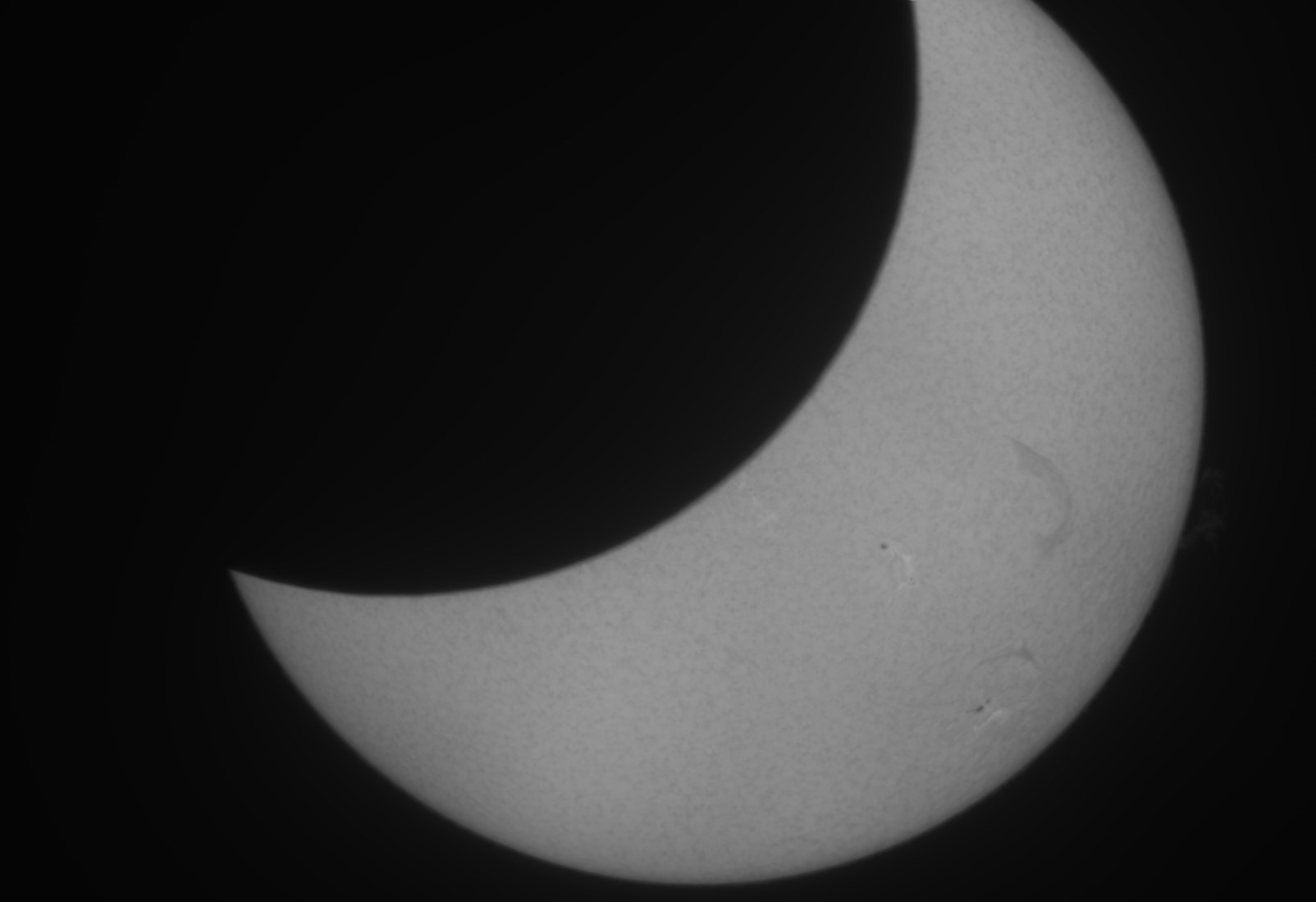
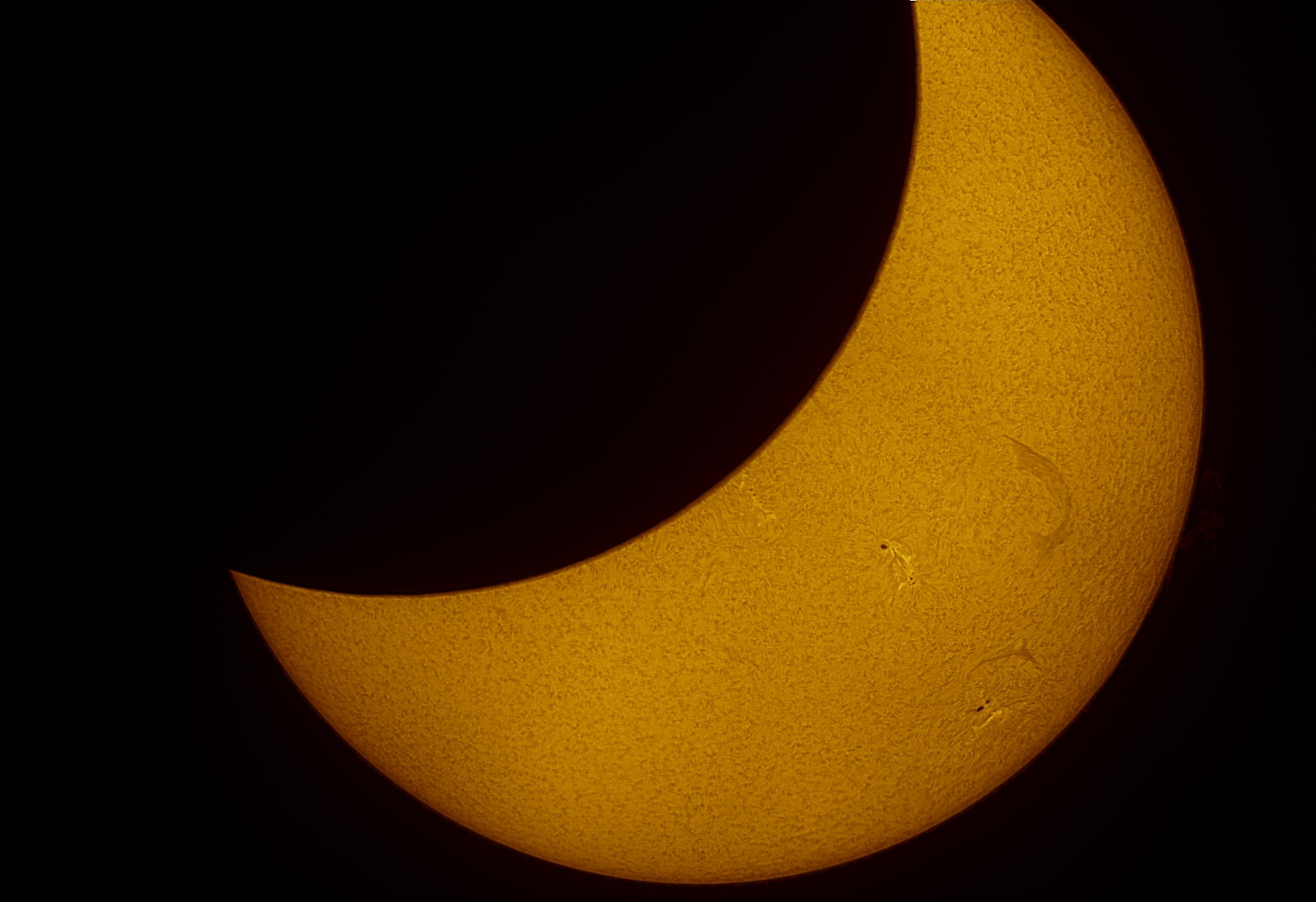
The eclipse at 18:48, Player One Apollo-M MAX
- Integration
- 900 of 3,000 frames
- Field
- 0.69 x 0.47 degrees
- Telescope
- ToupTek Hope D60
- Camera
- Player One Apollo-M MAX
- Mount
- ZWO AM3N
- Target
- Partial solar eclipse, 12 August 2026 (18:48)
- Type
- Partial solar eclipse in hydrogen alpha
The eclipse at 18:30, Player One Apollo-M MAX
- Integration
- the best 30% of one recording
- Field
- 0.69 x 0.47 degrees
- Telescope
- ToupTek Hope D60
- Camera
- Player One Apollo-M MAX
- Mount
- ZWO AM3N
- Target
- Partial solar eclipse, 12 August 2026 (18:30)
- Type
- Partial solar eclipse in hydrogen alpha
The eclipse in motion
Sixteen stacked recordings
The eclipse in motion
- Date
- 12 Aug 2026
- Gear
- Player One Apollo-M MAX behind the DayStar Quark Chromosphere on the ToupTek Hope D60, ZWO AM3N, 16 stacked recordings from 18:30 to 18:52
Raw against finished
Watch it in my eclipse Short
The 2 targets, the unprocessed side against my finished image, each with its integration, the camera and the palette:
- Partial solar eclipse, 12 August 2026 (18:48): 900 of 3,000 frames of light, Player One Apollo-M MAX, DayStar Quark Chromosphere, the stacked frames with no sharpening and no colour
- Partial solar eclipse, 12 August 2026 (18:30): the best 30% of one recording of light, Player One Apollo-M MAX, DayStar Quark Chromosphere, the stacked frames with no sharpening and no colour
CHECK OUT THIS INCREDIBLE VIEW of Our SUN?! · published 12 August 2026 · 1:01 · Watch on YouTube · 34,004 views, 1,254 likes on 2 Oct 2026
Jump to
- 0:00 The eclipse in hydrogen alpha
- 0:04 The specialised eyepiece on my rig
- 0:09 The live view on my laptop
- 0:17 Huge eruptions at the Sun's edge
- 0:36 Sunspots, the cooler regions
- 0:47 The eclipse in white light
Tested numbers and the download
Finished image
- Download the raw stack JPEG · 0.1 MB · 1,604 x 1,099
- Download the finished image JPEG · 0.2 MB · 1,604 x 1,099
Licence: for personal use, credit Damon Scotting. Both JPEGs 1,604 x 1,099 px.
+37 C sensor temperature during imaging uncooled camera
630 mm focal length, measured stated 630 mm, on the Sky-Watcher Heliostar 76Ha, measured from the Sun's limb
1.32 x 0.90° field of view 1,608 x 1,104 px on Player One Apollo-M MAX
1.8 MP Player One Apollo-M MAX 1,608 x 1,104 px, 14.5 x 9.9 mm
Should you buy it?
76/100 Stars for Your Buck
Pros
- A global shutter reads the whole frame at once.
- The whole Sun fits the frame at 630 mm: the disc is 649 pixels across on the Sky-Watcher Heliostar 76Ha.
- Fast: Player One rate it at 126 frames a second at full size, and my full-disc recording ran at 109.
- Light: 160 g, with a 1.25 inch nose and an M42 thread.
- A sensor tilt plate is built in for chasing out Newton's rings.
Cons
- Uncooled: SharpCap read the sensor at 37 C on a September afternoon, and the Active Cooling System costs extra.
- 1.8 MP: at about 1,200 mm the Sun overfills the 1104 pixel height, as in my eclipse frames.
- A 12-bit ADC.
- No ZWO ASIAIR: the ASIAIR connects ZWO astronomy cameras only (plus some DSLRs), so it needs a computer running SharpCap or similar.
That is what everyone wants: to see the whole Sun and capture it in a single frame.
Who the Apollo-M MAX is for
Complete beginner
Skip
It shows nothing of the Sun on its own: it needs a hydrogen-alpha telescope or a dedicated solar filter system and a computer first.
Hydrogen-alpha solar imager
Buy
On a 630 mm solar telescope the whole disc sits in one 1608 x 1104 frame, recorded at over 100 frames a second.
Eclipse chaser
Buy
A global shutter at over 100 frames a second records a fast-changing eclipse in short bursts, with the Moon's edge sharp against the chromosphere.
Deep-sky imager
Skip
1.8 MP, a 12-bit ADC and no cooler: a cooled IMX533 or IMX571 camera is the tool for nebulae and galaxies.
Planetary imager with a long SCT
Skip
Its 9 um pixels need very long focal lengths for Jupiter and Saturn; an IMX585 or IMX533 camera samples finer at the same focal length.
Three alternatives I have reviewed
- Altair Hypercam 585MM A cooled 8.3 MP mono IMX585 with small pixels 71/100 £445 Read the review
- Player One Uranus-C Player One's uncooled IMX585 colour planetary camera 76/100 £395 Read the review
- ZWO ASI120MM A 1.2 MP mono camera for a fraction of the price 75/100 £199 Read the review
Questions and more about this review
Reviewed by
Damon Scotting
The Telescope Man Verified
BSc (Hons) Physics with Astrophysics and Cosmology, Loughborough University PGCE / QTS, University of Nottingham
About Damon About Damon Damon Scotting is The Telescope Man. He holds a BSc (Hons) in Physics with Astrophysics and Cosmology from Loughborough University and a PGCE with QTS from the University of Nottingham, and taught physics in secondary schools before becoming an astronomy creator. He is a contributing writer for BBC Sky at Night Magazine and the author of 42 Wonders of Our Night Sky, and his photograph of the galaxy M100 with the dwarf planet Ceres was Highly Commended in the Astronomy Photographer of the Year 2024 competition run by Royal Observatory Greenwich. He has appeared on the BBC's Blue Peter. More than 750,000 people follow his astronomy channels on YouTube, Instagram and TikTok, and he has reviewed more than 140 telescopes, mounts, cameras, filters and accessories hands-on for this site. More about Damon · How I test · Damon's book
I review all kinds of gear: most of it I buy, some is gifted and some is loaned, and all of it is reviewed the same way. How this site is funded
Seven questions, answered
Questions about the Player One Apollo-M MAX
Reviewed 12 August 2026 ·Updated 24 September 2026
I review all kinds of gear. Most of it I buy, some is gifted and some is loaned, and all of it is reviewed the same way: no company sees or approves a review before it is published. How this site is funded
- Which Apollo-M is this? The Apollo-M MAX: Sony's 1.1 inch IMX432 mono global-shutter sensor, 1608 x 1104 pixels of 9 um. The plain Apollo-M uses the smaller IMX174, and the Apollo-M MINI the IMX429. The specifications and the comparison table ↓
- Does the whole Sun fit the frame? At 630 mm, yes: on the Sky-Watcher Heliostar 76Ha the disc was 649 pixels across in a 1608 x 1104 frame. At about 1,200 mm, as in my eclipse frames, the disc is taller than the frame. What I captured ↓
- Is the Apollo-M MAX cooled? No. It has passive cooling only; SharpCap read 37 C during my September solar session. Player One sell an Active Cooling System as an extra. Tested numbers and the download ↓
- Can it image deep-sky objects? It is built for the Sun: 1.8 megapixels, a 12-bit ADC and no cooler. For nebulae and galaxies a cooled IMX533 or IMX571 camera is the better buy. The specifications and the comparison table ↓
- What took the eclipse frames? The Apollo-M MAX behind the DayStar Quark Chromosphere on my ToupTek Hope D60, on the ZWO AM3N. Each frame is the best part of one high-speed recording stacked in ASIVideoStack: 900 of 3,000 frames for the 18:48 crescent. The raw stacks against the finished images ↓
- How heavy is it? 160 g, 66 mm across, with 12.5 mm of back focus. The rig on the mount ↓
- What have I not tested on the Apollo-M MAX? I have not used it on the planets or the Moon, with the Active Cooling System or in white light, and I did not measure its read noise.