SVBONY SV545 review: a lot of star for your buck
Where does it rank on our leaderboard
| Rank | Telescope | Stars for Your Buck | Recorded UK price |
|---|---|---|---|
| 1 | Askar 50P | 95 out of 100 | £299 |
| 2 | ToupTek Hope D60 | 93 out of 100 | £749 |
| 9 | SVBONY SV545 | 85 out of 100 | £459 |
| 12 | Askar SQA55 | 82 out of 100 | £795 |
| 16 | SVBONY SV555 | 79 out of 100 | £509 |
| 26 | Askar SQA60 Pro | 71 out of 100 | £1,249 |
| 38 | Altair 60EDF | 51 out of 100 | £499 |
| 41 | Celestron 114 LCM | 42 out of 100 | £361 |
| 42 | Celestron AstroMaster LT 76 | 13 out of 100 | £200 |
Contents
- 01 Where does it rank on our leaderboard
- 02 Specifications and features
- 03 In the hand
- 04 How good is it? Here's what I captured
- 05 Raw against finished
- 06 The rig on the mount
- 07 What is it for
- 08 Watch the review
- 09 Tested numbers and the download
- 10 Should you buy it?
- 11 Questions and more about this review
In 30 seconds
Stars for Your Buck 85/100
Reviewed 3 May 2026 Updated 22 Sep 2026
- Rank
- #9 of 42 telescopes
- Verdict
- Damon's pick
Written by Damon Scotting 6 min read
Buy it if
- You want a five-element Petzval that frames whole groups of objects, like the Christmas Tree Cluster and the Rosette Nebula, in one shot.
- You want a light second scope that can ride in the guide scope dovetail of your main telescope.
- You care about accurate, naturally vibrant star colour.
Skip it if
- You want detail in small targets: at 203 mm the field is 6.6 x 4.4 degrees on an APS-C sensor.
- You want a dual-speed rack and pinion focuser: the SV545 focuses with a helical ring.
- You want an autofocus motor in the box: SVBONY supply the kit to mount one, not the motor.
“In my personal opinion, I think it's a worthy addition to the telescope market. It is offering a lot of star for your buck with its pricing.”
Specifications and features
Against the telescopes I have reviewed
Compare with
| SVBONY SV545 reviewed #9 of 42 | Askar 50P #1 of 42 | Askar SQA55 #12 of 42 | SVBONY SV555 #16 of 42 | William Optics RedCat 51 #29 of 42 | |
|---|---|---|---|---|---|
| Recorded UK price | £459 | £299 | £795 | £509 | £849 |
| Stars for Your Buck | 85/100 | 95/100 | 82/100 | 79/100 | 69/100 |
| Aperture | 45 mm | 50 mm | 55 mm | 54 mm | 51 mm |
| Focal length | 203 mm | 190 mm | 264 mm | 243 mm | 250 mm |
| Focal ratio | f/4.5 | f/3.8 | f/4.8 | f/4.5 | f/4.9 |
| Optical design | Petzval, 5 elements in 3 groups, fully multi-coated | Quadruplet Petzval, one SD element | Quintuplet Petzval, SD and ED elements | Petzval, 5 elements in 3 groups | Four element Petzval, FPL-53 |
| Image circle | 44 mm (full frame) | APS-C, optimised for 1 inch sensors | 44 mm | 44 mm | 48 mm |
| Back focus | 55 mm camera-train spacing has been used successfully by owners; maximum/minimum usable spacing not established | 55 mm | 55 mm | 55 mm, M48x0.75 male thread | 55 mm |
| Focuser | Helical, lockable 360 degree rotator | Single-speed focus ring, 15 mm travel, rotator | Dual-speed focus ring, separate coarse and fine controls, MXL teeth | Helical, lockable 360 degree rotator | Internal rack and pinion (WIFD), EAF ready |
| Weight, tube | 0.98 kg, tube only | 1.4 kg with tube ring and dovetail plate | 1.84 kg, 2.18 kg with handle and dovetail | 2.45 kg (net) | 1.77 kg OTA, 2.38 kg total |
| Length, tube | not recorded | 147 mm retracted, 182 mm extended | 316 mm with dew shield | not recorded | 298 mm |
| Dew shield | Removable | Retractable | Removable | Lens hood, 93 mm | Fixed |
| In the box | EAF mount kit, handle with Vixen finder saddle, dovetail plate, camera angle adjuster, 2 inch filter holder, plastic and M48 metal lens covers, soft padded case | Tube with ring and dovetail, manual | Tube, waterproof hard case | EAF mount kit, handle with Vixen saddle, dovetail, camera angle adjuster, 2 inch filter holder, lens cover, padded case | Bahtinov mask cap, M48 adapter, plate, ring with handle, case |
In the hand
With the SVBONY SC571CC
On the ZWO AM3N
Lens hood and handle bracket
Focus scale and bracket
Helical focus ring and rotator
45 mm f/4.5 APO
How good is it? Here's what I captured
Four targets
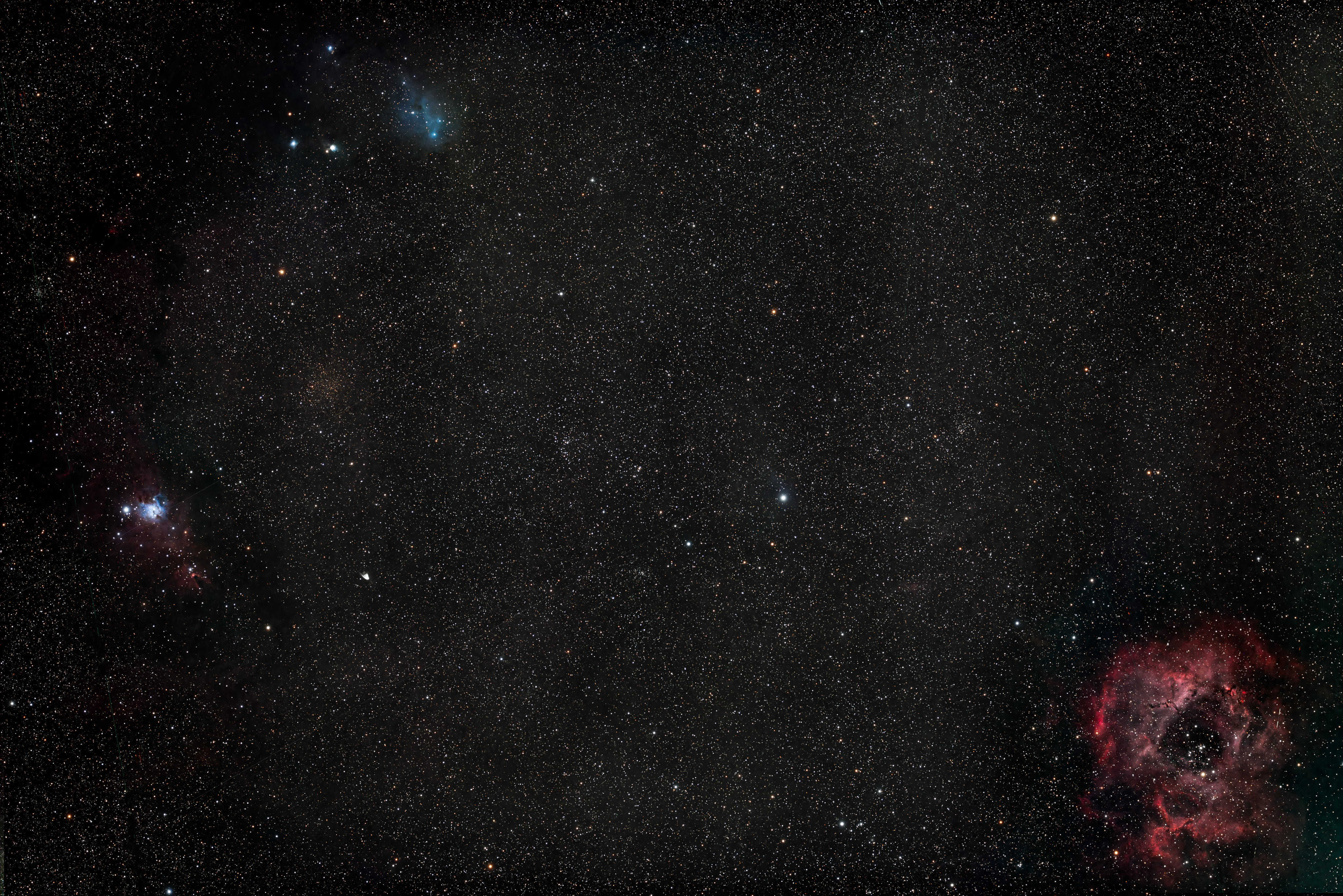
Christmas Tree Cluster, IC 447 and the Rosette Nebula, SVBONY SC571CC
- Integration
- 1 h (20 x 180 s)
- Field
- 6.65 x 4.44 degrees
- Telescope
- SVBONY SV545
- Camera
- SVBONY SC571CC
- Mount
- Unknown
- Target
- Christmas Tree Cluster, IC 447 and the Rosette Nebula
- Type
- Open clusters and nebulae
- Location
- Bortle 6.8 (in my garden)
Monkey Head Nebula, Jellyfish Nebula and M35, SVBONY SC571CC
- Integration
- 1 h (20 x 180 s)
- Field
- 6.65 x 4.44 degrees
- Telescope
- SVBONY SV545
- Camera
- SVBONY SC571CC
- Mount
- Unknown
- Target
- Monkey Head Nebula, Jellyfish Nebula and M35
- Type
- Nebulae, supernova remnant and open clusters
- Location
- Bortle 6.8 (in my garden)
Whale Galaxy (NGC 4631) and Crowbar Galaxy (NGC 4656), SVBONY SC571CC
- Integration
- 1 h (20 x 180 s)
- Field
- 6.53 x 4.19 degrees
- Telescope
- SVBONY SV545
- Camera
- SVBONY SC571CC
- Mount
- Unknown
- Target
- Whale Galaxy (NGC 4631) and Crowbar Galaxy (NGC 4656)
- Type
- Galaxy field
- Location
- Bortle 6.8 (in my garden)
Pleiades (M45), SVBONY SC571CC
- Integration
- 1 h (20 x 180 s)
- Field
- 6.55 x 4.37 degrees
- Telescope
- SVBONY SV545
- Camera
- SVBONY SC571CC
- Mount
- Unknown
- Target
- Pleiades (M45)
- Type
- Open cluster and reflection nebula
- Location
- Bortle 6.8 (in my garden)
Raw against finished
The rig on the mount
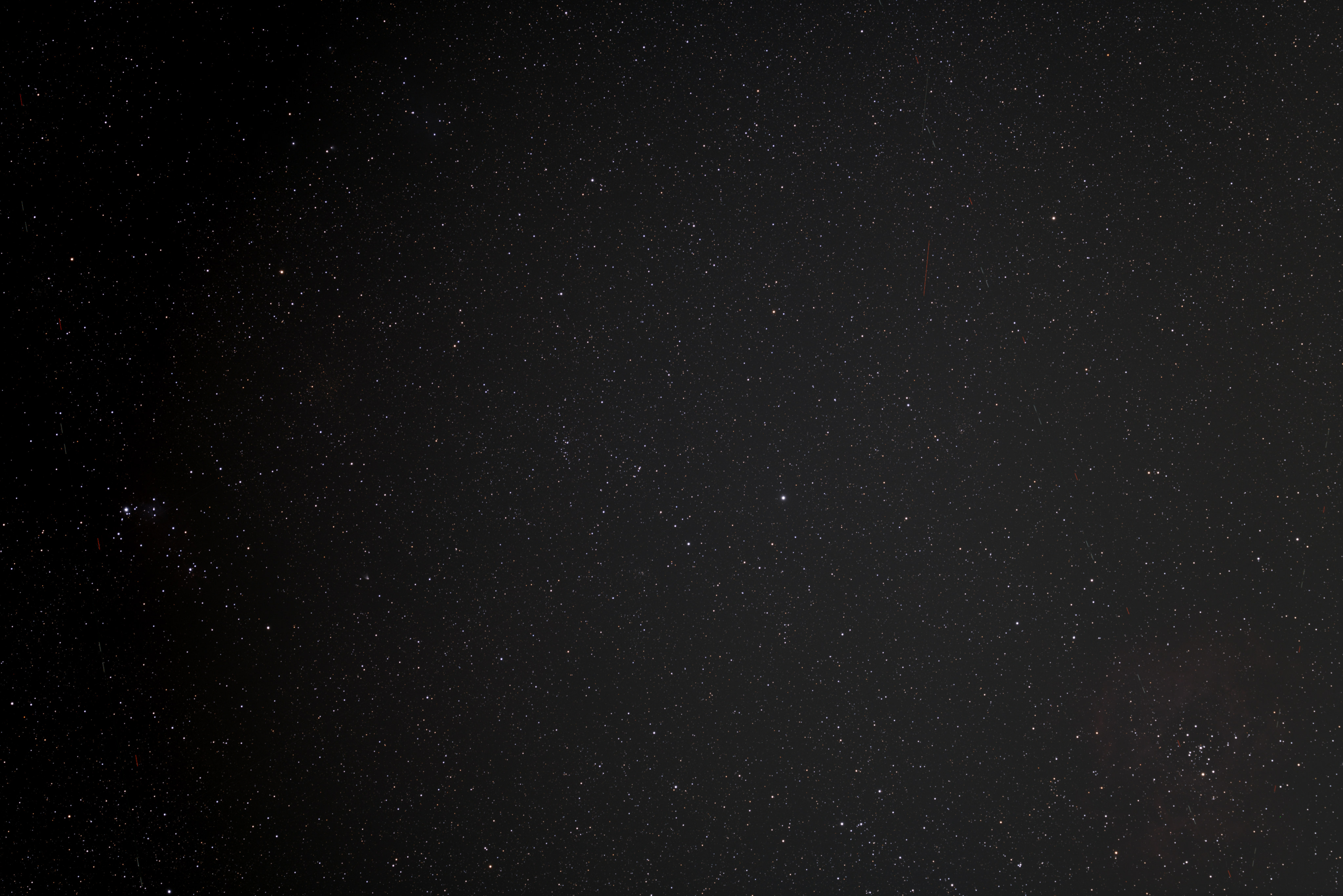
The 3 targets, the raw combined stack against my finished image, each with its integration, the camera and the palette:
- Christmas Tree Cluster, IC 447 and the Rosette Nebula: 1 h (20 x 180 s) of light, SVBONY SC571CC, the raw combined stack with one automatic stretch
- Monkey Head Nebula, Jellyfish Nebula and M35: 1 h (20 x 180 s) of light, SVBONY SC571CC, the raw combined stack with one automatic stretch
- Whale Galaxy (NGC 4631) and Crowbar Galaxy (NGC 4656): 1 h (20 x 180 s) of light, SVBONY SC571CC, the raw combined stack with one automatic stretch
On the TeSeek 11, then on six other mounts
What is it for
Seven things it is for
A five-element Petzval
SVBONY are by far the most cost-effective brand on the market, and yet here we have a five element Petzval telescope.
Main scope or second scope
It's easy to adjust this telescope to be your main scope or even a secondary scope mounted in the guide scope dovetail on your main.
Helical focusing, autofocuser ready
It comes with all of the necessary gear to custom fit your own electronic autofocuser, as well as a well-designed spot for the autofocuser to sit on.
A full 360 degree rotator
You can easily adjust the angle of the camera by a full 360 degrees, making this a very straightforward to use portable scope.
Plenty of room to zoom in
The Monkey Head Nebula, the Jellyfish Nebula and Messier 35, the Shoe Buckle Cluster, share one frame, and there's plenty of room to zoom in and have a play around.
Sharp in the corners
I wanted to really test the corners of this telescope, so I framed a couple of bright stars and large galaxies towards the edges. The Whale Galaxy up in the top right hand corner is looking very nice and sharp.
Groups of objects in one frame
There are still plenty of groups of objects in our night sky that make for excellent targets. Thanks to thoughtful framing, the Christmas Tree Cluster, IC 447 and the dazzling Rosette Nebula share the same shot.
Watch the review
Is the $499 Svbony SV545 the Best Cheap Telescope on Earth? · published 3 May 2026 · 5:46 · Watch on YouTube · 4,576 views, 214 likes on 2 Oct 2026
Jump to
- 0:35 SVBONY's reputation and the five element Petzval
- 0:50 Specifications, the helical focuser and the rotator
- 1:26 Pairing it with the SVBONY SV571 camera
- 1:49 Orion's Belt and Sword, from raw stack to finished
- 2:34 The Monkey Head, the Jellyfish and M35
- 3:05 The Pleiades and the Askar 71F
- 3:31 The Whale and Crowbar galaxies in the corner
- 4:02 The Christmas Tree Cluster to the Rosette Nebula
- 4:45 My verdict
Transcript of the review video 1,175 words · 11 chapters · searchable
Press a time stamp to play from there.
0:00 Could this be the best cheap telescope?
0:00 Could this be the best cheap telescope on the market today? 0:02 It is the SVBONY SV545 telescope. 0:04 It has an aperture of 45 mm, a focal length of 202.5 mm, and therefore an F ratio of f/4.5. 0:10 Its five element Petzval APO design allows it to take wonderful images like this. 0:16 In today's video, we are going to be taking a detailed look at what makes this telescope stand out amongst the intense competition and assess whether or not this $499 scope is in fact one of the best value telescopes on the market. 0:29 I'm Damon Scotting and this is Astronomical.
0:35 SVBONY's reputation and the five element Petzval
0:35 SVBONY is renowned for releasing affordable telescope gear. 0:37 They are by far the most cost effective brand on the market, but the terms high quality are rarely associated with the brand. 0:43 And yet here we have a five element Petzval telescope under $500. 0:47 So let's try and find the catch.
0:50 Specifications, the helical focuser and the rotator
0:50 Here's a full list of this telescope specifications. 0:54 It is a little scope, but it is one of the most versatile telescopes I've ever used. 0:58 It's easy to adjust this telescope to be your main scope or even a secondary scope mounted in the guide scope dovetail on your main. 1:03 It uses a helical focuser as opposed to the standard dual speed focuser, which means it's a little different to try and install with your own electronic autofocuser if that's what you even want. 1:13 But fortunately, it comes with all of the necessary gear to enable you to custom fit it, as well as a well-designed spot for the autofocuser to sit on. 1:21 You can easily adjust the angle of the camera by a full 360°, making this a very straightforward to use portable scope.
1:26 Pairing it with the SVBONY SV571 camera
1:26 But what about the quality of the images? 1:29 Well, in order to test this out, I partnered it with one of the most popular astro camera sensors in history. 1:34 This is SVBONY's brand new SV571. 1:38 It's a little bit unique in its design and it uses the popular IMX571 sensor which means a huge resolution of 26 megapixels with some relatively large pixels. 1:47 This feels like a match made in heaven.
1:49 Orion's Belt and Sword, from raw stack to finished
1:49 Especially when this arrangement allows me to perfectly frame Orion's Belt and its sword in the same singular shot. 1:55 This is how the raw stacked shot turned out after 1 hour's worth of 3 minute long exposures. 2:00 And then here it is after I've run it through the free software GraXpert to remove the nasty little gradient caused by the dense light pollution in my town. 2:07 And then I've applied the paid services of BlurXTerminator and NoiseXTerminator to really clean up and sharpen my image. 2:15 Look at that. 2:15 We're maximizing the detail visible in this image. 2:17 The cherry on top, though, is that I've had a play around with the colours and levels in Photoshop to give me this shot as my final image, which is absolutely gorgeous, even if it is a far cry from its original state. 2:29 The sharpness and colours of the image are impressive, and I see very little to complain about so far.
2:34 The Monkey Head, the Jellyfish and M35
2:34 Next up, I've gone for a real playground of cosmic wonders. 2:36 We've got the Monkey Head Nebula, the Jellyfish Nebula, and Messier 35, the Shoe Buckle Cluster. 2:43 I think the thing to really note with these images captured with the SV545 is that the star colours are gorgeous. 2:49 They are very accurate and naturally quite vibrant. 2:51 Yeah, I really like how this image has turned out as well. 2:54 There's plenty of room to zoom in and have a play around. 2:56 The telescope obviously presents you with a very wide field of view given its 45mm aperture, but there's still plenty of groups of objects in our night sky that make for excellent targets.
3:05 The Pleiades and the Askar 71F
3:06 Now, for our next target, maybe it is that it was getting very low down in the horizon, but I've captured far better shots of the Pleiades than this. 3:14 It appears it's just not being able to bring out as much detail from its thick dust clouds as I'd hoped. 3:20 For comparison, here's a shot I captured with a similarly priced Askar 71F of the Pleiades with the same IMX571 sensor. 3:27 Perhaps I'm being too harsh with this judgment, but this one wasn't fun to edit afterwards, and it just felt a little disappointing.
3:31 The Whale and Crowbar galaxies in the corner
3:32 I wanted to really test the corners of this telescope and see how it fares. 3:36 So, for the next shot, I've got a couple of bright stars and large galaxies framed towards the edges. 3:42 You can see dozens of tiny faint galaxies throughout the image, but the key one to note is of course the Whale Galaxy up here in the top right hand corner. 3:51 Now, this is looking very nice and sharp. 3:52 We've also got its galactic companion, the Crowbar Galaxy, alongside it. 3:56 The two of which are looking excellent, even located all the way up here in the corner. 4:00 So, I'm quite happy with that.
4:02 The Christmas Tree Cluster to the Rosette Nebula
4:02 And then to finish things off, we've got another cosmic collection of wonders. 4:05 this time with plenty of opposing colours with a very space-esque reds and blues. 4:10 Towards the left hand side here, we have the Christmas tree cluster which can be seen alongside the very small Hubble's Variable Nebula. 4:18 Look at this little ghostlike superhero of a deep sky object. 4:20 Moving upwards, we can see IC 447 and these fantastic shades of blue. 4:23 How often do you see something like this in nature? 4:28 It really is spellbinding, especially in contrast to the reds of the Christmas tree cluster. 4:32 But then moving all the way to the opposite corner of the frame, we have the dazzling Rosette Nebula. 4:36 A wonder well worth imaging on its own. 4:41 But thanks to the thoughtful framing, we can capture all of these curiosities in the same shot as one another.
4:45 My verdict
4:45 So, there we have it. 4:47 What do you think of the SV545 telescope from SVBONY and the images I've captured with it? 4:51 There is a product link in the description down below if you wish to take a more detailed look at its specifications and features. 4:57 And you can also get a nice discount by using the code on screen right here, making it an even better deal than before. 5:03 In my personal opinion, I think it's a worthy addition to the telescope market. 5:06 It is offering a lot of star for your buck with its pricing. 5:10 I spoke at the beginning about how SVBONY have always been the go-to cheap alternative brand. 5:14 While this telescope certainly lives up to that title, it's affordable and the results speak for themselves. 5:20 Thanks for watching. 5:20 I'm Damon Scotting and this was Astronomical.
5:23 The 42 Wonders of Our Night Sky book
5:24 It is finally here. 5:24 42 Wonders of Our Night Sky book has officially been released. 5:28 What started as my biggest astronomy series on YouTube is now a full book. 5:32 140 pages packed with stunning deep sky objects, practical stargazing tips, fun facts, puzzles, games, and side-by-side comparisons showing what each of these wonders look like through three very different setups.
Tested numbers and the download
Finished image
- Download the raw stack JPEG · 1.5 MB · 4,096 x 2,733
- Download the finished image JPEG · 4.1 MB · 4,096 x 2,733
Licence: for personal use, credit Damon Scotting. Both JPEGs 4,096 x 2,733 px.
-10 C sensor temperature during imaging set point -10 C
203 mm focal length, plate solved SVBONY states 203 mm
6.65 x 4.44° field of view 6,248 x 4,176 px on SVBONY SC571CC
26 MP SVBONY SC571CC 6,248 x 4,176 px, 23.5 x 15.7 mm
Should you buy it?
85/100 Stars for Your Buck
Pros
- “Its five element Petzval APO design allows it to take wonderful images.”
- “It is a little scope, but it is one of the most versatile telescopes I've ever used.”
- “The star colours are gorgeous. They are very accurate and naturally quite vibrant.”
- “The Whale and Crowbar galaxies are looking excellent, even located all the way up in the corner.”
Cons
- “It uses a helical focuser as opposed to the standard dual speed focuser, which means it's a little different to install with your own electronic autofocuser.”
- “On the Pleiades it just wasn't able to bring out as much detail from the thick dust clouds as I'd hoped.”
- “The telescope presents you with a very wide field of view given its 45 mm aperture.”
It's affordable, and the results speak for themselves.
Who the SV545 is for
Budget imager with an APS-C camera
Buy
A five-element Petzval with a 44 mm image circle, so an APS-C sensor sits well inside it and galaxies stay sharp right into the corners.
Imager adding a second scope to one mount
Buy
At 0.98 kg for the tube it can ride in the guide scope dovetail of your main telescope, and it works as a main scope on its own too.
Wide-field nebula and cluster imager
Buy
It fits the Christmas Tree Cluster and the Rosette Nebula in one frame, and the Monkey Head, the Jellyfish and M35 in another.
Galaxy and small-target imager
Skip
At 203 mm small targets are tiny in the frame; my recommendation is the Askar 71F, whose 490 mm showed far more of the Pleiades dust.
Buyer who wants a dual-speed focuser
Skip
The SV545 focuses with a helical ring; my recommendation is the ToupTek Hope D60, with a dual-speed rack and pinion and a higher score on my board.
Buyer choosing between the SV545 and the SV555
Buy
Choose the SV545: it is lighter and cheaper, and the bigger SV555 gave me no better images.
Three alternatives I have reviewed
- Askar 50P 50 mm f/3.8, quadruplet Petzval, one SD element 95/100 £299 Read the review
- ToupTek Hope D60 60 mm f/4.66, 5-element planar apochromatic 93/100 £749 Read the review
- Askar 71F 71 mm f/6.9, quadruplet air-spaced APO, one ED element, self-flattening 81/100 £599 Read the review
Questions and more about this review
Reviewed by
Damon Scotting
The Telescope Man Verified
BSc (Hons) Physics with Astrophysics and Cosmology, Loughborough University PGCE / QTS, University of Nottingham
About Damon About Damon Damon Scotting is The Telescope Man. He holds a BSc (Hons) in Physics with Astrophysics and Cosmology from Loughborough University and a PGCE with QTS from the University of Nottingham, and taught physics in secondary schools before becoming an astronomy creator. He is a contributing writer for BBC Sky at Night Magazine and the author of 42 Wonders of Our Night Sky, and his photograph of the galaxy M100 with the dwarf planet Ceres was Highly Commended in the Astronomy Photographer of the Year 2024 competition run by Royal Observatory Greenwich. He has appeared on the BBC's Blue Peter. More than 750,000 people follow his astronomy channels on YouTube, Instagram and TikTok, and he has reviewed more than 140 telescopes, mounts, cameras, filters and accessories hands-on for this site. More about Damon · How I test · Damon's book
I review all kinds of gear: most of it I buy, some is gifted and some is loaned, and all of it is reviewed the same way. How this site is funded
Nine questions, answered
Questions about the SVBONY SV545
Reviewed 3 May 2026 ·Updated 22 September 2026
I review all kinds of gear. Most of it I buy, some is gifted and some is loaned, and all of it is reviewed the same way: no company sees or approves a review before it is published. Shop links marked Ad are affiliate links: I earn a commission when you buy through them, at no extra cost to you. How this site is funded
- What is the real focal length of the SVBONY SV545? SVBONY quote 203 mm, and SVBONY UK 202.5 mm. My SV545 frames on an IMX571 camera plate solve at 3.83 arcseconds per pixel, which with 3.76 micron pixels is 202.5 mm and a field of 6.65 x 4.44 degrees. Tested numbers and the download ↓
- Does the SV545 need a field flattener? No. It is a five element Petzval in three groups with a flat field built in: SVBONY sell it as a full-frame astrograph and SVBONY UK quote a 44 mm image circle. Every capture on this page is on an APS-C IMX571 sensor with no flattener. The specifications and the comparison table ↓
- How sharp is the SV545 in the corners? On an APS-C sensor, sharp enough for galaxies: the Whale and the Crowbar sit in the top right corner of my frame and hold their shape, with dozens of tiny faint galaxies across the field. I have not tried a full-frame camera on it. The raw stacks against the finished images ↓
- Does the SV545 come with an autofocuser? No. The kit to mount one is in the box, but the focus motor itself is sold separately. The specifications and the comparison table ↓
- Which camera did I use with the SV545? Every capture here is on the SVBONY SC571CC, a cooled 26 megapixel IMX571 colour camera, in 180 second subs. It feels like a match made in heaven with this telescope. What I captured ↓
- How does the SV545 do on the Pleiades? Not as well as my other targets. The Pleiades was getting very low on the horizon when I shot it, and my frame here is only 36 minutes of 3 minute subs. What I captured ↓
- Should I buy the SV545 or the SV555? For me, the SV545. I expected better images from the bigger SV555 than the shots I got with the SV545, but sadly that was not the case: the smaller SV545 produced some stunning colour shots, and the images were very easy to edit. The specifications and the comparison table ↓
- What does the SVBONY SV545 cost and where can I buy it? The prices I recorded: £459 at First Light Optics (UK), awaiting stock; $540 at Amazon US (SVBONY store), US, in stock; $540 at SVBONY (Global), in stock. A record, not a live price
- What have I not tested on the SV545? I have not tested the SV545 on a full-frame sensor, with an autofocuser fitted, on the planets or the Moon, or against another telescope on the same night.