ZWO ASI6200MM Pro review: 62 megapixels of full-frame mono
Where does it rank on our leaderboard
| Rank | Camera | Stars for Your Buck | Recorded UK price |
|---|---|---|---|
| 1 | SVBONY SV705C | 93 out of 100 | £229 |
| 2 | SVBONY SC571CC | 90 out of 100 | £1,029 |
| 4 | ZWO ASI2600MC Air | 88 out of 100 | £2,149 |
| 11 | Player One Saturn-C | 78 out of 100 | £514 |
| 15 | Player One Uranus-C | 76 out of 100 | £395 |
| 18 | ZWO ASI6200MM Pro | 74 out of 100 | £3,999 |
| 23 | ZWO ASI220MM | 67 out of 100 | £299 |
| 28 | ZWO ASI183MC | 38 out of 100 | £549 |
| 29 | Nikon COOLPIX P1000 | 32 out of 100 | £787 |
Contents
- 01 Where does it rank on our leaderboard
- 02 Specifications and features
- 03 In the hand
- 04 The rig on the mount
- 05 How good is it? Here is what it captured
- 06 Raw against finished
- 07 What is it for
- 08 Versus the ASI 4400MC
- 09 Watch the review
- 10 Tested numbers and the download
- 11 Should you buy it?
- 12 Questions and more about this review
In 30 seconds
Stars for Your Buck 74/100
Reviewed 2 Sep 2026 Updated 24 Sep 2026
- Rank
- #18 of 29 cameras
- Verdict
- Worth a look
Written by Damon Scotting 8 min read
Buy it if
- You image narrowband through a full-frame astrograph (an image circle of 44 mm or more) and want 62 megapixels of mono
- You want room to crop: a 4K view cut from one frame still holds its detail
- You already own a large filter wheel and 2 inch or 36 mm filters
Skip it if
- You are starting out: a colour camera needs no filter wheel and no filters
- Your telescope covers only APS-C, or your targets are small: most of the sensor goes to waste
- You are budget conscious: my recommendation is an APS-C mono camera such as the ToupTek ATR2600MM
“It is a whopping 62 megapixels, meaning it is about 50% larger than an 8K image.”
Specifications and features
Against the cameras I have reviewed
Compare with
| ZWO ASI6200MM Pro reviewed #18 of 29 | ZWO ASI6200MC #27 of 29 | ASI 4400MC #20 of 29 | ToupTek SkyEye 24AC #5 of 29 | ZWO ASI2600MM Air #7 of 29 | ToupTek ATR2600MM #19 of 29 | |
|---|---|---|---|---|---|---|
| Recorded UK price | £3,999 | £3,999 | £3,299 | £1,804 | £2,499 | £1,488 |
| Stars for Your Buck | 74/100 | 59/100 | 72/100 | 85/100 | 84/100 | 73/100 |
| Sensor | Sony IMX455, back-illuminated | Sony IMX455, back-illuminated | Sony IMX366, back-illuminated | Sony IMX410, full frame | Sony IMX571, with a built-in SC2210 guide sensor | Sony IMX571 mono, back-illuminated |
| Format | Full frame, 36 x 24 mm (43.3 mm diagonal) | Full frame, 36 x 24 mm | Full frame, 36 x 24 mm | Full frame | APS-C, 23.5 x 15.7 mm | APS-C, 23.4 x 15.7 mm |
| Colour or mono | Mono | Colour | Colour | Colour | Mono | Mono |
| Resolution | 9576 x 6388, 61.2 MP | 9576 x 6388, 61.2 MP | 8192 x 5460, 44.7 MP | 6064 x 4040, 24.5 MP | 6248 x 4176, 26.1 MP | 6224 x 4168, 25.9 MP |
| Pixel size | 3.76 um | 3.76 um | 4.4 um | 5.94 um | 3.76 um | 3.76 um |
| Cooling | Two-stage TEC, 30 to 35 C below ambient | Two-stage TEC, 30 to 35 C below ambient | Two-stage TEC, 30 to 35 C below ambient | Two-stage TEC, 30 to 35 C below ambient | 30 to 35 C below ambient | Two-stage TEC, 35 C below ambient on short exposures, 42 C on long ones |
| Read noise | 0.86 e- | 0.86 e- | 1.1 e- | 0.3 to 4.48 e- | 0.9 to 4.2 e- | 0.77 to 2.77 e- |
| Full well | 51.4 ke- | 51.4 ke- | 74.6 ke- | 104 ke- | 50 ke- | 51 ke- |
| ADC | 16-bit | 16-bit | 14-bit | 14-bit | 16-bit | 16-bit |
| Weight | 700 g | 700 g | 700 g | 718 g | 775 g | 577 g |
| Back focus | 17.5 mm (55 mm with the boxed extenders) | 17.5 mm | 17.5 mm | 17.5 mm | 12.5 or 17.5 mm | 17.5 mm with the M42 adapter |
| Interface | USB 3.0, two USB 2.0 hub ports, 512 MB DDR3 buffer | USB 3.0, two USB 2.0 hub ports, 512 MB DDR3 buffer | USB 3.0, two USB 2.0 hub ports, 512 MB DDR3 buffer | USB 3.0, a two-port USB hub, DC 12 V | Wi-Fi 5, four USB 2.0 hub ports, 256 GB eMMC | USB 3.0, two USB 2.0 hub ports, 512 MB DDR3 buffer |
| In the box | The camera, M48-M48 16.5 mm and M54-M48 21 mm extenders, an M42M-M48F adapter, a dust cover, a 2 m USB 3.0 cable, two 0.5 m USB 2.0 cables, a hex key, a quick guide and a camera bag | The camera, M48-M48 16.5 mm and M54-M48 21 mm extenders, an M42M-M48F adapter, a dust cover, a 2 m USB 3.0 cable, two 0.5 m USB 2.0 cables, a hex key, a quick guide and a camera bag | The camera, a 2 inch silicone dust cover, M48-M48 16.5 mm and M54-M48 21 mm extenders, an M42M-M48F adapter, two 0.5 m USB 2.0 cables, a 2 m USB 3.0 cable, a hex key, a quick guide and a camera bag | The camera, a 12 V 3 A adapter, a 1.5 m USB 3.0 cable, a CD, a hex key, M54M-M48F 21 mm and M48M-M48F 16.5 mm extenders and an M48M-M42F adapter | Camera, two 1 m DC power cords, 1.5 m DC extension, two 0.5 m USB 2.0 cables, 16.5 mm and 21 mm M54 spacers, M48 to M54 ring, cable strap, hex wrench, quick start guide | The camera, a 12 V 3.3 A power adapter and cable, a 1.5 m USB 3.0 cable, M48-M42 0 mm, 16.5 mm and 21 mm extenders, a 12.5 mm M42 adapter and a cover |
In the hand
The rig on the mount
On the JUWEI-17, then on six other mounts
How good is it? Here is what it captured
Eight targets
Veil Nebula, ZWO ASI6200MM Pro, Antlia 2.5 nm SHO
- Integration
- 1 h 30 min
- Field
- 2.9 x 1.9 degrees
- Telescope
- Askar SQA130
- Camera
- ZWO ASI6200MM Pro
- Mount
- ZWO AM7
- Target
- Veil Nebula (NGC 6960 and NGC 6992)
- Type
- Supernova remnant
- Location
- Bortle 6.8 (in my garden)
You are looking at the aftermath of a star 20 times the size of our own Sun, which reached the end of its life about 10,000 years ago.
Elephant's Trunk Nebula, ZWO ASI6200MM Pro, Antlia 2.5 nm SHO
- Integration
- 1 h 30 min
- Field
- 3.3 x 2.2 degrees
- Telescope
- Askar SQA130
- Camera
- ZWO ASI6200MM Pro
- Mount
- ZWO AM7
- Target
- Elephant's Trunk Nebula (IC 1396)
- Type
- Emission nebula
- Location
- Bortle 6.8 (in my garden)
The Elephant Trunk Nebula is an absolute hall of famer when it comes to images of our night sky.
North America Nebula, ZWO ASI6200MM Pro, Antlia 2.5 nm SHO
- Integration
- 4 h 9 min (83 x 180 s)
- Field
- 2.7 x 1.8 degrees
- Telescope
- ZWO FF110
- Camera
- ZWO ASI6200MM Pro
- Mount
- ZWO AM3N
- Target
- North America Nebula (NGC 7000)
- Type
- Emission nebula
- Location
- Bortle 6.8 (in my garden)
Now this is a great target to really stretch the muscles of this 62 megapixel camera.
It's high above the horizon all night, practically overhead, which means it was easy to get a whopping four hours of imaging time in just one night.
Heart Nebula, ZWO ASI6200MM Pro, Antlia 2.5 nm SHO
- Integration
- 1 h 9 min (23 x 180 s)
- Field
- 2.7 x 1.8 degrees
- Telescope
- ZWO FF110
- Camera
- ZWO ASI6200MM Pro
- Mount
- ZWO AM3N
- Target
- Heart Nebula (IC 1805)
- Type
- Emission nebula
- Location
- Bortle 6.8 (in my garden)
I think the Heart Nebula looks genuinely impressive here and we've really maximised our field of view.
Andromeda Galaxy, ZWO ASI6200MM Pro, ZWO LRGB
- Integration
- 2 h 18 min (46 x 180 s)
- Field
- 2.7 x 1.8 degrees
- Telescope
- ZWO FF110
- Camera
- ZWO ASI6200MM Pro
- Mount
- ZWO AM3N
- Target
- Andromeda Galaxy (M 31)
- Type
- Galaxy
- Location
- Bortle 6.8 (in my garden)
It is certainly still picking up some very sharp details, particularly in these galactic bands.
Bode's and Cigar Galaxies, ZWO ASI6200MM Pro, LRGB
- Integration
- 1 h
- Field
- 3.2 x 2.1 degrees
- Telescope
- Askar SQA130
- Camera
- ZWO ASI6200MM Pro
- Mount
- ZWO AM7
- Target
- Bode's and Cigar Galaxies (M 81 and M 82)
- Type
- Galaxies
- Location
- Bortle 6.8 (in my garden)
It's impossible to steal the show from the gorgeous spiralling arms of Bode's Galaxy and the unique chaotic structure of the Cigar Galaxy.
Rosette Nebula, ZWO ASI6200MM Pro, SHO
- Integration
- 36 min (12 x 180 s)
- Field
- 3.3 x 2.2 degrees
- Telescope
- Askar SQA130
- Camera
- ZWO ASI6200MM Pro
- Mount
- ZWO AM7
- Target
- Rosette Nebula (NGC 2237)
- Type
- Emission nebula
- Location
- Bortle 6.8 (in my garden)
Nevertheless, the fine structure is there to be seen, as well as its vibrant colours.
Dumbbell Nebula, ZWO ASI6200MM Pro, SHO
- Integration
- 42 min (14 x 180 s)
- Field
- 2.7 x 1.8 degrees
- Telescope
- ZWO FF110
- Camera
- ZWO ASI6200MM Pro
- Mount
- ZWO AM3N
- Target
- Dumbbell Nebula (M 27)
- Type
- Planetary nebula
- Location
- Bortle 6.8 (in my garden)
A target that realistically would have been perfectly framed by the ASI533 camera. The ASI6200 on the other hand just feels like a huge overkill.
Raw against finished
What is it for
The 6 targets, the raw combined stack against my finished image, each with its integration, the camera and the palette:
- Elephant's Trunk Nebula (IC 1396): 1 h 30 min of light, ASI6200MM Pro, SHO, the raw combined stack with one automatic stretch
- Heart Nebula (IC 1805): 1 h 9 min (23 x 180 s) of light, ASI6200MM Pro, SHO, the raw combined stack with one automatic stretch
- North America Nebula (NGC 7000): 4 h 9 min (83 x 180 s) of light, ASI6200MM Pro, SHO, the raw combined stack with one automatic stretch
- Andromeda Galaxy (M 31): 2 h 18 min (46 x 180 s) of light, ASI6200MM Pro, LRGB, the raw combined stack with one automatic stretch
- Bode's and Cigar Galaxies (M 81 and M 82): 1 h of light, ASI6200MM Pro, LRGB, the raw combined stack with one automatic stretch
- Rosette Nebula (NGC 2237): 36 min (12 x 180 s) of light, ASI6200MM Pro, SHO, the raw combined stack with one automatic stretch
Five things it is for
Narrowband through light pollution
Partnered with 2.5 nm narrowband filters, it isolates the light of the nebula so well that a hazy, light-polluted sky behaves like a far darker one.
Room to crop
The Cygnus Wall looks immense, sharp and structured, and I can crop into that area alone and still end up with a 4K image.
A whole galaxy in one frame
Because the sensor is full frame, a few angle adjustments fitted the entirety of the Andromeda Galaxy within the same field of view.
Space is big
The Andromeda frame did not feel like a 62 megapixel shot to me. The Heart Nebula definitely does: it gives me that space is big kind of feeling.
My best image
The Veil Nebula is my Mona Lisa, my starry night: the kind of image I would put up against the Hubble Space Telescope.
Versus the ASI 4400MC
The North America Nebula on both, plate-solved and star-aligned (residual 0.02 px per 1000)
| Target | Telescope | Integration | Subs | Filter | Nights |
|---|---|---|---|---|---|
| North America Nebula (NGC 7000) | Askar SQA130 + ZWO ASI6200MM Pro | 180 min | not recorded | SHO (Antlia 2.5 nm) | 2026-03-26, 2026-03-29 |
| North America Nebula (NGC 7000) | Askar SQA130 + ZWO ASI4400MC Pro | 120 min | 40 x 180 s | not recorded | 1 night, 2026 |
Watch the review
Is the ZWO FF110 Worth $1,499? (ZWO FF110 + ASI 6200MM + AM3N + ZWO LRGB) · published 2 September 2026 · 6:45 · Watch on YouTube · 14,693 views, 237 likes on 2 Oct 2026
Jump to
- 1:30 The rig: ASI6200MM Pro, AM3N mount, LRGB and 2.5nm narrowband filters
- 2:19 Andromeda Galaxy (M31), 2 hours LRGB, full frame field of view
- 3:03 Heart Nebula (IC 1805) in SHO with Antlia 2.5nm filters
- 3:54 North America Nebula (NGC 7000), 4 hours in one night, the Cygnus Wall
- 4:28 Dumbbell Nebula (M27), a planetary nebula on a full frame sensor
- 5:18 Elephant's Trunk Nebula (IC 1396), 3 hours, the crown jewel
- 6:04 Verdict after 35 hours with the FF110
Transcript of the review video 1,387 words · 10 chapters · searchable
Press a time stamp to play from there.
0:00 Can a $1,499 telescope produce exhibit worthy images?
0:02 These are all images I captured with ZWO's latest telescope, the FF110. 0:02 It cost $1,499. 0:07 And in today's video, we're going to see exactly why and what it's capable of. 0:11 I'm going to be pushing this telescope to its absolute limits by using the biggest and best camera I have to try and capture some exhibit worthy images from my back garden. 0:17 Is it possible? 0:20 Let's find out. 0:20 I'm Damon Scotting and this is Astronomical.
0:23 ZWO FF110 specs: 110mm, 766mm f/7, flat field, 44mm image circle
0:25 All right, so this is the ZWO FF110. 0:25 So that's 110 millimetres of aperture with a focal length of 766 millimetres. 0:33 So roughly an F ratio of F7. 0:35 The optics are a four element fully airspaced apochromatic design with one ED element. 0:40 And critically the field is flat natively. 0:42 There's no need for a separate flattener that you have to go out and buy and spend extra money on. 0:45 It provides a 44 mm image circle which covers a full-frame sensor corner to corner like the ASI 6200 monochrome camera which I'll be using in today's video.
0:53 Focuser, built in rotator, weight and length
0:56 The focuser is a 3-in rack and pinion with 10:1 dual speed. 0:58 And there is a 360° camera rotator built into the back with an engraved scale, which is the sort of thing you only appreciate when you have spent 20 minutes in the cold trying to square up a mosaic panel. 1:11 The optical tube alone weighs about 5.75 kilos, and that's closer to 6.8 when you have all of the rings and the handle included. 1:18 In terms of length, it is 664 mm at its shortest. 1:21 And then with the dew shield extended, we have about 815 mm at its full extension. 1:26 So first impressions, it is a very nice piece of kit. 1:30 Now, of course, we are dealing with just the optical tube here.
1:30 The rig: ASI6200MM Pro, AM3N mount, LRGB and 2.5nm narrowband filters
1:31 So in order to capture some images of our night sky, we do also need a camera and a mount. 1:35 So everything you are about to see has been shot with an ASI 6200 monochrome Pro, which is a full-frame mono camera mounted on top of an AM3N harmonic drive mount. 1:47 Now, another key element is that in today's video, I'm going to be imaging multiple different targets. 1:49 And in order to do so, I need to use different filter sets, and they include ZWO's LRGB filter set as well as Antlia's 2.5 nanometre narrowband filters. 2:00 Now, the cost of this combination is a long way north of the price of the tube itself, so this is certainly something to factor in. 2:05 The telescope really is the cheapest component in our setup today. 2:08 You can, of course, partner it with cheaper gear, but in today's video, I'm trying to demonstrate what its true capabilities are from a light polluted English garden. 2:17 So, without further ado, let's see how well it can cope. 2:19 All right, so first up is one of our nearest galaxies, Andromeda.
2:19 Andromeda Galaxy (M31), 2 hours LRGB, full frame field of view
2:22 You're going to have to excuse me using a huge camera like this that costs more than twice that of the telescope itself. 2:27 Because the telescope supports full-frame cameras, I thought it was smart to push it to its limits. 2:32 And because of that decision and a few angle adjustments, I've managed to fit the entirety of the Andromeda Galaxy within the same field of view. 2:38 I think this might be the first telescope I've reviewed so far this year that has an F ratio higher than five, which is notable here because this shot does not feel as bright as my other attempts, but it is certainly still picking up some very sharp details, particularly in these galactic bands. 2:53 This was a little over 2 hours worth of integration time with the ZWO 2 inch LRGB filter set. 2:57 I think it's done an adequate job, but to tell you the truth, at the moment, I am just whelmed.
3:03 Heart Nebula (IC 1805) in SHO with Antlia 2.5nm filters
3:04 Let's see if this changes with our next target, the Heart Nebula. 3:06 For this shot, I'm using the Uber Premium Antlia 2 and 1/2 nanometre filter set, which again, sorry, I'm aware this is a bit of a mismatch since these filters collectively cost more than this telescope. 3:18 But the goal was to cut through the dense light pollution in my area to give me some stunning vibrant displays. 3:23 And as you can start to see, that's precisely what I've ended up with here. 3:27 These colours are fantastic. 3:29 I weirdly felt that the Andromeda Galaxy shot didn't really feel like a 62 megapixel shot. 3:33 Well, this one definitely does. 3:36 This shot has really given me that damn space is big kind of feeling. 3:41 This was 30 minutes worth of hydrogen alpha shots, 30 minutes of O III shots, and 15 minutes of S II. 3:45 So yeah, I'm much happier with this capture. 3:50 I think the Heart Nebula looks genuinely impressive here, and we've really maximized our field of view. 3:53 Now, this is a great target to really stretch the muscles of this 62 megapixel camera.
3:54 North America Nebula (NGC 7000), 4 hours in one night, the Cygnus Wall
4:00 The North America Nebula provides a stunning stellar landscape. 4:02 It's high above the horizon all night, practically overhead, which means it was easy to get a whopping four hours of imaging time in just one night. 4:10 The Cygnus Wall down at the bottom here is looking immense, very sharp and structured. 4:15 You can crop into this area specifically and still end up with a 4K resolution image. 4:19 Yeah, I'm very happy with these central blue colours. 4:23 I think they are gorgeous. 4:24 But I still wouldn't give the shot the award for my favourite of this video.
4:28 Dumbbell Nebula (M27), a planetary nebula on a full frame sensor
4:28 Could that title perhaps go to our next deep sky object? 4:30 This is the Dumbbell Nebula, a target that realistically would have been perfectly framed by the ASI 533 camera. 4:36 The ASI 6200, on the other hand, just feels like a huge overkill. 4:42 This target is really fun for bringing out the fainter nebulosity that is otherwise invisible in the visible spectrum of light that we can observe. 4:50 And it has most definitely done that. 4:52 But perhaps I've skimped a little bit on the integration time. 4:54 And as a result, the colours of this nebula have suffered. 4:58 Normally, there's a nice hint of these red and orange colours, but I've just failed at making them pop here. 5:04 The Dumbbell Nebula is a planetary nebula, which means you're not looking at the explosive death of a massive star. 5:08 Instead, you're watching the relatively slow demise of a star a bit bigger than our own as it sheds its outermost layers whilst knocking on Death's door and beginning its demise into a lowly white dwarf star.
5:18 Elephant's Trunk Nebula (IC 1396), 3 hours, the crown jewel
5:18 A little underwhelming perhaps, but fear not, for I have saved the very best till last. 5:26 This is the Elephant Trunk Nebula. 5:26 And if you're a fan of stunning colour palettes, it doesn't get much better than this shot right here. 5:31 With 3 hours worth of integration time, the details and structures here are pinpoint. 5:35 It's sharp and well framed. 5:38 It is however just a shame about that stupid bloody satellite trail. 5:42 I know half of you have already spotted it. 5:44 So to the half who hadn't, I apologize for spoiling this shot. 5:48 I think it ticks all the boxes. 5:50 The shot is stunning. 5:50 is both vibrant and sharp, whilst also feeling like an epic 62 megapixel shot of our night sky. 5:58 This is definitely the crown jewel from today's video. 6:00 The kind of back garden shot that you frame in your office.
6:04 Verdict after 35 hours with the FF110
6:04 Yeah, not bad for a $1,499 telescope. 6:07 Yeah. 6:07 Okay, so what do we think? 6:10 I spent about 35 hours in total with this telescope over the course of a couple of months, and I've really enjoyed it. 6:15 In fact, I've been using it quite a lot to image the sun as well. 6:19 The FF110 telescope is just one telescope that's part of a much larger range recently released by ZWO. 6:25 So, if you do already own one of these telescopes, part of this range, then please let me and countless others know in the comments down below about your own personal experience. 6:32 Based on my time so far, I think it's a decent addition to the astrophotography market. 6:37 If you'd like to purchase one for yourself, then you can find direct product links in the description down below. 6:41 Thanks for watching. 6:41 I'm Damon Scotting and this was astronomical.
Check out more videos on the ZWO ASI6200MM Pro
The $5,000 Telescope That's Closing the Gap With Hubble!?
30 Apr 2026
Tested numbers and the download
Finished image
- Download the raw stack JPEG · 2.4 MB · 4,096 x 2,728
- Download the finished image JPEG · 1.6 MB · 4,096 x 2,728
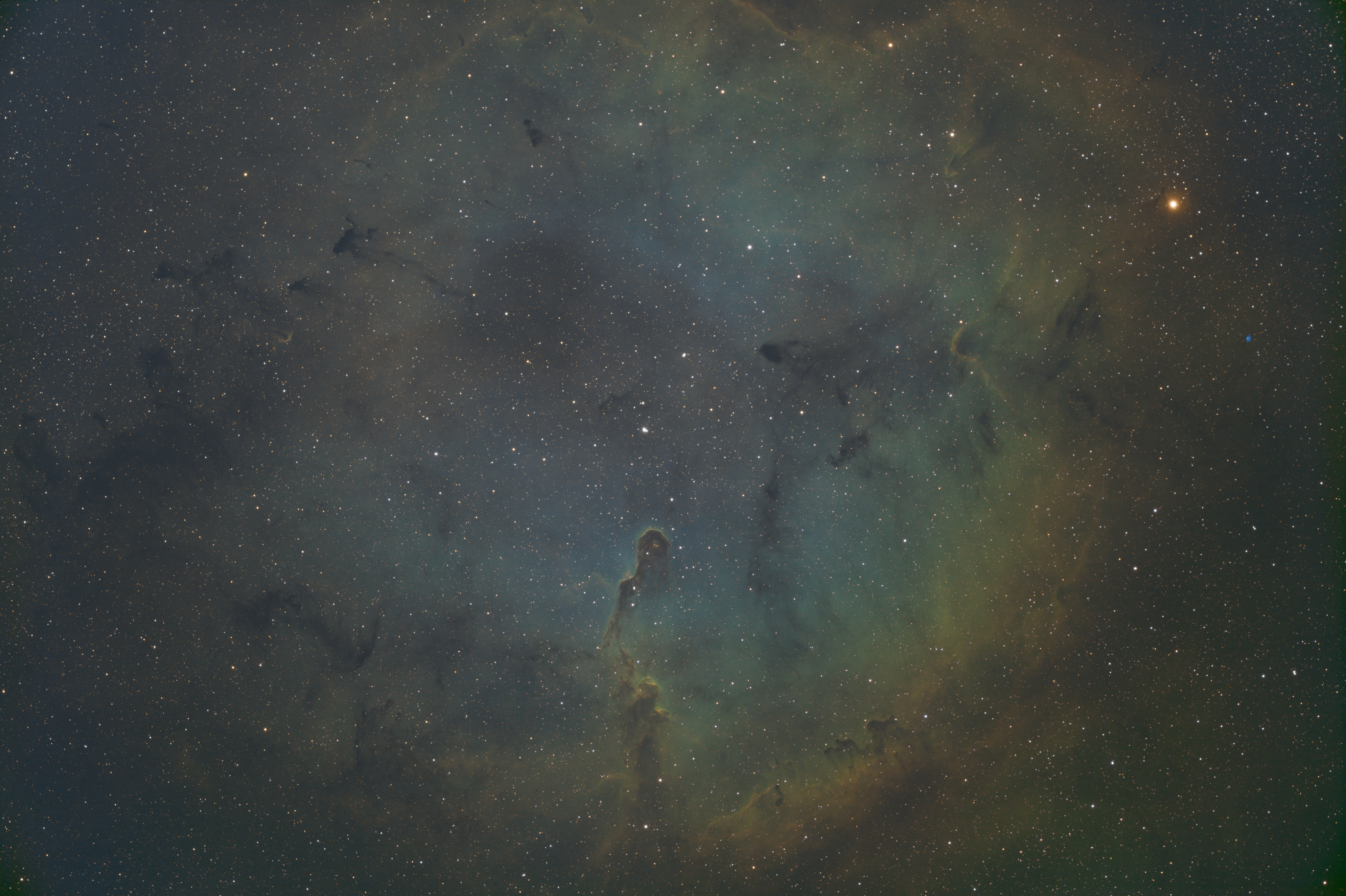
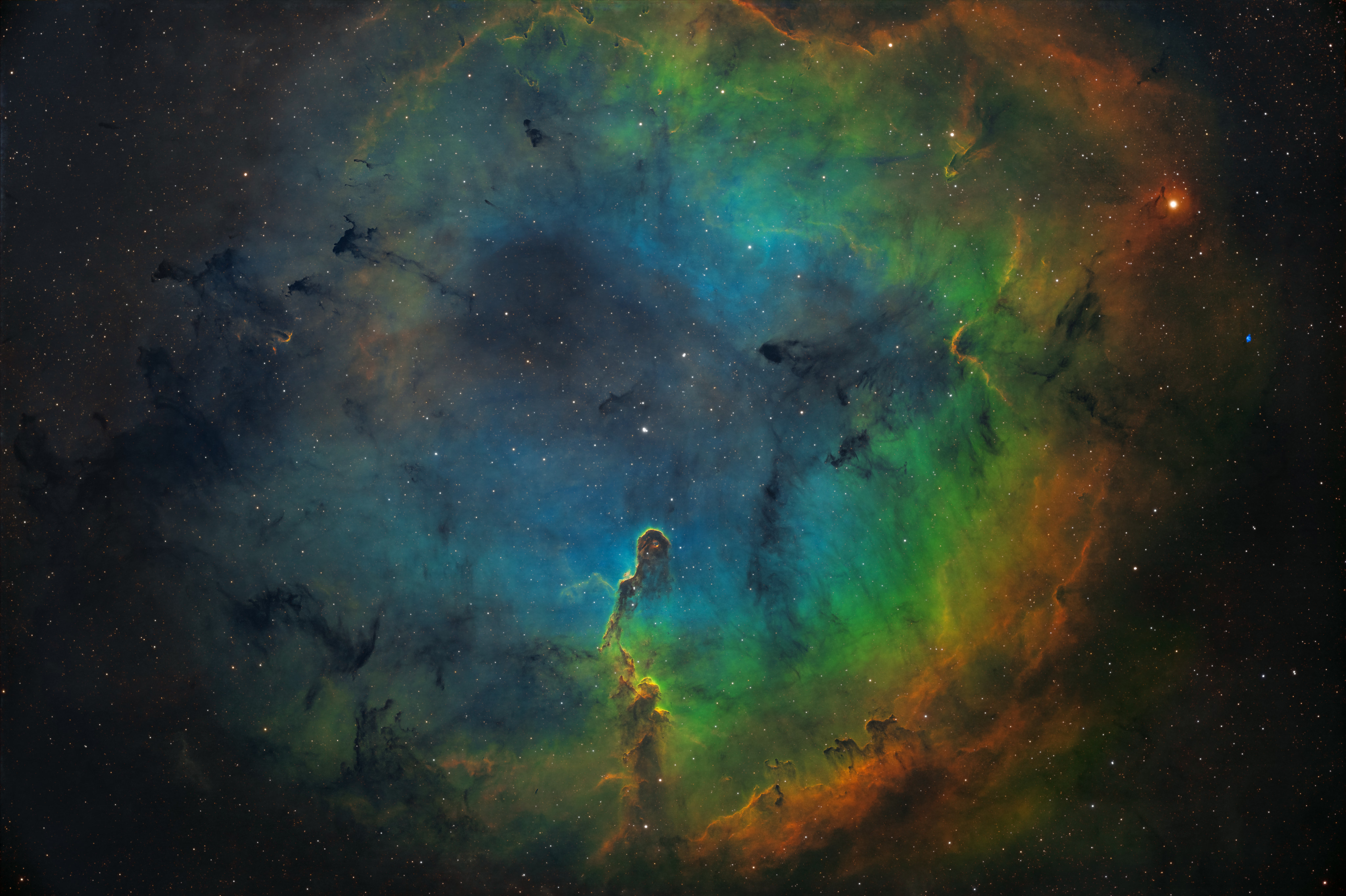
Licence: for personal use, credit Damon Scotting. Both JPEGs 4,096 x 2,728 px.
-10 C sensor set point the set point I run every cooled camera at
765 mm focal length, plate solved on the ZWO FF110, which ZWO states at 766 mm
2.70 x 1.80° field of view 9,576 x 6,388 px on ASI6200MM Pro
61.2 MP ASI6200MM Pro 9,576 x 6,388 px, 36 x 24 mm
Should you buy it?
74/100 Stars for Your Buck
Pros
- 62 megapixels of full-frame mono: I can crop a 4K view of the Cygnus Wall out of one frame and keep the detail.
- With 2.5 nm narrowband filters it pulled 12 hours of the Elephant's Trunk and 3 hours of the Veil out of a light-polluted sky.
- The field holds the whole Andromeda Galaxy at 765 mm and a galaxy group with room to spare at 619 mm.
- It held the -10 C set point on every sub: my 233 FF110 lights read -10.1 to -9.9 C.
- Zero amp glow, 0.86 e- read noise and a native 16-bit ADC on the current model.
Cons
- Overkill on small targets: the Dumbbell Nebula would have been perfectly framed by an ASI533, and here it sits small in a huge field.
- It costs more than twice the ZWO FF110 I used it on, and the narrowband filters cost more again.
- Mono means a filter wheel and full-size filters: every colour image I made with it here is built from separate H, S and O, or L, R, G and B, subs.
- Each 180 s sub is a 122 MB file (9576 x 6388 at 16 bits), so storage fills fast.
- It needs a telescope whose image circle covers a 43.3 mm diagonal to use the whole sensor.
The biggest and best camera I have.
Who the ASI6200MM Pro is for
Narrowband imager with a full-frame astrograph
Buy
The sensor fills a 44 mm image circle, and with 2.5 nm filters I pulled 12 hours of the Elephant's Trunk out of a light-polluted sky.
Complete beginner
Skip
Start with a colour camera: mono needs a filter wheel, filters and a separate run through each filter for one colour image.
Owner of an APS-C mono camera
Skip
Do not upgrade unless your telescope covers full frame: the pixels are the same 3.76 microns, only the field grows.
Imager of small targets
Skip
Small targets sit small: the Dumbbell Nebula looked lost in the field at 765 mm.
Budget-conscious mono imager
Skip
My recommendation is the ToupTek ATR2600MM: the same pixel size on an APS-C sensor for well under half the price.
Imager who wants one camera for the big nebulae
Buy
One 62 megapixel frame covers a whole nebula complex and still crops to a 4K view.
Three alternatives I have reviewed
- ZWO ASI2600MM Air APS-C mono with the same 3.76 micron pixels, guiding built in 84/100 £2,499 Read the review
- ToupTek ATR2600MM APS-C mono IMX571 for well under half the price 73/100 £1,488 Read the review
- ASI 4400MC Full-frame colour: no filter wheel, colour in one exposure 72/100 £3,299 Read the review
Questions and more about this review
Reviewed by
Damon Scotting
The Telescope Man Verified
BSc (Hons) Physics with Astrophysics and Cosmology, Loughborough University PGCE / QTS, University of Nottingham
About Damon About Damon Damon Scotting is The Telescope Man. He holds a BSc (Hons) in Physics with Astrophysics and Cosmology from Loughborough University and a PGCE with QTS from the University of Nottingham, and taught physics in secondary schools before becoming an astronomy creator. He is a contributing writer for BBC Sky at Night Magazine and the author of 42 Wonders of Our Night Sky, and his photograph of the galaxy M100 with the dwarf planet Ceres was Highly Commended in the Astronomy Photographer of the Year 2024 competition run by Royal Observatory Greenwich. He has appeared on the BBC's Blue Peter. More than 750,000 people follow his astronomy channels on YouTube, Instagram and TikTok, and he has reviewed more than 140 telescopes, mounts, cameras, filters and accessories hands-on for this site. More about Damon · How I test · Damon's book
I review all kinds of gear: most of it I buy, some is gifted and some is loaned, and all of it is reviewed the same way. How this site is funded
Eight questions, answered
Questions about the ZWO ASI6200MM Pro
Reviewed 2 September 2026 ·Updated 24 September 2026
I review all kinds of gear. Most of it I buy, some is gifted and some is loaned, and all of it is reviewed the same way: no company sees or approves a review before it is published. Shop links marked Ad are affiliate links: I earn a commission when you buy through them, at no extra cost to you. How this site is funded
- Is the ZWO ASI6200MM Pro worth it? For narrowband imaging through a full-frame astrograph, yes: it is the biggest and best camera I have. On an APS-C telescope or for small targets, no: most of the 36 x 24 mm sensor goes to waste. What I captured ↓
- What telescope does the ASI6200MM Pro need? One whose image circle covers the 43.3 mm diagonal. I used it on the ZWO FF110 (a 44 mm image circle) and the Askar SQA130 (55 mm). The specifications and the comparison table ↓
- How cold does it run? I run it at a -10 C set point, and the 233 lights from my FF110 nights read -10.1 to -9.9 C. ZWO rates the cooling at 30 to 35 C below ambient. Tested numbers and the download ↓
- How much integration went into my images? From 36 minutes on the Rosette Nebula to 12 h 33 min on the Elephant's Trunk; the North America Nebula on the FF110 is four hours of 180 s subs in one night. What I captured ↓
- How big are the files? Each 180 s sub is 9576 x 6388 pixels at 16 bits, 122 MB on disk, so a night of subs runs to many gigabytes. Tested numbers and the download ↓
- ASI6200MM Pro or ASI2600MM Air? Both use 3.76 micron pixels. The ASI6200MM Pro has 2.3 times the sensor area (61.2 against 26.1 megapixels); the ASI2600MM Air costs less and adds a built-in guide sensor and wireless control. The specifications and the comparison table ↓
- How much does the ASI6200MM Pro cost and where can I buy it? The prices I recorded: £3,999 at First Light Optics (UK), awaiting stock; $3,999 (ZWO's 2025 P25 version) at Agena Astro (US), in stock; $3,999 at ZWO store (Global), in stock. A record, not a live price The verdict, the readers and the sellers ↓
- What have I not tested on the ASI6200MM Pro? Read noise, full well and dark current: I quote ZWO figures and have not measured them.