DwarfLab DWARF II review: pocket-sized, but now outclassed
Where does it rank on our leaderboard
| Rank | Telescope | Stars for Your Buck | Recorded UK price |
|---|---|---|---|
| 1 | ZWO Seestar S30 Pro | 99 out of 100 | £649 |
| 2 | ZWO Seestar S50 Pro | 91 out of 100 | £999 |
| 4 | ZWO Seestar S30 | 88 out of 100 | £419 |
| 5 | Vaonis Vespera Pro 2 | 63 out of 100 | £2,599 |
| 6 | DwarfLab DWARF 3 | 61 out of 100 | £459 |
| 7 | Vaonis Vespera III | 60 out of 100 | £2,199 |
| 8 | ZWO Seestar S50 | 55 out of 100 | £539 |
| 9 | DwarfLab DWARF II | 22 out of 100 | £369 |
| 10 | Unistellar eVscope 2 | 8 out of 100 | £4,099 |
Contents
- 01 Where does it rank on our leaderboard
- 02 Specifications and features
- 03 In the hand
- 04 From the review video
- 05 How good is it? Here's what I captured
- 06 Raw against finished
- 07 Same target, other smart telescopes
- 08 What is it for
- 09 Watch the review
- 10 Tested numbers and the download
- 11 Should you buy it?
- 12 Questions and more about this review
In 30 seconds
Stars for Your Buck 22/100
Reviewed 25 Aug 2023 Updated 23 Sep 2026
- Rank
- #9 of 10 smart telescopes
- Verdict
- With reservations
Written by Damon Scotting 8 min read
Buy it if
- You find a working one second-hand and want a smart telescope that finds, tracks and stacks by itself in a body that fits a coat pocket.
- You want to go from the bag to imaging in about 90 seconds, with nothing to assemble or align.
- You mainly want bright, wide targets such as the Orion Nebula, the Pleiades and Andromeda.
Skip it if
- You want to buy new: every edition is sold out at DwarfLab's own UK and US stores.
- You want detail in faint nebulae and small galaxies: at 24 mm it has the smallest aperture of any smart telescope I have reviewed.
- You want the best pictures for the money: my recommendation is the DWARF mini.
“The DWARF II is a lot smaller and lighter than the Seestar, but it does fall short in terms of imaging capabilities.”
Specifications and features
Against the smart telescopes I have reviewed
Compare with
| DwarfLab DWARF II reviewed #9 of 10 | ZWO Seestar S30 Pro #1 of 10 | DwarfLab DWARF mini #3 of 10 | ZWO Seestar S30 #4 of 10 | |
|---|---|---|---|---|
| Recorded UK price | £369 | £649 | £399 | £419 |
| Stars for Your Buck | 22/100 | 99/100 | 89/100 | 88/100 |
| Aperture | 24 mm (telephoto) | 30 mm (telephoto); 3.4 mm | 30 mm (telephoto); 3.4 mm | 30 mm |
| Focal length | 100 mm (telephoto) | 160 mm (telephoto); 6 mm | 150 mm (telephoto); 6.7 mm | 150 mm |
| Focal ratio | f/4.2 (telephoto); f/2.4 (wide-angle) | f/5.3 (telephoto); f/1.75 | f/5 | f/5 |
| Optical design | Refractor | 4-element apochromatic lens with ED glass; separate wide-angle camera | Six-element apochromatic lens; separate wide-angle camera | Apochromatic triplet with ED glass; separate wide-angle camera |
| Sensor | Sony IMX415 Starvis, 1/2.8 inch, 1.45 um pixels | Sony IMX585 (telephoto); Sony IMX586 | Sony IMX662, 1/2.8 inch, 2.9 um pixels (telephoto); OmniVision OS02K10 | Sony IMX662 (telephoto); separate wide-angle sensor |
| Resolution | 3840 x 2160, 8 MP (telephoto); 2 MP (wide-angle) | 3840 x 2160, 8.3 MP | 1920 x 1080, 2 MP | 1080 x 1920 (telephoto); 1920 x 1080 |
| Field of view | 3.72 degrees diagonal (telephoto); 50 degrees diagonal (wide-angle) | 4.6 degrees (telephoto); 63 degrees | 2.45 degrees diagonal (telephoto); 50.59 degrees diagonal | 2.46 degrees diagonal (telephoto); 23.2 degrees |
| Filters | Built-in VIS (440 to 640 nm) and Astro (440 to 670 nm) filters; UHC filter and two ND solar filters in the Deluxe edition | UV/IR cut; light pollution (OIII 30 nm, H-alpha 20 nm); dark field | Dark; astro 440 to 680 nm; dual narrowband OIII 493 nm and H-alpha 656 nm | UV/IR cut; light pollution (OIII 30 nm, H-alpha 20 nm); dark field; magnetic solar filter |
| Weight | 1.2 kg | 1.65 kg | 840 g | 1.65 kg |
| Battery | 5,600 mAh, replaceable; about 3 hours on a full charge | 6000 mAh, about 6 hours | 7,000 mAh, built in; about 4 hours | 6000 mAh, about 6 hours |
| Storage | 64 GB microSD card included; up to 512 GB | 128 GB eMMC | 64 GB, built in | 64 GB eMMC |
| App | DWARFLAB app | Seestar app, free with no monthly fee | DWARFLAB app | Seestar app, the same app as the S50 |
In the hand
On its box
In the hand
The lens window
With its carry bag
The status ring
Lens window at night
From the review video
Three frames from my videos
Tracking under the night sky
Imaging from my phone
Beside the Seestar S50 case
How good is it? Here's what I captured
Seven targets
M 42 Orion Nebula, Sony IMX415 (built in)
- Integration
- 11 min (44 x 15 s)
- Field
- 3.19 x 1.79 degrees
- Telescope
- DwarfLab DWARF II
- Camera
- Sony IMX415 (built in)
- Mount
- Built-in DWARF II alt-azimuth mount
- Target
- M 42 Orion Nebula
- Type
- Emission nebula
- Location
- Bortle 6.8 (in my garden)
M 45 Pleiades, Sony IMX415 (built in)
- Integration
- 1 h 12 min (287 x 15 s)
- Field
- 3.02 x 1.69 degrees
- Telescope
- DwarfLab DWARF II
- Camera
- Sony IMX415 (built in)
- Mount
- Built-in DWARF II alt-azimuth mount
- Target
- M 45 Pleiades
- Type
- Open cluster with reflection nebula
- Location
- Bortle 6.8 (in my garden)
M 31 Andromeda Galaxy, Sony IMX415 (built in)
- Integration
- Unknown
- Field
- 2.83 x 1.59 degrees
- Telescope
- DwarfLab DWARF II
- Camera
- Sony IMX415 (built in)
- Mount
- Built-in DWARF II alt-azimuth mount
- Target
- M 31 Andromeda Galaxy
- Type
- Spiral galaxy
- Location
- Bortle 6.8 (in my garden)
As opposed to being a mere blurry patch of light, we can make out an impressive amount of detail.
M 13 Hercules Globular Cluster, Sony IMX415 (built in)
- Integration
- Unknown
- Field
- 2.63 x 1.48 degrees
- Telescope
- DwarfLab DWARF II
- Camera
- Sony IMX415 (built in)
- Mount
- Built-in DWARF II alt-azimuth mount
- Target
- M 13 Hercules Globular Cluster
- Type
- Globular cluster
- Location
- Bortle 6.8 (in my garden)
It is probably my favourite image out of them all: amongst a sea of stars, an ultra-dense collection of 700,000 stars.
NGC 7000 North America Nebula, Sony IMX415 (built in)
- Integration
- Unknown
- Field
- 3.14 x 1.77 degrees
- Telescope
- DwarfLab DWARF II
- Camera
- Sony IMX415 (built in)
- Mount
- Built-in DWARF II alt-azimuth mount
- Target
- NGC 7000 North America Nebula
- Type
- Emission nebula
- Location
- Bortle 6.8 (in my garden)
NGC 6992 Eastern Veil Nebula, Sony IMX415 (built in)
- Integration
- 20 to 25 min (80 to 100 x 15 s)
- Field
- 2.85 x 1.61 degrees
- Telescope
- DwarfLab DWARF II
- Camera
- Sony IMX415 (built in)
- Mount
- Built-in DWARF II alt-azimuth mount
- Target
- NGC 6992 Eastern Veil Nebula
- Type
- Supernova remnant
- Location
- Bortle 6.8 (in my garden)
M 11 Wild Duck Cluster, Sony IMX415 (built in)
- Integration
- Unknown
- Field
- 3.03 x 1.70 degrees
- Telescope
- DwarfLab DWARF II
- Camera
- Sony IMX415 (built in)
- Mount
- Built-in DWARF II alt-azimuth mount
- Target
- M 11 Wild Duck Cluster
- Type
- Open cluster
- Location
- Bortle 6.8 (in my garden)
Raw against finished
Same target, other smart telescopes
The 2 targets, the raw combined stack against my finished image, each with its integration, the camera and the palette:
- M 42 Orion Nebula: 11 min (44 x 15 s) of light, Sony IMX415, the raw combined stack with one automatic stretch
- M 45 Pleiades: 1 h 12 min (287 x 15 s) of light, Sony IMX415, the raw combined stack with one automatic stretch
M 42 Orion Nebula, M 45 Pleiades, M 31 Andromeda Galaxy, NGC 7000 North America Nebula on the DwarfLab DWARF II and four other smart telescopes; the panes pan and zoom together
What is it for
Six things it is for
Two lenses in one small body
It has two lenses, one for wide-angle photography and the other for more distant objects such as birds and, well, stars. Its unique design makes the most of its compact size and still allows it a magnified view of our universe.
A folded light path
When you picture a telescope you picture a long optical tube, so with so little room behind the telephoto lens you might be concerned about the image. The DWARF II makes use of some very nifty technology: the light that comes in is reflected further down the body and received at the back end, where the camera sensor takes the photo. I am really impressed by that.
From the bag to imaging in 90 seconds
There is no heavy tripod, no coordinates to type in and no alignment stars. Once you know what you are doing and are not connecting a new device for the first time, it takes just 90 seconds to go from inside a carrier bag to imaging an island of one trillion stars, the Andromeda Galaxy.
Live stacking in the app
As I press capture in Astro mode it starts taking 15-second exposures, and every picture it takes is stacked in front of me, so I see my image get better and better with every single frame. When I press stop, the image is saved to the microSD card in the telescope and available to download to my phone immediately.
A clip-on solar filter
With the Deluxe package you are given a slap-on magnetic solar filter that goes across the front and covers the wide-angle lens too. The field of view of the DWARF II is actually quite wide, and the app finds the Sun with a great deal of ease.
A gadget to show people
If someone came round and you said this is my telescope, they would not believe you: it looks like a Nintendo Switch. Within the space of three minutes you can show them that it is a telescope and that it is capable of capturing the night sky.
Watch the review
The FUTURE of Astrophotography? (Dwarf 2 Telescope Review) · published 25 August 2023 · 10:48 · Watch on YouTube · 35,251 views, 1,146 likes on 20 May 2026
Jump to
- 0:47 Unboxing and specs
- 2:46 Cost
- 3:05 Why normal telescopes are a pain
- 4:45 Setup time is fast
- 5:18 Why it is special
- 6:32 Images I have taken
- 7:37 The Heart and Veil nebulae
- 8:26 M 81, M 82 and the Whirlpool Galaxy
- 9:14 The limiting factors
- 10:13 In summary: a very cool gadget
Transcript of the review video 2,168 words · 11 chapters · searchable
Press a time stamp to play from there.
0:00 Intro
0:00 This is special this is the future of astronomy and I am aware of how sensationalist that statement is But just allow me 20 seconds of your time to showcase how easy it is to capture the cosmos with this No hands And there we go, 0 to 700,000 stars in just under three minutes. 0:34 This is the DWARF II telescope. 0:37 In today's video I'm going to be showcasing what this tiny telescope is capable of. 0:41 I'm Damon Scotting and this is Astronomical.
0:47 Unboxing and specs
0:48 This is the DWARF II smart telescope. 0:51 It is very rare that I get my hands on a telescope that is brand new. 0:54 This follows DwarfLab's first variation, the tiny scope that I reviewed in a video a couple years back, and was capable of seeing the moons of Jupiter and star clusters like the Pleiades up close. 1:05 It was fairly impressive for the price, but the majority of the feedback from that tiny scope seems to be, it can't do enough. 1:11 You want it to do more. 1:12 You want your telescope to be capable of imaging more objects than just the brightest things in our night sky. 1:18 And that is where the Dwarf 2 Smart Telescope comes in. 1:21 because this is no ordinary telescope. 1:23 The most spectacular feature of this telescope is that it possesses the ability to find deep sky objects with pinpoint precision. 1:29 It also tracks the objects and then best of all, stacks your long exposure images for you within its app. 1:34 It is extremely lightweight and clearly very portable, but interestingly, it is being advertised strongly as a 2 in 1 telescope. 1:41 I was very surprised to learn that it has the ability to track moving animals, which is actually quite impressive. 1:46 And it is worth mentioning that as we increase the focal length of our telescopes, our tracking needs to be even more precise. 1:52 So the fact that this telescope has a equivalent focal length of 675 mm despite being so tiny is amazing. 1:58 This means that we can really push it in terms of imaging smaller and fainter deep sky objects. 2:02 I am in the process right now of making a video in which I'm using my smartphone to image the night sky. 2:06 Now I'm not talking about wide field images of the Milky Way and just doing timelapses of our night sky. 2:11 I'm actually referring to taking images of deep sky objects using my smartphone. 2:15 Which sounds impossible, especially considering the telephoto lens doesn't have much room to magnify your image in a clean way, shall we say. 2:23 Now, this telescope is facing a similar problem, and when you picture telescopes, you picture long optical tubes. 2:28 So to see the telephoto lens just here with very limited room behind it, you might be a bit concerned about the quality of the image that's going to be produced. 2:35 Well, actually, the DWARF II telescope makes use of some very nifty technology. 2:40 The light that comes in is then reflected further down the tube and then received at the back end here, in which the camera sensor then takes a photo, which is actually really cool.
2:46 Cost
2:48 I am really impressed by that. 2:50 There are two packages to choose from. 2:51 The classic package contains the essentials and the deluxe package includes an additional battery as well as a filter set that will allow you to image the sunspots on the surface of our sun and bring out more detail when imaging certain deep sky objects. 3:04 Right, so allow me to just briefly run you through the process of astrophotography when I first got into it.
3:05 Why normal telescopes are a pain
3:09 The first thing you'd have to do is bring all your equipment into the garden. 3:12 So we have a heavy duty tripod, a go-to mount, and then we have our large telescope tube. 3:18 would have to put it all together, most likely in the dark conditions that we're facing right now. 3:22 If it's cold, you're in for a very rough night because pretty much all of the gear is made out of metal, so you best make sure you wrap up warm, but then if you wear an extra thick gloves, it makes it hard to fine-tune and tighten all the screws up. 3:33 So once you've pulled you back by lifting all the equipment outside into your garden and setting up, and also when you've managed to navigate the minefield, that is your dog's poop, you will then have your telescope set up. 3:43 Now we have to turn it on, and once we do, we are asked for our GPS coordinates, which, of course, everyone has memorized into their brain. 3:50 And if you don't, you have to go inside now to your computer and look these up and then write them down in a piece of paper, come back outside, type them in. 3:56 And then once you do that, you are asked to give it your elevation, which, again, we all know off by heart. 4:01 Then you've got to tell it if you are in daylight saving times, what time zone, specifically, you are in. 4:06 And then once you've done all that, it's going to ask you to point the telescope at up to three different stars so they can get an idea of what your location is here on planet Earth. 4:15 It's a nightmare process that can take up to an hour just to get going. 4:19 And then once you are finally going, you then have to start imaging your targets. 4:23 You have to plant your DSLR camera inside the eyepiece holder and start taking long exposure images. 4:29 So it's a no-brainer that the DWARF II telescope takes out literally all of that struggle, all of those worries about stepping in dog poo, because you just pull it out of your bag, plonk it onto a nice solid flat surface and just let it do its job. 4:43 That's it. 4:44 Very simple. 4:45 This is precisely how long it took for DwarfLab to get set up and start tracking an object.
4:45 Setup time is fast
4:49 The app interface is extremely easy to use and although I said at the start of this video you could be taking long exposure images of objects in under three minutes, the actual time it turns out is exactly half of that. 5:01 It takes just 90 seconds to go from inside a carrier bag to imaging an island containing one trillion stars known as the Andromeda Galaxy. 5:10 When I said this was special, I meant it. 5:13 And if that wasn't impressive enough, it's what follows that really cements this as being a special telescope for me.
5:18 Why it is special
5:20 As I press capture on this Astro mode, it starts taking 15 second exposures of the target I'm looking at. 5:27 Now referring back to my old Astrophotography setup, I would take lots of long exposure photographs and then once then that was over, I'd pack all my equipment up, get back inside, have a cup of tea to warm up, put my SD card into my computer and load all of these images into a stacking software that allows me to create a final resultant image that looks nice and pretty. 5:47 That in its own right can take beyond an hour. 5:50 But unfolding before my eyes right now, I am seeing that process be completed. 5:56 Every picture that this telescope is taking, it is stacking it in front of me. 6:01 I am witnessing live stacking. 6:03 So I'm seeing my image get better and better with every single frame. 6:06 And then once I'm done, once I've decided that's it, looks pretty good, I'm happy with that. 6:11 I just press stop capture, and I have my resulting image saved onto the micro SD card in the telescope itself, and available to download onto my phone immediately. 6:21 This is of course very dependent on how long you want to image for, but if I said I want to pop outside right now and have a look at the dumbbell nebula, then I can bring my bag with this telescope outside and I'll be able to take an image of the dumbbell nebula within three minutes.
6:32 Images I have taken
6:34 All right, now for the most important part of the video, the images. 6:37 They speak for themselves, but allow me to add a small bit of context towards each of them. 6:43 This is our nearest galactic neighbour and as opposed to being a mere blurry patch of light, we can make out an impressive amount of detail. 6:50 This is the great globular cluster in Hercules and it's probably my favourite image out of them all. 6:55 Amongst a sea of stars we have this ultra-dense collection of 700,000, beautiful. 7:02 The Eagle Nebula, home to the Pillars of Creation, almost too difficult for the DWARF II to make out. 7:09 M33, the Triangulum Galaxy. 7:09 Nearby to Andromeda, quite a fun target that's also quite large. 7:16 As opposed to the Pinwheel Galaxy which appears relatively smaller in our night sky. 7:20 Another one in which we are pushing the telescope's capabilities. 7:25 This one's tricky, it's the Dumbbell Nebula. 7:25 It's easy to get the central blue colour in your images but much harder to get the red and the outer fainter shades of blue. 7:34 Any idea what this object is? 7:34 It's referred to as the Heart Nebula. 7:34 It's almost too big for this telescope's field of view and it could have definitely used some more images in order to bring out this red nebulosity.
7:37 The Heart and Veil nebulae
7:45 Which is the case for a lot of these targets such as the Western and Eastern Veil Nebulas. 7:51 I captured 80 to 100 15-second exposures which translates to about 20 to 25 minutes of total exposure time which really isn't much. 7:57 Once the skies are clearer i'll try again to bring out more detail in these objects by imaging them for a few hours instead of just 20 minutes. 8:06 The Pleiades star cluster rises above the horizon at about four in the morning right now so there's a very small window to image it. 8:13 This is again 20 minutes worth of exposures but even with that you can still make out the faint veil of dust enveloping these young stars. 8:22 And lastly we have a couple of two for ones. 8:22 The first First is M81 and M82, Bode's Galaxy and the Cigar Galaxy, a fun contrast in shapes of the galaxy.
8:26 M 81, M 82 and the Whirlpool Galaxy
8:36 Then we have the Whirlpool Galaxy, which I have forever struggled to take a nice image of with my 8 inch Newtonian telescope, but it has to be said the tiny little dwarf telescope has done a remarkable job here. 8:48 The weather in Britain this summer has been poor, so I've been having to wait patiently for windows in which there are clear skies. 8:55 There have been one or two nights where I've been outside for three hours and only actually managed to get 20 minutes worth of images. 9:00 But this is my collection so far and with autumn fast approaching I'm eagerly awaiting the chance to test this telescope out on the Orion Nebula and Horsehead Nebula. 9:10 I'll be sure to post further results to my Instagram page. 9:13 Right, what are the limiting factors?
9:14 The limiting factors
9:15 Besides the obvious point that this has a very small focal length due to its compact size, the image quality is I'd say good but not great. 9:23 Yeah I'd compare the quality of these images to what I was able to capture with my Canon 1000D about 10 years ago that's a similar quality to what I'm seeing right now appear on my phone. 9:34 I have very poor memory because I seem to remember my first stacked image of the Andromeda Galaxy being mind-blowingly amazing but apparently not. 9:40 The setup I used back then cost 750 pounds whereas a Dwarf 2 is clearly capable of capturing much more. 9:49 Both of these images were roughly an hour's worth of long exposures. 9:52 The key difference here is that a dwarf 2 telescope is less than half the price of my old setup and in terms of creating these images is about five times quicker and easier as well. 10:01 I like things that make astronomy and astrophotography more accessible. 10:05 They make it easier. 10:05 You don't have to spend hours fiddling around in the garden. 10:08 So in summary, I don't think people generally say it's about telescopes but this is a very cool gadget.
10:13 In summary: a very cool gadget
10:17 This is fantastic for showcasing a night sky. 10:17 If someone came around to your house and you said oh yeah this is my telescope they wouldn't believe you for starters they'd be like it looks like a Nintendo switch you can show said person within the space of three minutes that it is a telescope and it is capable of capturing the night sky it's incredibly quiet pretty much doesn't make a sound at all yeah overall I'm just I'm really impressed by this like I actually cannot believe how good this is thanks for watching if you'd like to buy a telescope then please use the affiliate link in the description below
Check out more videos on the DwarfLab DWARF II
Is THIS the BEST SMART Telescope in the world?
5 Apr 2024
What YOU can SEE through a $10, $500 and a $1,000 SOLAR Telescope!
29 Dec 2023
Tested numbers and the download
Finished image
- Download the raw stack JPEG · 2.9 MB · 3,835 x 2,156
- Download the finished image JPEG · 1.8 MB · 3,835 x 2,156
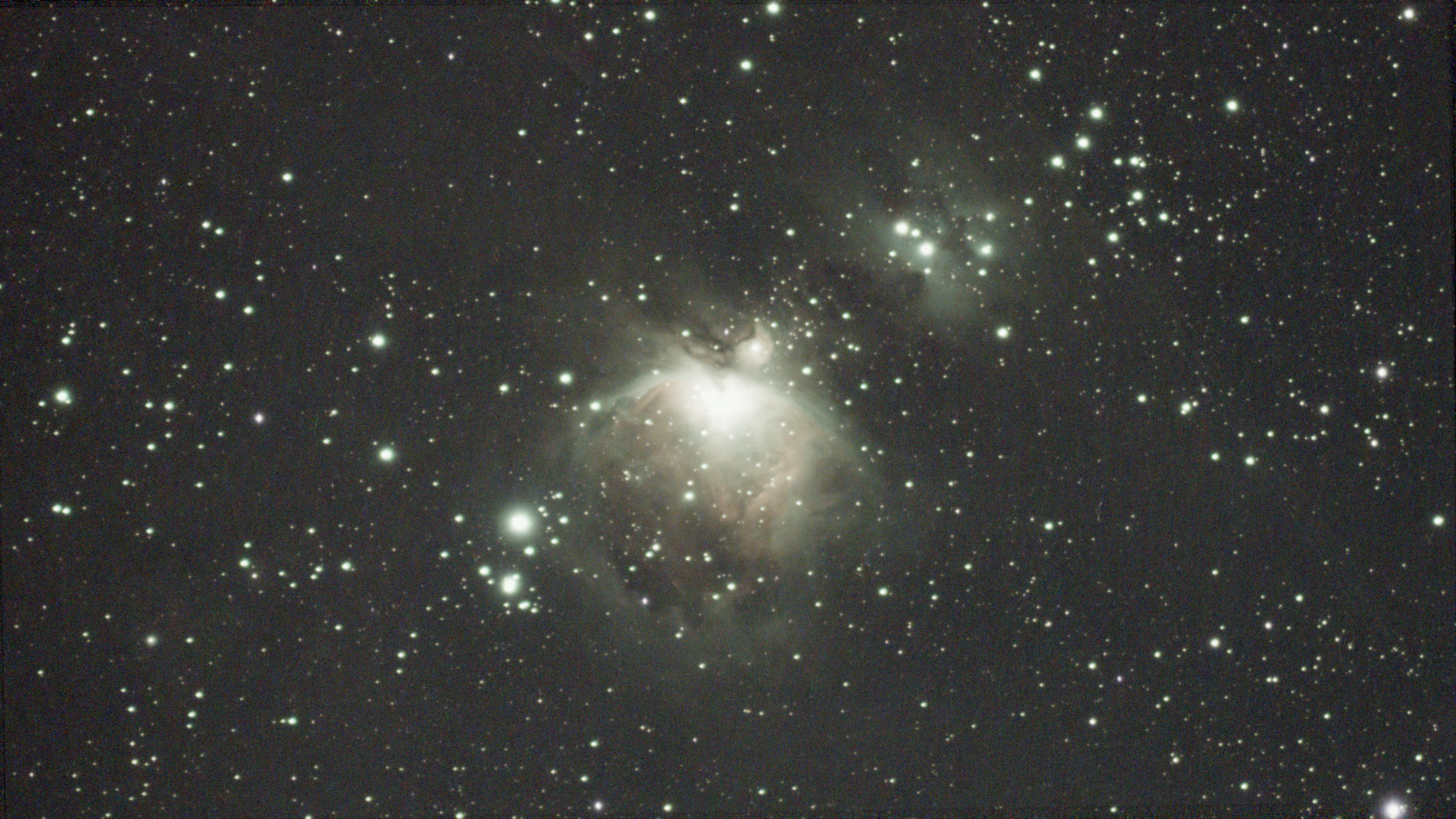
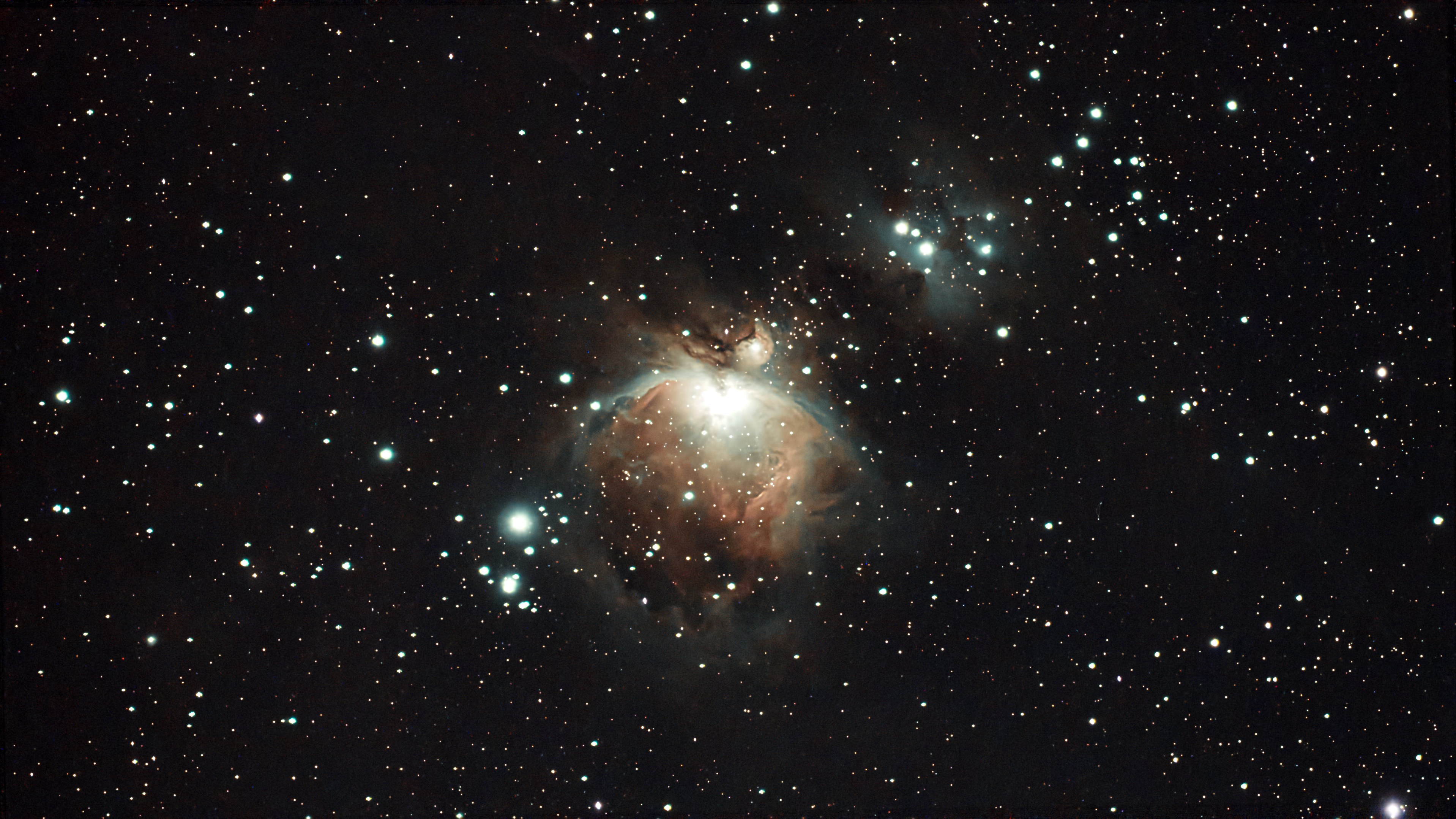
Licence: for personal use, credit Damon Scotting. Both JPEGs 3,835 x 2,156 px.
Unknown sensor temperature during imaging
100 mm focal length, plate solved DwarfLab states 100 mm
3.19 x 1.79° field of view 3,840 x 2,160 px on Sony IMX415
8.3 MP Sony IMX415 3,840 x 2,160 px, 5.6 x 3.1 mm
Should you buy it?
22/100 Stars for Your Buck
Pros
- “It is a lot smaller than a Seestar and, to better describe it, cuter; I have managed to fit it in my trouser pocket.”
- “You just pull it out of your bag, put it on a nice solid flat surface and let it do its job.”
- “It finds deep-sky objects with pinpoint precision, plate-solves each image to centre the target, then tracks it.”
- “On the Pleiades the DWARF II brings out a tremendous amount of dust and gas, far more than the eVscope 2.”
- It is incredibly quiet: it barely makes a sound.
Cons
- “It does fall short in terms of imaging capabilities; the images from the Seestar S50 blow the DWARF out of the water.”
- “Its smaller size means a smaller aperture and reduced light gathering; the Seestar S50 has more than twice its aperture.”
- “The image quality is similar to what I was able to capture with my Canon 1000D about ten years ago.”
- “The Heart Nebula is almost too big for its field of view, and faint nebulae need a few hours, not 20 minutes, to bring out their red nebulosity.”
- “On the Sun, bringing out detail is quite difficult, even with the footage sharpened as much as it will go.”
The image quality is, I'd say, good, but not great.
Who the DWARF II is for
Complete beginner buying new
Skip
It is sold out new; my recommendation is the DWARF mini, which is still on sale.
Second-hand bargain hunter
Buy
A working DWARF II still finds, tracks and live-stacks by itself, and goes from its bag to imaging in about 90 seconds.
Showing the sky to family and friends
Buy
Within three minutes you can show someone that it is a telescope and that it captures the night sky.
Wants detail in faint nebulae
Skip
With 24 mm of aperture faint targets stay faint; my recommendation is the Seestar S30 Pro.
Wants the lightest smart telescope for travel
Skip
The DWARF mini weighs 840 g to the DWARF II's 1.2 kg; my recommendation is the mini.
Already owns a Seestar S30 or DWARF mini
Skip
The DWARF II would be a step down to 24 mm of aperture; keep what you have.
Three alternatives I have reviewed
- DwarfLab DWARF mini DwarfLab's current small smart telescope: 30 mm of aperture in an 840 g body, and still on sale. 89/100 £399 Read the review
- ZWO Seestar S30 Pro My top-scoring smart telescope: 30 mm, an IMX585 sensor and a 4.6 degree field. 99/100 £649 Read the review
- ZWO Seestar S30 30 mm with a built-in duo-band filter and a magnetic solar filter in the box. 88/100 £419 Read the review
Questions and more about this review
Reviewed by
Damon Scotting
The Telescope Man Verified
BSc (Hons) Physics with Astrophysics and Cosmology, Loughborough University PGCE / QTS, University of Nottingham
About Damon About Damon Damon Scotting is The Telescope Man. He holds a BSc (Hons) in Physics with Astrophysics and Cosmology from Loughborough University and a PGCE with QTS from the University of Nottingham, and taught physics in secondary schools before becoming an astronomy creator. He is a contributing writer for BBC Sky at Night Magazine and the author of 42 Wonders of Our Night Sky, and his photograph of the galaxy M100 with the dwarf planet Ceres was Highly Commended in the Astronomy Photographer of the Year 2024 competition run by Royal Observatory Greenwich. He has appeared on the BBC's Blue Peter. More than 750,000 people follow his astronomy channels on YouTube, Instagram and TikTok, and he has reviewed more than 140 telescopes, mounts, cameras, filters and accessories hands-on for this site. More about Damon · How I test · Damon's book
I review all kinds of gear: most of it I buy, some is gifted and some is loaned, and all of it is reviewed the same way. How this site is funded
Eight questions, answered
Questions about the DwarfLab DWARF II
Reviewed 25 August 2023 ·Updated 23 September 2026
I review all kinds of gear. Most of it I buy, some is gifted and some is loaned, and all of it is reviewed the same way: no company sees or approves a review before it is published. How this site is funded
- Can you still buy the DWARF II new? Not from DwarfLab: every edition is sold out at DwarfLab's UK store (Classic £369) and US store (Classic $459), and First Light Optics lists only DWARF II accessories. The specifications and the comparison table ↓
- How long does the DWARF II take to set up? About 90 seconds from the bag to imaging once you know what you are doing. Allow about three minutes the first time, when you connect a new phone. What is it for ↓
- How long are its exposures? Astro mode takes 15-second exposures and stacks them live. My Pleiades stack holds 4,305 seconds, about 1 hour 12 minutes; my Orion Nebula stack holds 660 seconds. What I captured ↓
- Is the DWARF II better than a Seestar? No. The Seestar S50 has more than twice its aperture, and its images blow the DWARF out of the water. My Orion Nebula and Pleiades sit beside the Seestar S50's in the smart telescope compare.
- What field of view does it cover? DwarfLab states 3.72 degrees across the diagonal for the telephoto lens. My plate solve of its Orion Nebula stack reads 2.99 arcseconds per pixel, which is 100 mm on its 1.45 micron pixels and a field of 3.19 x 1.79 degrees (3.66 degrees diagonal), enough for the whole Pleiades in one frame. Tested numbers and the download ↓
- What is the difference between the Classic and Deluxe editions? The Deluxe adds a second battery and a filter set: a UHC filter for nebulae and two ND solar filters for the Sun. DwarfLab UK lists the Classic at £369 and the Deluxe at £479, both sold out. The specifications and the comparison table ↓
- What should I buy instead? My recommendation is the DWARF mini for the smallest and lightest smart telescope, or the Seestar S30 Pro for the best images at this size.
- What have I not tested on the DWARF II? I have not tested the wide-angle camera, the wildlife tracking mode or the battery life, and I have no planetary images from the DWARF II.